

Ramayana vs Godzilla Minus Zero Reviews: 7 Big Differences
Ramayana vs Godzilla Minus Zero Reviews: This is Epicofilm’s research-based, source-attributed guide updated November 5, 2026. It distinguishes verified facts from opinions, preliminary reports and changing figures.
Quick answer: Based on the Rotten Tomatoes pages checked on November 5, 2026, Godzilla Minus Zero has a clearer early critical consensus, with 91% positive reviews among 76 critics. Ramayana: Rise of a Legend, also marketed as Ramayana: Part One, has a much smaller seven-review sample and significantly divided reactions. This is not a scientific comparison of artistic merit, and it does not establish which movie any individual viewer will enjoy. The two films offer radically different experiences: a sprawling Indian mythological epic versus a Japanese science-fiction monster drama about a society confronting fresh devastation after war.
On adjacent dates in the international cinema calendar, two major productions from Asia have become unusually interesting to compare. Nitesh Tiwari’s Ramayana: Part One opened worldwide on November 5. Takashi Yamazaki’s Godzilla Minus Zero opened in Japan on November 3 and reaches North America on November 6. Those details are documented by Prime Focus Studios and Godzilla’s official website, respectively. The coincidence creates a natural question for audiences searching for something spectacular to see in theaters: which movie offers the stronger experience?
That question needs more than an unsupported declaration of a winner. Each production has a different relationship with its source material and audience. Ramayana is a contemporary film adaptation of an ancient epic with living cultural and religious importance. Godzilla Minus Zero continues a modern cinematic series that has repeatedly connected giant-monster destruction with postwar memory and nuclear anxiety. One has an especially broad network of characters and moral concerns; the other uses catastrophe and survival as its dramatic engine. A responsible comparison explains those differences before weighing the reviews.

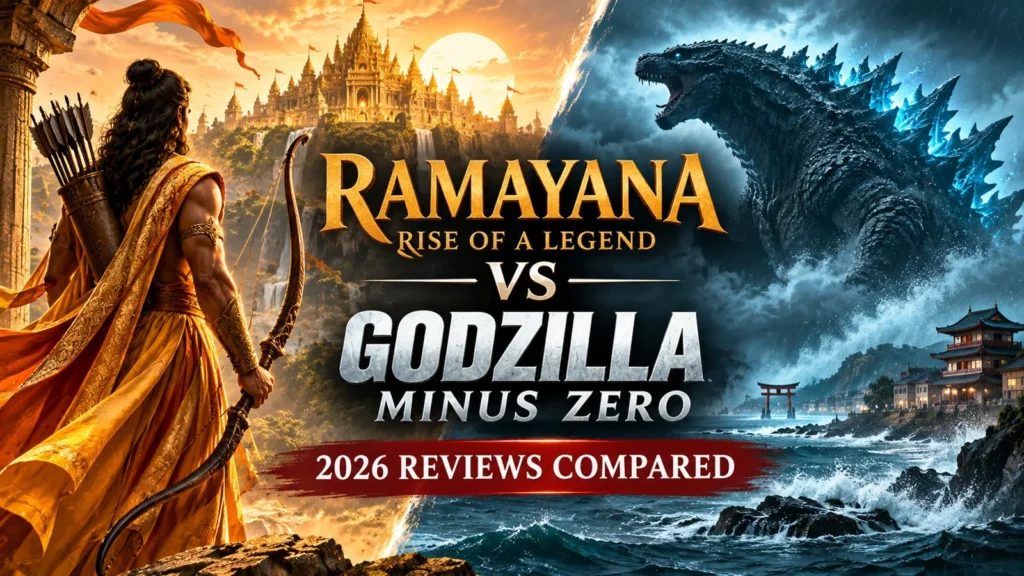
Original editorial artwork; not an official film still, actor photograph, or authenticated documentary image.
This Epicofilm guide compares known release details, ratings, screenplay concerns, visual-effects responses, accessibility, screening formats, and the role of audience expectations. The article is a synthesis of published material, not a claim that its author attended either premiere or reviewed both films firsthand. Scores and availability are dated because they can change rapidly around release.
Ramayana vs Godzilla Minus Zero Reviews: Two release dates, two distinct productions
The official Prime Focus Studios announcement identifies the Indian production as Ramayana: Part One and gives November 5, 2026 as its worldwide theatrical release date. Rotten Tomatoes lists the same film under Ramayana: Rise of a Legend, directed by Nitesh Tiwari, with a 195-minute running time for that listing. The principal cast includes Ranbir Kapoor as Rama, Sai Pallavi as Sita and Yash as Ravana. The title difference is important for readers and search engines: one film is being discussed under multiple names, not two separate releases.
TOHO and GKIDS, through the official Godzilla website, confirm that Godzilla Minus Zero opened in Japan on November 3 and has a wide North American release on November 6. It is directed and written by Takashi Yamazaki, who also oversees its visual effects. The Rotten Tomatoes listing gives a 135-minute runtime. That is roughly an hour shorter than the Ramayana runtime shown on Rotten Tomatoes, although versions of the latter may vary by market and language. Viewers should check their own local listings instead of assuming every version has exactly the same duration.
A film’s length does not determine quality. Some of the greatest epics need room for multiple relationships and difficult decisions, while a compact monster film can tell an affecting story through concentrated tension. The difference matters for planning the evening: a long mythological feature requires more time, and it may appeal especially to audiences who enjoy extended world-building. The Japanese sequel may better fit viewers looking for a focused two-hour-plus theatrical experience. Neither choice is inherently a judgment on the filmmakers’ abilities.
How the Rotten Tomatoes numbers compare
The clearest numerical contrast is the early Tomatometer data. When checked for this article, Godzilla Minus Zero showed 91% from 76 critics. The Ramayana listing displayed seven reviews, without a directly comparable published aggregate percentage in the accessible listing. Some of those seven responses were positive, others mixed or negative. It would be inaccurate to invent an aggregate number from that small sample or to present a handful of selectively chosen reviews as a complete critical consensus.
The Tomatometer is a proportion of critics whose reviews have been assessed as positive. It is not the average of their scores. A film with 91% positive notices could still have individual reviews that express significant reservations; conversely, a divided film may contain achievements acknowledged even by its detractors. The sample size also matters. A score based on many reviews is generally less volatile than a number drawn from just a few. That distinction is especially important on opening day, when new critics and audiences may still be adding their responses.
The best comparison is therefore a qualified one. Godzilla Minus Zero starts with the stronger and more substantial published critical consensus. Ramayana remains more polarizing in the available material. Neither conclusion tells us who will have the bigger opening weekend, which film will age better, or which audience’s emotional preferences are more valid. Review aggregators describe patterns among reviewers; they do not replace the full reasons behind each critic’s assessment.
What critics actually praised about Godzilla Minus Zero
Rotten Tomatoes’ early review roundup described Godzilla Minus Zero as a larger and emotionally ambitious follow-up to Godzilla Minus One. Its critical coverage pointed to spectacle, sophisticated creature effects, and an extension of the human narrative that helped distinguish the previous film from more disposable monster entertainment. The sequel has a particularly high bar to meet because its predecessor won the Academy Award for Best Visual Effects, an achievement formally acknowledged in the official Godzilla promotional material.
Takashi Yamazaki returns in several important creative capacities, including director and visual-effects supervisor. That continuity matters. It suggests a creator responsible for the earlier film’s blend of spectacle and character drama is again shaping the overall experience. Yet continuity alone is not proof of success; sequels can become bigger while losing clarity. Some early critics have been notably enthusiastic, but others have questioned whether the sequel spends too much time on its human storyline or arrives at a completely satisfying finale.
The Associated Press review by Jake Coyle, for example, took a more critical view of the balance between melodrama and monster action. This is useful counterevidence to any claim that every critic loved the film. Even a high aggregate rating can conceal disagreement about pacing, character arcs, monster screen time and final-act construction. A trustworthy review comparison should tell readers both what the movie appears to do well and what viewers may find frustrating.
What critics praised about Ramayana
The Ramayana: Rise of a Legend reviews are noticeably divided, but reviewers on both sides have acknowledged the extraordinary ambition of the project. Screen Rant awarded 7/10 and singled out its technical and visual achievements. IndieWire gave the movie a B grade and recognized the epic scale of its production. These responses suggest that the filmmakers have succeeded in creating an imposing cinematic environment, even where questions remain about their narrative decisions.
The production aims to introduce legendary characters, royal kingdoms, extraordinary events and a large philosophical conflict to viewers who may have very different levels of familiarity with the source material. That is a difficult editorial assignment. In a story where many viewers already know important plot developments, the adaptation’s interest often lies in interpretation and emotional texture rather than surprise. In a global release, the film must also remain accessible to audiences encountering Rama, Sita and Ravana for the first time.
Positive reviews have found value in the design, costumes and overall spectacle. But appreciation for individual achievements should not be stretched into a claim of universal acclaim. Next Best Picture gave 5/10 and argued the narrative contains too much material for some characters to develop fully. IGN’s 4/10 review criticized CGI, action and AI-assisted lip-syncing in the English presentation. When writing about these reactions, it is more informative to name the specific areas of disagreement than to divide everyone into simplistic ‘loved it’ and ‘hated it’ camps.
An ancient epic versus a modern kaiju sequel
The two films are not rival adaptations of similar material. Ramayana draws upon a centuries-old storytelling tradition associated with questions of dharma, duty, commitment, loyalty and moral consequence. Specific meanings and interpretations vary across communities and retellings. A movie based on this tradition must decide how much to explain to unfamiliar viewers while retaining the emotional and cultural resonance that established audiences expect.
Godzilla Minus Zero operates within a film series born in postwar Japan. Its predecessor, Godzilla Minus One, was acclaimed partly because it centered human vulnerability rather than treating its creature simply as a technological demonstration. Official material describes the new story as taking place two years after the earlier catastrophe, when a recovering society faces another threat. That premise can be grasped with little outside knowledge, although knowing the previous film gives additional context to the characters’ circumstances.
The distinction affects the kind of dramatic tension each production seeks. A mythological epic can build power through choices, obligations and sacrifices whose meaning extends across generations. A Godzilla story can place immediate physical danger against the slower processes of grief and rebuilding. The question is not whether myths are ‘better’ than science fiction. The question is whether the film’s chosen cinematic structure supports the themes it claims to explore.
Storytelling and character development
One recurring criticism of Ramayana is that the screenplay attempts to carry a large amount of narrative material. This is a common challenge when adapting an expansive text into a feature film. If major scenes follow one another without enough quieter moments, audiences may understand what happens without fully connecting to why it matters for the characters. The problem is not unique to Indian cinema; expensive franchise films worldwide sometimes emphasize introductions and preparation at the expense of a satisfying self-contained arc.
The Godzilla sequel appears to face a related but inverted concern. Its established characters and social setting provide room for emotional drama, yet at least some reviews believe that emphasis reduces the balance of monster action or leads to an overextended human storyline. A movie about recovery must take its people seriously; a kaiju audience may still expect sustained menace and creative creature encounters. The challenge is not to choose drama or spectacle but to make them strengthen each other.
Whether a particular viewer regards either imbalance as serious depends on expectations. Someone interested in mythology may welcome the time devoted to tradition and ceremony. Someone attending a Godzilla movie primarily for large-scale destruction may be less patient with reflective dialogue. Those preferences are legitimate, but they are not objective measurements. A useful recommendation explains the kind of movie on offer instead of telling every audience to expect the same experience.
Comparing the visual effects fairly
Both productions put heavy expectations on visual effects, but the tasks are not identical. Ramayana must construct a fantastical world: architecture, kingdoms, mythical figures, environments and supernatural events. Godzilla Minus Zero must make a giant destructive creature believable in a detailed social and physical setting. One design problem concerns creating an expansive reality with multiple magical rules; the other concerns anchoring an impossible monster in a world that otherwise feels historical and tactile.
Critics have been especially positive about Godzilla Minus Zero‘s effects, a response that carries particular significance after the Oscar-winning work on its predecessor. The official promotional campaign even emphasizes its IMAX filming credentials. Still, visual quality involves more than sharp textures or rendering detail. Scale, lighting, motion, sound, editing and the reactions of human characters all contribute to whether an effect feels convincing. An elaborate shot that lacks emotional purpose can be less memorable than a simpler one executed with precision.
Ramayana has received praise for its digital scale and costume design, along with criticism of artificial-looking CGI in certain scenes. That division should be described rather than resolved by a writer who has not personally inspected the same theatrical versions. An effect may work beautifully in one sequence but not another. Individual critics also bring different preferences about realism, stylization and the acceptability of digital modification. For an honest comparison, the evidence supports stronger critical consistency for Godzilla, not a categorical claim that every frame of one film is superior.
Why the English-language presentation matters
Ramayana has an additional challenge: the international English presentation. The studio’s official release information lists English alongside Hindi and other Indian languages, while published criticism mentions AI-assisted lip synchronization. This means audiences in different markets may encounter differently adapted dialogue and, potentially, a different edit or runtime. A review of one version should not automatically be presented as a review of every language track.
Language is a significant part of performance. Timing, mouth movement, silence and vocal intensity all help convey what a character feels. When technical localization changes the appearance of speech, it may improve accessibility for some viewers but disturb others. It is therefore sensible to tell readers which version a critic reviewed whenever that information is available. For viewers comfortable with subtitles, an original-language screening may provide a different experience from a fully dubbed performance.
Godzilla Minus Zero likewise originates in Japanese, and local availability of subtitles or dubbing may vary. The core issue is not whether subtitles are ‘better’ in every circumstance. It is that comparisons of acting and dialogue should account for the version being watched. Otherwise, a reviewer might attribute qualities of dubbing or adaptation to performers whose original vocal work the audience has not heard.
Which movie is better for a first-time international viewer?
For viewers unfamiliar with both franchises, accessibility is a meaningful factor. The official Godzilla synopsis offers a relatively direct setup: Japan has suffered catastrophic destruction, struggled to recover, and now confronts another threat. The prior film enriches the stakes, and watching it first may improve understanding of continuing relationships. But the general survival premise is readily understood.
The Ramayana requires a more culturally specific introduction. Its characters carry religious and literary significance beyond the immediate film, and different retellings emphasize different themes. The basic story can certainly engage people with no previous knowledge: a prince, a family, a difficult moral journey and a powerful adversary offer recognizable dramatic foundations. However, audiences unfamiliar with the narrative may need the film to spend time explaining relationships, obligations and why certain decisions are meaningful.
Neither barrier is necessarily a weakness. Discovering a different storytelling tradition can be a rewarding reason to go to the cinema. The responsible recommendation is to choose based on curiosity. If the viewer wants an entry point into a major Indian epic, Ramayana has a distinctive cultural appeal. If the viewer wants a contemporary extension of celebrated Japanese monster cinema, Godzilla Minus Zero is the natural fit.
Which film is better for fans of big-screen spectacle?
The answer depends on the kind of image that creates excitement. Ramayana emphasizes royal worlds, mythical scale and action shaped by a long epic tradition. For some viewers, that breadth is the point: the pleasure lies in watching a complex and familiar world translated into expensive cinema. Godzilla Minus Zero brings the immediate visual contrast of a giant creature and vulnerable human environments. Its danger is not only fantastical but spatial: the audience understands scale through streets, ships, buildings and people.
A premium cinema can help both approaches. The Godzilla official campaign confirms special IMAX presentation, including sequences framed for the format. Ramayana has also been promoted as a large-format theatrical event. Still, an expensive ticket is not a substitute for good storytelling. A larger screen may amplify the visual impact of an excellent scene but will not automatically repair dialogue, pacing or an underdeveloped character.
If a reader is deciding whether to pay for IMAX, the best practical advice is to inspect actual local show formats, ticket prices and seating quality. Not every premium theater offers the same experience. For someone especially sensitive to longer movies, Ramayana‘s listed duration is a meaningful consideration. The decision can be made without declaring either film universally superior.
Cultural significance and global reception
The global comparison can easily become reductive if framed as ‘India versus Japan’ or as a contest between fan communities. Both films emerge from distinct histories and serve audiences far beyond their countries of production. A careful critic can respect those traditions while still discussing craft. Cultural importance is a reason to pay attention, not an automatic substitute for evaluating how a specific film communicates its ideas.
For Ramayana, the existence of numerous retellings means viewers may bring strong prior images of the characters. A creative interpretation can be welcomed by one group and rejected by another for reasons separate from conventional technical criticism. Godzilla also carries cultural history, particularly the relationship between the monster and the anxieties of postwar and nuclear-era Japan. Modern sequels inherit that symbolism while attempting to speak to new audiences.
A global publication has an opportunity to explain these contexts rather than exploit them for a sensational headline. Comparing critical scores is useful, but treating cultural stories as sporting teams is less useful. The most responsible coverage separates documented production information from interpretation and avoids claiming that a particular national audience is a single unified group.
Can the opening weekend settle the argument?
Box-office collections tell us how much revenue the films generated, not whether one has the better screenplay. They are influenced by ticket prices, screen counts, holiday calendars, competing releases, market availability, marketing and established brand recognition. The two productions also have different release dates and rollout structures, which complicate any simple first-day comparison.
The films may be playing in different numbers of theaters across different countries. A worldwide total for one should not be compared casually with a single-territory result for the other. Even similar published gross figures may be calculated under different exchange rates or reporting conventions. A reliable box-office comparison should state the relevant period, currency, territory and reporting source.
As of this opening-day article, it would be premature to claim a final outcome for either worldwide theatrical run. Godzilla Minus Zero‘s North American wide release is scheduled for tomorrow, November 6, while Ramayana has only just opened worldwide. The safest editorial practice is to compare confirmed critical reactions now and update the commercial analysis later with dated, attributed totals.
What the opposing reviews reveal about expectations
A movie comparison becomes much more informative when it identifies the expectations underlying disagreement. In Ramayana‘s case, some critics value the monumental presentation of the epic, while others believe that technical scale cannot compensate for mechanical pacing or insufficient character development. That does not make one group more intelligent or culturally sensitive than the other. It shows how different reviewers prioritize the elements of cinema.
For Godzilla Minus Zero, praise often centers on creature effects, atmosphere and emotional commitment. Reservations emerge when critics believe the human storyline slows the monster film or the climax fails to deliver its promise. Again, a viewer’s priorities matter. Someone seeking a tragedy with a monster may embrace material that a viewer seeking near-continuous spectacle finds frustrating.
For the person standing at the ticket counter, the valuable question is not simply ‘Which has a higher score?’ It is ‘Which reviews describe problems I personally care about?’ A high aggregate score is a helpful signal, but a single thoughtful review that understands a viewer’s preferences can sometimes be more predictive of enjoyment than a large statistical average.
Verdict: which film should you watch?
For the stronger early consensus among professional critics, choose Godzilla Minus Zero. The accessible Rotten Tomatoes data shows 91% positive reviews from 76 critics, a much clearer signal than Ramayana‘s seven listed reviews and mixed scores. That conclusion is bounded by the November 5 research date and may change as more material appears.
For a large-scale adaptation of an influential Indian epic, consider Ramayana: Rise of a Legend. The film’s substantial cast, mythology and visual ambition distinguish it from conventional contemporary fantasy. Viewers should be aware that early reviews express meaningful concerns about pacing and aspects of the English presentation.
If you are interested in both, there is no reason to treat the choice as a permanent allegiance. These films offer complementary rather than interchangeable experiences. One explores a major ancient storytelling tradition through modern digital cinema; the other extends Japanese kaiju filmmaking through a mixture of spectacle and human drama. Watching both may be more rewarding than demanding that either prove the other has no value.
The final editorial recommendation is modest: use the evidence to match the movie to the viewer. Avoid artificially converting a complex comparison into an unfounded declaration that one nation or film culture has ‘won.’ A useful comparison respects differences in genre, audience, release schedule and critical sampling while remaining specific about what the available sources actually show.
Frequently asked questions – Ramayana vs Godzilla Minus Zero Reviews
1. Which film has better early Rotten Tomatoes reviews, Ramayana or Godzilla Minus Zero?
On November 5, 2026, Godzilla Minus Zero had 91% positive reviews from 76 critics in the accessible Rotten Tomatoes listing. Ramayana: Rise of a Legend had seven listed critics and a divided response. The difference in sample sizes is important, and the numbers may change.
2. When does Ramayana: Part One release worldwide?
Prime Focus Studios confirmed November 5, 2026 as the worldwide cinema release. Its announcement lists Hindi, Tamil, Telugu, Kannada, Malayalam and English among release languages. Local show times depend on the theater and country.
3. When does Godzilla Minus Zero release in North America?
The official Godzilla website confirms November 6, 2026 for a wide North American theatrical release. It opened in Japan on November 3. Other international schedules should be checked through local distributor listings.
4. Are Ramayana: Part One and Ramayana: Rise of a Legend different movies?
No. The two titles refer to the Nitesh Tiwari film. Prime Focus Studios uses Ramayana: Part One while Rotten Tomatoes lists Ramayana: Rise of a Legend. Using both names in editorial coverage helps readers recognize the same production.
5. Is Godzilla Minus Zero a sequel to Godzilla Minus One?
Yes. Official promotional information describes the story as taking place two years after the events of the previous film. Director Takashi Yamazaki returns, and several established characters are part of the sequel.
6. Is Ramayana based on a book or an original screenplay?
The film adapts the Ramayana, an ancient epic traditionally associated with Valmiki and an extensive history of regional retellings. The movie is a cinematic interpretation rather than the origin of the characters and story.
7. Does Rotten Tomatoes measure average star ratings?
Not directly. The Tomatometer represents the proportion of qualifying critic reviews classified as positive. An individual review’s star score is not interchangeable with the aggregate percentage.
8. Which movie is longer (Ramayana vs Godzilla Minus Zero) ?
The Rotten Tomatoes listings consulted for this article show 195 minutes for Ramayana and 135 minutes for Godzilla Minus Zero. The runtime of particular dubbed or international versions may differ, so local listings remain the final practical reference.
9. Which movie has better visual effects (Ramayana vs Godzilla Minus Zero Reviews)?
The available critical response is more consistently positive toward Godzilla Minus Zero‘s visual effects. Ramayana also receives praise for its scale but draws criticism in some reviews for artificial-looking CGI. This is a description of critical reception, not a first-hand technical audit.
10. Should I see Godzilla Minus One before Minus Zero?
It is advisable if you want to understand the returning characters and earlier consequences. Official synopsis material places the sequel two years after the original, making previous knowledge helpful even though the broad premise is understandable.
11. Can I watch Ramayana without knowing Hindu mythology?
Yes. Its themes of family, responsibility, love and conflict are accessible, although familiarity with the epic may add context to the characters’ decisions and cultural importance. The movie does not require viewers to share any particular religious belief.
12. Is Ramayana available in English?
Prime Focus Studios lists English among the film’s release languages. Published critics have discussed localization choices in that version, including AI-assisted lip-syncing. Confirm the audio or subtitle option before buying tickets.
13. Which movie is better for families (Ramayana vs Godzilla Minus Zero Reviews)?
The answer depends on ages and tolerance for intense imagery. Ramayana has a PG-13 listing in the United States, while Godzilla Minus Zero is listed as R on Rotten Tomatoes. Parents should consult their local classifications and content guidance rather than relying solely on genre labels.
14. Are both movies available in IMAX (Ramayana vs Godzilla Minus Zero Reviews)?
Both have been marketed for premium theatrical experiences, and official Godzilla material confirms special IMAX presentation. Availability varies by market, venue and date. A local ticketing page is the most reliable source for specific show formats.
15. Which has better box office performance so far (Ramayana vs Godzilla Minus Zero Reviews)?
A final worldwide comparison cannot be responsibly made at the research cutoff. The films have different rollout dates, and Godzilla Minus Zero has yet to begin its wide North American release. Confirmed dated totals can be compared once both have comparable reporting periods.
16. Is the higher-rated film guaranteed to be more enjoyable?
No. An aggregate reflects a sample of critics, not an individual viewer’s tastes. Personal familiarity with the source material, appetite for spectacle, interest in human drama, and preferred language presentation can all influence enjoyment.
17. Is this article based on personal viewings of both movies?
No. It is a research-based comparison of official information and published critical reception. No firsthand viewing or interview is implied. That distinction matters because quoted opinions belong to their original critics.
Sources and update policy
- Prime Focus Studios, official worldwide release statement: https://www.primefocusstudios.com/news/ramayana-premieres-in-los-angeles-ahead-of-worldwide-release
- Rotten Tomatoes, Ramayana: https://www.rottentomatoes.com/m/ramayana_rise_of_a_legend
- Godzilla official film website and release dates: https://godzilla.com/pages/godzilla-minus-zero
- Rotten Tomatoes, Godzilla Minus Zero: https://www.rottentomatoes.com/m/godzilla_minus_zero
- Rotten Tomatoes, early Godzilla reviews: https://editorial.rottentomatoes.com/article/godzilla-minus-zero-first-reviews/
- Associated Press review, via the Godzilla Rotten Tomatoes listing: https://apnews.com/article/c8d8c43a7808672fe10ff36f4487af9d
Fact-check and update policy: Movie listings, critic percentages and release availability are snapshots as of November 5, 2026. Update with a clear modification date if those facts change. No unverified aggregate score, personal viewing claim, unofficial box-office total or fabricated critical quote has been added.
Editorial standard: Figures, ratings and availability can change; consult the dated sources linked in this article. Generated illustrations are conceptual, not documentary evidence.





Pingback: Ramayana: Rise of a Legend Review (2026): Verdict & 7 Insights
Pingback: Ramayana Rise of a Legend Review (2026): Honest Verdict