
Updated November 11, 2026. This is a source-based explainer of the released finale and its credits scenes, with original editorial analysis. It does not claim an advance screening or a firsthand interview.
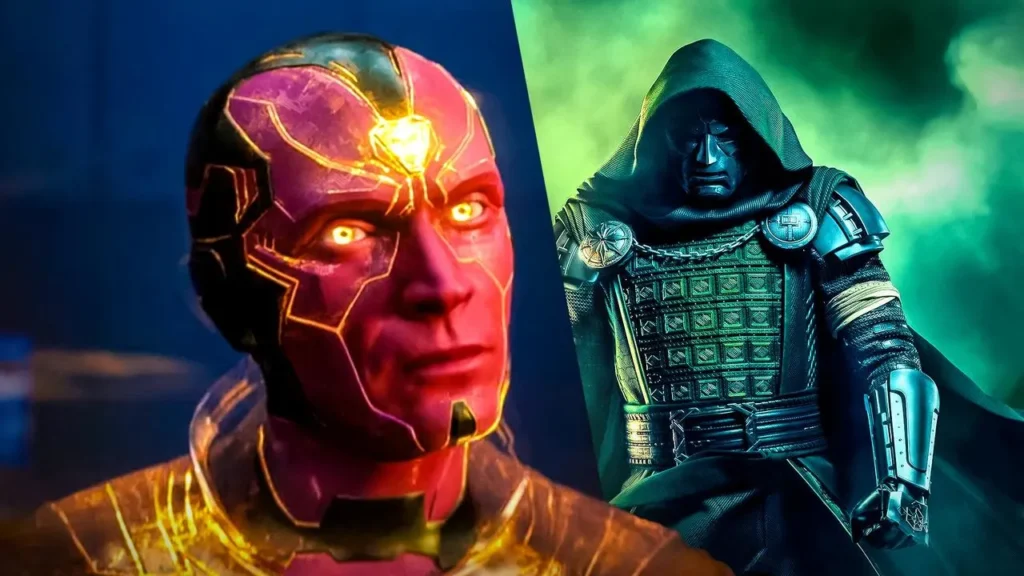
The VisionQuest post-credits scenes give viewers two different reasons to stay: one continues Ultron’s unfinished story, while the other brings Wanda Maximoff and Doctor Doom into the same frame. The important distinction is between the family story that ends inside the episode and the larger Marvel story teased afterward. They are connected, but they do not resolve the same questions.
If you have seen an earlier recap saying that Wanda does not return, you have a good reason to be confused. Reporting about the public release identifies an additional scene that was absent from press screeners. Below, we explain that discrepancy, separate the two scenes, and mark where evidence ends and interpretation begins.
Quick answer: how many VisionQuest post-credits scenes are there?
There are two bonus credits scenes in the released VisionQuest finale. Watch through the entire credits sequence to catch both. This guide uses “first credits scene” and “final credits scene” because coverage is inconsistent about the mid-credits label. The count matters more than that terminology. Nerdist’s released-episode guide and GamesRadar’s updated breakdown both identify two scenes.
Spoiler warning: Everything after this paragraph discusses the finale, both bonus scenes, and earlier events in WandaVision, Agatha All Along, and Doctor Strange in the Multiverse of Madness.
The two scenes at a glance
| Sequence | Main focus | Immediate implication | Still unanswered |
|---|---|---|---|
| First credits scene | Ultron and Jocasta’s code | His personal story remains open | What he can restore, and what he will choose |
| Final credits scene | Wanda and Doctor Doom | Her apparent ending is revisited | Her condition, freedom, and future role |
The descriptions that follow draw on release-day reporting, rather than treating every early screener recap as a complete account of the public episode. That distinction is particularly important for a series whose final surprise was withheld.
Why did some VisionQuest finale recaps miss the Wanda scene?
The most useful evidence is an explicit correction, not speculation about viewers imagining an extra ending. TheWrap updated its finale report to include a Wanda sequence that was not in the episode screener supplied to the press. Its interview with showrunner Terry Matalas also distinguishes bringing Wanda into Vision’s central story from dealing with her elsewhere.
That explains how two articles can appear to contradict each other without both describing the same viewing material. A critic can discuss the episode available for review, while an updated viewer guide accounts for material attached to the release. This is a version-and-cutoff problem before it is a continuity problem.
For readers, the publication date alone is not enough. Check whether a report acknowledges the released credits material and whether its conclusion refers to the main episode or the full viewing experience. “Wanda is not part of the family reunion” and “Wanda appears after the credits” are different statements. One does not automatically invalidate the other.
It is also worth resisting a more dramatic explanation when a simpler documented one exists. The existence of an updated report does not prove that Disney secretly changed the story in response to criticism. A scene excluded from advance viewing can still be part of the intended public presentation. Without additional evidence about production or distribution, those are separate claims.
First credits scene: what does Ultron have, and why does Jocasta matter?
In The Direct’s account of the Ultron scene, he is at the Horton estate with a Jocasta-labeled AI chip. That report connects the object to a labeled AI chip seen in Tony Stark’s workspace in Avengers: Age of Ultron. The practical reveal is that Ultron has access to code associated with Jocasta; the scene does not show a completed restoration.
This is a smaller-scale tease than a world-ending announcement, and that is precisely why it is interesting. A character’s next objective can be emotional rather than immediately tactical. Wanting a companion does not make that character trustworthy, but it changes the question the audience needs to ask. Instead of only wondering whom he will attack, we can ask what kind of relationship he believes he is rebuilding.
Possessing a digital record is not the same thing as recovering an entire person. A copy might preserve information without preserving the history of a particular relationship. It might also be incomplete, altered, or interpreted differently by the person who uses it. These are possibilities raised by the premise, not outcomes the scene demonstrates.
That is the strongest way to read the image of the chip: as an opportunity with ethical consequences. If restoration happens later, the crucial issue will be the restored being’s independence. Does she have her own desires? Can she disagree? Is she being welcomed back or constructed to satisfy somebody else’s expectations? Those questions make the tease more substantial than an Easter egg hunt.
For now, the restrained conclusion is that Ultron’s story has room to continue. A potential mission is visible. Its method, success, and moral direction remain open. An unresolved intention can support another appearance without establishing when or where that appearance will happen.
Final credits scene: Wanda and Doctor Doom explained
The Direct’s separate report on the final scene describes a return to the aftermath of Wanda’s destruction of Mount Wundagore in Doctor Strange in the Multiverse of Madness. Doom moves the rubble, addresses her, and green energy accompanies the moment in which she opens her eyes. The sequence is presented as a continuation of that earlier endpoint.
The revealing part is the relationship between the action and the intention behind it. Helping somebody emerge from danger is not automatically an act of kindness. An intervention can give the rescuer leverage, and an offer of survival can carry conditions the recipient did not choose. That is the disturbing possibility the staging invites us to consider.
Our interpretation is that the scene turns relief into uncertainty. A viewer who wanted another chance for Wanda receives the image of another chance, but alongside a figure with an interest in her power. The emotional reward is therefore unstable. The question shifts from whether another appearance is possible to what circumstances would surround it.
It would go too far to turn that reading into a complete account of Doom’s plan. The short sequence does not provide rules for its magic, explain every step of Wanda’s recovery, or demonstrate the full limits of her agency. A visible effect can establish that something has happened without giving us a technical manual for it.
That leaves a productive tension for the next story. Wanda can be both a person whose fate matters to her family and a powerful figure whom others want to use. A good continuation would need to address both. Treating her only as a weapon would leave the emotional stakes of this trilogy unfinished.
Does this mean Scarlet Witch is alive?
The released-scene reporting supports the narrow claim that Wanda responds and opens her eyes after Doom intervenes. People’s finale coverage also identifies the scene as a major signal about her possible future. It does not follow that viewers have been shown a complete explanation of her physical or magical condition.
Three questions should be kept separate. First, is there a new on-screen response from Wanda? Second, what process made that response possible? Third, what does it mean for her freedom afterward? A brief scene can answer the first while leaving the second and third unresolved. Collapsing those questions produces confident headlines that outrun the available evidence.
In particular, “she never died,” “she was resurrected,” and “she survived in a suspended state” are not interchangeable explanations. Each describes a different chain of events. Unless a later story or an authoritative explanation settles the mechanism, the image itself does not require us to choose one.
The same care applies to personality and allegiance. Being seen in a dangerous person’s company does not prove a willing alliance. Receiving help does not demonstrate consent to everything that follows. The most useful next development would be a scene that gives Wanda a point of view: what she knows, what she wants, and whether she can act on it.
Is Doctor Doom actually Tony Stark?
The casting overlap is real; the identity claim is not established by it. Disney’s official coverage of Avengers: Endgame’s encore release explicitly distinguishes Robert Downey Jr.’s new Doctor Doom role from Tony Stark/Iron Man. Viewers should not replace that distinction with an assumption based only on a familiar performer.
An actor’s history adds a layer of audience recognition. It can make an entrance feel uncanny before the script explains anything. But audience recognition is not the same as a character recognizing somebody within the story. The former exists outside the fictional world; the latter requires evidence inside it.
This matters when interpreting casting-driven theories. A theory might be entertaining and still be unproven. To establish a connection, the story would need to supply one: dialogue, a disclosed history, a clearly identified variant, or another concrete explanation. A shared face alone cannot tell us which explanation applies.
For the credits sequence, the practical reading is straightforward. Evaluate Doom’s conduct as the conduct of the character the story identifies, rather than importing the trust or affection accumulated by a different role. That keeps the scene’s threat legible and prevents nostalgia from doing work the narrative has not done.
Why the code and restoration questions belong in Vision’s story
Disney+’s official series introduction frames VisionQuest around a rebuilt Vision, AI personas embedded in his programming, and his encounter with Thomas Shepard. It also locates the show after WandaVision and Agatha All Along. Questions about identity are therefore part of the series’ central premise, not an unrelated philosophical exercise added by the credits.
For a rebuilt being, continuity has several dimensions. There is the body that exists now, the information available to it, the relationships others remember, and the choices it makes in the present. Those dimensions can overlap without being identical. A character might recover knowledge of a past relationship without instantly knowing how to live inside it.
The credits material invites the same distinction from another direction. Restoration can describe repairing damage, retrieving a copy, reactivating a system, or reviving a person. Stories sometimes use those actions as if they were equivalent, but the emotional difference is enormous. Repairing a thing serves its owner. Recovering a person should leave room for that person’s choices.
That is why the quieter AI thread and the more spectacular magical thread belong beside each other. They ask related questions through different fictional tools. Technology and magic can both create a promise that loss is reversible. Neither automatically resolves what the returned being owes to the person responsible.
This interpretation also explains why “the character is back” is only the beginning of a useful discussion. The next question is whether the return restores a relationship, creates a new one, or exposes a need to let an old version go. A continuation can become richer by acknowledging those differences instead of treating a return as an uncomplicated reset.
Does Wanda’s scene change the meaning of the family ending?
Vulture’s finale recap describes Billy and Tommy helping revive Vision and the resulting family reunion. That emotional endpoint is part of the episode’s story. The later Wanda tease introduces another problem; it does not erase the relationships that have just been rebuilt.
There are two ways to experience that structure. A franchise-focused viewer may see the credits as the part that matters most because they point toward another title. A character-focused viewer may regard the family resolution as the real conclusion and the bonus material as an invitation to return. Both responses are understandable, but they answer different questions about what counts as an ending.
Our reading gives the central resolution priority. A future tease is more effective when it complicates something emotionally meaningful that has already happened. If every moment exists only to advertise another project, the current story becomes disposable. If the current story closes a meaningful chapter, a later threat has something worth disrupting.
For that reason, it is useful to watch the episode’s ending without rushing mentally to the credits. Consider what the characters have chosen and what has changed between them. Then consider what the added scenes place at risk. The contrast creates the stakes; the mere appearance of a recognizable name does not create them on its own.
The Children’s Crusade connection: useful context, not a confirmed adaptation
There is a concrete comics comparison behind the discussion. Marvel’s Wiccan and Speed reading guide describes a search that brings the Young Avengers to Wanda in Latveria, without her memories or powers and engaged to Doctor Doom. It also explains the comics’ family relationship between Wanda, Billy, and Tommy.
That makes The Children’s Crusade a relevant reference point. It brings family, identity, missing memories, and Doom into one story. It does not make every detail a prediction for the screen. Comics continuity and screen continuity have their own histories, and an adaptation can borrow one relationship while changing the events around it.
A helpful comparison looks for narrative functions rather than demanding a matching checklist. Is somebody searching for a family member? Does uncertainty about identity create vulnerability? Does a powerful outsider claim to offer protection while gaining influence? Those are meaningful parallels even when locations, supporting characters, and outcomes differ.
Readers who want the actual comic can use Marvel’s collection listing, which identifies the event material included in its modern-era collection. That is a firmer starting point than treating a social-media summary as the complete original story.
The distinction protects both versions. The comic can be appreciated as its own work instead of reduced to a spoiler sheet for a future film. The screen story can make a different choice without being judged against an adaptation promise its creators have not made.
Does the finale confirm a Young Avengers movie or team?
Marvel’s official comics team profile identifies Wiccan and Speed as Young Avengers characters. That is relevant background for why fans connect the brothers with the team. It is not, by itself, an announcement of a screen project, a final lineup, or an appearance in a particular film.
A reunion can make a team-up easier to imagine without promising one. There is a practical difference between characters being available for another story and an announced production being built around them. A credits scene often increases the number of plausible directions while confirming very few of them.
For now, keep the possibilities in that category. A family search, an encounter with other young heroes, or a role in a larger crossover would each require additional storytelling. None needs to be presented as a certainty for the finale to have significance. The available character relationships already give a future writer several distinct paths.
What is actually confirmed about Avengers: Doomsday?
Disney’s 2026 Comic-Con announcement lists Avengers: Doomsday for theatrical release on December 18, 2026 and identifies Anthony and Joe Russo as directors. It also identifies Downey as Victor von Doom. Those are official production and release facts, separate from interpreting a television scene.
Entertainment Weekly’s released-finale report connects the additional sequence with the upcoming film. The reasonable editorial conclusion is that the tease creates an obvious bridge. It is still a bridge, not a synopsis of the film’s whole plot.
A useful way to read the transition is as a change in scale. One series can examine an intimate problem, while a crossover places the consequences of that problem in a wider setting. What should survive that change is the emotional specificity: a person is missing, a family cares, and a powerful adversary may see an opportunity.
What should not be assumed is every step between those points. The scene does not tell us the length of a future performance, who will share a scene, how a final battle will work, or which comic ending will be used. A release date and a tease cannot establish those details.
Confirmed reporting versus open questions
| Claim | How to treat it |
|---|---|
| The public finale includes two credits scenes | Supported by updated release coverage |
| An added Wanda sequence was absent from press screeners | Explicitly acknowledged by TheWrap |
| Doom’s casting means he is Tony Stark | Not established; Disney identifies a different role |
| Every detail of The Children’s Crusade will be adapted | Unconfirmed theory |
| A completed Jocasta restoration is shown | Do not confuse possession of code with a completed outcome |
| A second season has an announced release date | No verified announcement established by the sources checked here |
Does VisionQuest have a confirmed Season 2?
This research did not establish an official second-season order or release date. The series’ presentation as the final chapter of the WandaVision trilogy is documented in Marvel’s original series announcement. That description explains its place in the trilogy; it is not the same as an announcement that no character can return.
There are several forms a continuation can take. A second season is one possibility, but a film appearance, a supporting role in another show, or a much later return is structurally different. An open character thread does not identify which production route a studio has selected.
The most reliable update would be a direct order, a dated announcement, or a statement naming the returning project. Until then, a fabricated release window creates more confusion than an honest unanswered question. The credits remain meaningful as character possibilities even without a production calendar attached.
What should you watch to understand the ending?
For viewers who want focused context rather than an enormous franchise marathon, start with the family-centered television chain: WandaVision, Agatha All Along, then VisionQuest. Add Doctor Strange in the Multiverse of Madness for the earlier endpoint revisited in the final tease. Avengers: Age of Ultron supplies earlier context for Vision and Ultron.
This is our editorial catch-up route, not an official mandatory viewing order. Its purpose is to separate two needs: understanding the emotional family story and recognizing the history behind a bonus scene. Someone who wants only the latter should not be told they must complete every Marvel release first.
Watch the television episodes as stories, rather than as containers of clues. Knowing a character’s name is helpful, but seeing why a relationship matters usually provides more value than memorizing a timeline. If the reunion means something to you, the threat to that reunion becomes easier to understand.
U.S. viewing guide: how to make sure you see both scenes
Disney identifies VisionQuest as a Disney+ series. As of this article’s November 11 research cutoff, the finale is released. Use the full episode in your authorized U.S. Disney+ app or browser session, rather than assuming a shared clip represents the entire ending. Catalog access can depend on your account and location.
Let the finale continue through the credits. If your player minimizes the video, presents a next-title prompt, or moves away from playback, return to the episode before concluding there is nothing else. No universal timestamp is supplied here: edition differences, playback interfaces, and credit navigation can make a copied time less useful than simply watching through to the end.
U.S. reports dated November 10 and a calendar entry dated November 11 should also be read in their time-zone context. The meaningful question now is whether the released finale is available in your own authorized account, not whether two publications use the same calendar date. This guide does not invent an ET/PT premiere time from those dates.
What the VisionQuest post-credits scenes ultimately add
The most satisfying interpretation is that both scenes ask what happens after somebody receives another chance. One thread approaches that question through information and reconstruction; the other through power and intervention. In each case, the act of bringing someone back is less simple than it first appears.
That reading gives the credits an identity beyond their franchise connections. The suspense is not only about which title comes next. It is about whether a return comes with independence, whether companionship can exist without control, and whether a rebuilt family will be allowed to determine its own future.
The evidence supports a substantial tease, but a useful explanation should leave the unanswered parts unanswered. Readers can enjoy the possibilities without mistaking them for announcements. Watch both scenes, keep the family ending in view, and treat the next official reveal as the place where those possibilities may finally become decisions.
VisionQuest post-credits scenes: frequently asked questions
1. Does the VisionQuest finale have anything after the credits?
Yes. Updated coverage of the released finale identifies two bonus scenes. Continue through the full credits rather than stopping after the first additional sequence. That is the spoiler-free viewing advice; the detailed explanations above reveal their contents.
2. Are the mid-credits and post-credits labels consistent?
No. Publications use the labels differently. This guide identifies the first and final credits scenes to avoid making the terminology the main issue. The practical point is that the released episode contains two separate bonus sequences.
3. Why did an early article say Wanda does not appear?
Some coverage was based on press screeners without the added Wanda scene. TheWrap specifically updated its report to acknowledge that distinction. Check the version described and the article’s update note before assuming it covers the full public release.
4. Is Wanda part of Vision’s central family reunion?
Do not confuse the reunion inside the episode with the separate Wanda material in the credits. They serve different narrative functions. The former addresses the family’s present relationships, while the latter opens another unresolved thread.
5. Does the final scene explain exactly how Wanda returns?
No complete mechanism is established by the brief material described in release reporting. A response on screen and an explanation of how that response became possible are different pieces of information. The latter remains an open question.
6. Is Robert Downey Jr. playing Iron Man in this tease?
Disney identifies his new role as Doctor Doom and distinguishes it from Tony Stark. Casting familiarity can encourage theories, but it does not establish a shared identity between two characters. A story connection would require additional evidence.
7. Does a Jocasta chip mean a person has already been restored?
No. Possession of code and a completed restoration are different stages. The interesting questions concern what could be recovered and whether a restored being would retain independent choices. The scene should not be described as answering all of them.
8. Is The Children’s Crusade confirmed as the next adaptation?
No confirmation was established here. Marvel’s comics guide makes it a relevant comparison, particularly for the family-and-Doom connection. A thematic parallel is useful context, but it does not promise that the screen story will reproduce the comic’s plot.
9. Must I read the comics before watching?
No. The comic provides an additional comparison, not required instructions for viewing. Start with the released screen story, then use the reading guide if you want to explore how similar relationships have been handled in another continuity.
10. Does the ending announce a Young Avengers project?
A character relationship is not a project announcement. Comics connections help explain fan interest, but an official screen lineup, production order, or release date would need its own evidence. Treat those possibilities as theories until that evidence appears.
11. Has VisionQuest Season 2 received a verified release date?
This research did not establish an official second-season release date. An unresolved thread can lead to several kinds of continuation. It is more accurate to keep the production question open than to invent a release window.
12. When is Avengers: Doomsday scheduled to open?
Disney’s cited 2026 announcement lists December 18, 2026, for its theatrical release. That is separate from any later home-streaming window. Check the distributor and local theater before making plans, since release arrangements can change.
13. Where can U.S. viewers watch VisionQuest?
Disney+ is the official streaming home identified by Disney. Use an authorized account and the complete episode. This article does not provide unauthorized copies, download links, or a promise that a particular subscription promotion is currently available.
14. What is the shortest useful catch-up route?
Our focused route is WandaVision, Agatha All Along, and VisionQuest, with Multiverse of Madness for the earlier Wanda endpoint. Age of Ultron adds Vision-and-Ultron background. This is an editorial suggestion rather than a requirement to watch the whole MCU.
15. Is this a firsthand review of the finale?
No. It is a sourced explanation with clearly identified editorial interpretation. Official announcements establish release and production details; attributed reporting supplies the released-scene descriptions. A factual correction can be submitted through Epicofilm’s Contact Us page.
Sources and editorial methodology
Research cutoff: November 11, 2026. Official Disney and Marvel announcements were used for series context, casting, comics background, and the scheduled film release. TheWrap’s direct showrunner interview and update note establish the screener distinction. Multiple release-day accounts were compared for the bonus scenes. Interpretive passages are Epicofilm’s analysis, not attributed dialogue, leaked production information, or a claim to know an unannounced plot.
- TheWrap: Terry Matalas interview and released-scene update
- GamesRadar: two-scene guide
- Nerdist: credits-scene breakdown
- The Direct: Jocasta chip context
- The Direct: Wanda and Doom scene report
- Disney+: official series introduction
- Disney: Doomsday release and casting announcement
- Marvel: Wiccan and Speed reading guide
For more entertainment viewing guides, explore Epicofilm’s Streaming Guides and Web Show Reviews. Read our Editorial Policy and Corrections Policy for our approach to sourcing and updates.