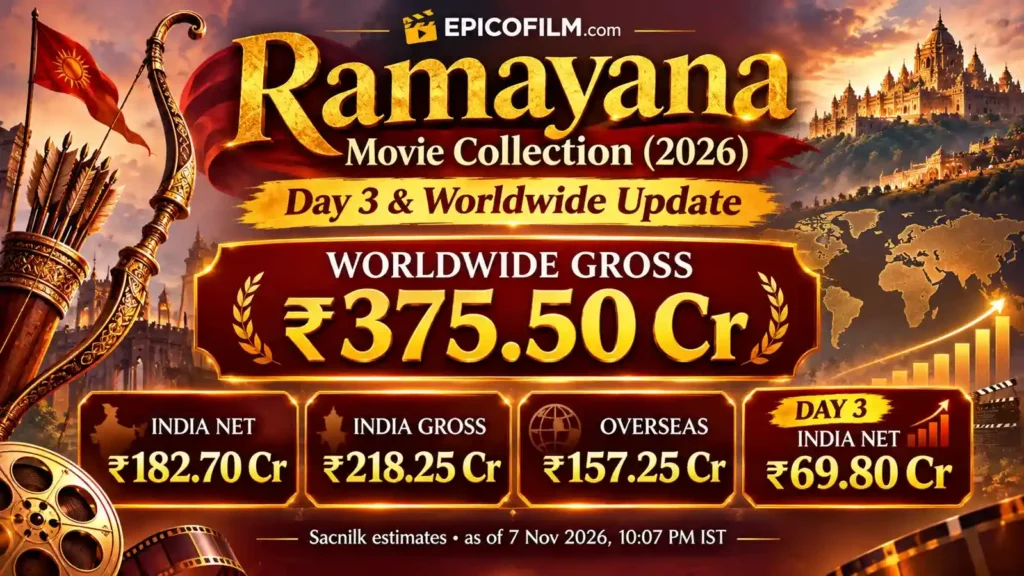

Ramayana Movie Collection (2026), November 8 update: Nitesh Tiwari’s Ramayana: Part One, also discussed online as Ramayana: Rise of a Legend, has reached an estimated ₹375.50 crore worldwide gross after three theatrical days, according to Sacnilk’s November 7 report updated at 10:07 p.m. IST. That consists of ₹218.25 crore India gross and ₹157.25 crore overseas gross. The same tracker puts the domestic India net at ₹182.70 crore, including an estimated ₹69.80 crore on Saturday, November 7. These are tracker estimates, and the overseas portion is explicitly described by Sacnilk as rough and subject to change. Source: Sacnilk Day 3 report.
The answer for readers searching for today’s Ramayana movie collection is therefore precise but limited: the latest completed-day snapshot available for this article is Saturday, November 7. Sunday, November 8 (Day 4) is under way; its final collection has not been verified at this reporting cutoff. Advance tickets for Sunday are not Sunday box-office receipts. The distinction matters because an early online estimate can be copied repeatedly until it begins to look official, even when its reporting window and accounting basis are unclear.
Editorial data cutoff: November 8, 2026, shortly after midnight IST. The main collection series below follows Sacnilk to keep the daily arithmetic consistent. Alternative reporting from Bollywood Hungama is presented separately rather than merged into those totals. This is a research-based box-office report, not a producer audit.
Ramayana Movie Collection Today: Quick Answer and Verified Data Snapshot
| Metric | Reported amount | Status and scope |
|---|---|---|
| Worldwide gross, Days 1–3 | ₹375.50 crore | Sacnilk estimated cumulative total through November 7 |
| India gross, Days 1–3 | ₹218.25 crore | Domestic gross, all languages |
| India net, Days 1–3 | ₹182.70 crore | Domestic net, all languages |
| Overseas gross, Days 1–3 | ₹157.25 crore | Rough overseas estimate, subject to revision |
| Saturday / Day 3 India net | ₹69.80 crore | Sacnilk late-night estimate |
| Sunday / Day 4 India net | Not yet finalized | November 8 screening day in progress |
The figures come from Sacnilk’s Day 3 report and its day-wise worldwide collection tracker. Both show the same three-day India and overseas breakdown at their recorded cutoff. The simple worldwide calculation is ₹218.25 crore India gross + ₹157.25 crore overseas gross = ₹375.50 crore worldwide gross. India net does not belong in that addition because net is another measure of the same domestic ticket sales, not extra revenue.
For readers outside India, one crore means ten million. Thus ₹375.50 crore equals ₹3.755 billion in rupee terms. That conversion does not turn rupees into US dollars; any dollar translation needs a specified exchange rate and date. Headlines that compare Indian collections to Hollywood openings should either retain the original currencies or disclose the exchange basis.
The reported ₹375.50 crore is not the movie’s final lifetime gross, a figure from the producer’s audited accounts, or a confirmed Sunday result. It is the best clearly dated single-tracker snapshot used here. The distinction allows the page to be updated later without quietly changing its historical claims.
Ramayana Movie Collection Day Wise: November 5, 6, 7 and 8
| Day | Date | India net | India gross | Overseas gross | Worldwide gross |
|---|---|---|---|---|---|
| Day 1 | Thu, Nov 5 | ₹64.85 Cr | ₹77.50 Cr | ₹51.25 Cr | ₹128.75 Cr |
| Day 2 | Fri, Nov 6 | ₹48.05 Cr | ₹57.30 Cr | ₹46.00 Cr | ₹103.30 Cr |
| Day 3 | Sat, Nov 7 | ₹69.80 Cr | ₹83.45 Cr | ₹60.00 Cr | ₹143.45 Cr |
| Three-day total | Nov 5–7 | ₹182.70 Cr | ₹218.25 Cr | ₹157.25 Cr | ₹375.50 Cr |
| Day 4 | Sun, Nov 8 | Not finalized | Not finalized | Not finalized | Not finalized |
Source: Sacnilk collection hub, updated November 7 at 10:07 p.m. IST. Gross and overseas estimates can be revised. The Day 4 row is deliberately unfilled until a sufficiently complete report is available.
This table is the practical heart of the article. It answers several overlapping Google searches—Ramayana movie collection, Ramayana collection day wise, Ramayana Part 1 box office collection, and Ramayana worldwide collection—without requiring a separate near-identical post for every spelling. Readers can scan one row, see the reporting date, and know exactly which measure they are reading.
A day-wise table must also preserve its calendar definitions. November 5 is Day 1 because the film opened on Thursday. Friday is Day 2, Saturday is Day 3, and Sunday is Day 4. “Opening weekend” may mean a three-day Friday-to-Sunday period in some international trade reporting, but this film’s Thursday release gives it a four-day opening stretch from Thursday through Sunday. Those two periods should not be confused.
The cumulative figure after Saturday is a report through the first three days, not the completed four-day weekend. Likewise, a Saturday overseas entry may be affected by time zones and distributor reporting schedules. The best practice is to attribute each region to the tracker and date from which it came, rather than assume every country closes its books simultaneously.
Ramayana Day 1 Collection: The Thursday Opening
Sacnilk reported ₹64.85 crore India net and ₹77.50 crore India gross for the Thursday, November 5 debut. Its accompanying worldwide day-wise hub lists overseas gross at ₹51.25 crore, yielding ₹128.75 crore worldwide gross for that day. The numbers describe an expansive opening, but the earliest day is usually influenced by pre-booked tickets, high fan interest and premium-format screenings. None of those elements establishes what the entire theatrical run will earn.
The Hindi version provided ₹47.50 crore net on Day 1 according to the same language-wise breakdown. Kannada added ₹7.25 crore, Telugu ₹6.00 crore, Tamil ₹2.60 crore, and Malayalam ₹1.50 crore. Together, those five versions sum to ₹64.85 crore. This is why an all-language total should not be mistaken for a Hindi-only performance number: different articles sometimes use “Bollywood opening” loosely even when the figure includes multiple dubbed-language markets.
Sacnilk’s three-day hub lists 25,200 Indian shows on Day 1. It also reports 36.0% occupancy on its own show-weighted basis. The show count is an indicator of the breadth of release, but it cannot be treated as a count of identical auditoriums or equal ticket prices. A small morning screen and a premium evening show are both one show in such a tally, yet their earning potential differs. If readers want to judge demand more carefully, they should consider attendance, capacity, admissions and timing along with the amount collected.
Another widely followed source, Bollywood Hungama, lists the opening-day India figure at ₹62.47 crore, not Sacnilk’s ₹64.85 crore. Its figures should not be inserted into Sacnilk’s table as though the sources had the same methodology. We address this difference later because it is useful context, not an error that can responsibly be erased by picking whichever number makes the biggest headline.
Ramayana Day 2 Collection: Why Friday Dropped
Friday, November 6 produced a reported ₹48.05 crore India net, ₹57.30 crore India gross, and ₹103.30 crore worldwide gross in Sacnilk’s day-wise series. Relative to the ₹64.85 crore net opening, the Friday domestic result was approximately 25.9% lower. A decline after a widely anticipated Thursday debut is not, on its own, evidence that audiences rejected a film; it is a change between two dates with potentially different audience mixes, booking patterns and show availability.
First-day ticket demand often includes audiences who made plans well in advance. Friday’s attendance can depend more on regular working-day availability and subsequent viewing choices. But attributing Ramayana’s Friday movement to any one cause would require evidence not contained in the daily revenue table. The numbers show what happened in recorded box-office estimates, not automatically why people bought fewer or more tickets.
Sacnilk’s listed Friday language results include ₹35.50 crore Hindi, ₹5.15 crore Kannada, ₹4.75 crore Telugu, ₹1.50 crore Tamil, and ₹1.15 crore Malayalam. These sum to ₹48.05 crore. The same source records around 23,316 Indian shows with 28.9% occupancy. A smaller daily gross alongside a lower counted occupancy is consistent with reduced ticket utilization on that day, but it does not establish a precise causal model without full venue-level datasets.
The overseas Friday gross in the same series is listed at ₹46.00 crore, giving a reported worldwide daily gross of ₹103.30 crore when added to India’s gross. Overseas entries are especially subject to reporting updates, so this figure belongs to the cited snapshot rather than being presented as permanently final.
For comparison, Bollywood Hungama’s live tracker reports ₹45.84 crore for the Friday domestic business. That difference reinforces the need for transparent attribution. A website that silently alternates between competing datasets risks creating a mathematically inconsistent “total” across several updates.
Ramayana Day 3 Collection: Saturday’s Strong Rebound
Saturday, November 7 is the clearest new development in this update. Sacnilk’s ₹69.80 crore India net estimate is ₹21.75 crore higher than Friday’s ₹48.05 crore. Dividing the increase by the Friday figure gives approximately 45.3% growth, matching the change noted in Sacnilk’s own reporting. Saturday also exceeded the Thursday opening by ₹4.95 crore India net on that data source.
The Saturday India gross is reported as ₹83.45 crore and the overseas gross as ₹60.00 crore, producing ₹143.45 crore worldwide for Day 3. Of the three days listed in the Sacnilk table, Saturday therefore recorded the highest estimated worldwide daily gross as well as the highest domestic net. This observation describes the cited three-day period; it is not a claim about the film’s eventual peak or lifetime business.
The source records 23,647 showings in India on Saturday and 40.3% occupancy overall. Hindi’s Saturday contribution rose to ₹53.00 crore, with Kannada at ₹6.30 crore, Telugu at ₹6.00 crore, Tamil at ₹2.50 crore, and Malayalam at ₹2.00 crore. All five together equal the reported ₹69.80 crore domestic net figure. Hindi still supplied the largest part of the revenue, but the language-wise returns show that non-Hindi versions together contributed a meaningful amount.
Saturday’s growth may encourage optimistic opening-weekend projections, but a single rebound cannot prove long-term demand, profitability or a specific final Sunday number. An experienced entertainment desk distinguishes a measurable increase from a forecast. The responsible headline is that the film rebounded on Saturday according to Sacnilk’s late-night estimate, not that it has already achieved a four-day record that has not yet been verified.
Ramayana Day 4 Collection: Sunday November 8 Status
Readers searching “Ramayana movie collection today” on Sunday, November 8 are likely hoping for an immediate fourth-day amount. At the reporting cutoff of this article, there is no verified completed Day 4 theatrical gross in the sources used here. A Sunday advance-booking report exists, but it measures tickets purchased for screenings rather than the actual total collected from Sunday’s completed theatrical schedule.
In a report dated November 7 at 3 p.m. IST, Bollywood Hungama said advance ticket sales for Sunday had reached ₹24.98 crore, representing 811,821 tickets across 20,397 shows as of 2:30 p.m. on Saturday. These numbers are informative for advance demand, not a substitute for Day 4 realized collection.
A separate Sacnilk advance-booking tracker can show another amount because it may use a later cutoff and distinguish blocked seats from confirmed online purchases. Those are not necessarily contradictory reports; they can be different snapshots of different counting rules. If you report an advance figure, give its exact time and say whether blocked seats are included. Never add Sunday’s reported advance sales to the three-day worldwide box-office gross as though it were extra completed business.
What would make a later Sunday update credible? A clear Day 4 source, a complete or clearly labeled provisional theatrical window, matching India net and India gross definitions, an overseas figure attributed to the same or separately named tracker, and an updated publication timestamp. Until then, “pending” is more accurate than a guessed ₹50 crore, ₹70 crore or any other round-number projection.
Ramayana Worldwide Collection: India Versus Overseas
The current reported worldwide gross is ₹375.50 crore after three days. Sacnilk divides that figure into ₹218.25 crore India gross and ₹157.25 crore overseas gross. As proportions of its worldwide total, those equal approximately 58.1% from India and 41.9% from overseas. These percentages are calculated from the cited numbers and rounded; they do not indicate the number of viewers in each region.
The overseas component matters because Ramayana is being distributed and discussed as an international event film rather than simply a domestic Hindi release. A worldwide strategy can broaden a movie’s potential audience, but global reporting creates additional complexity: theater weeks may differ by country, ticket prices are denominated in local currencies, and figures may arrive after different closing times.
The ₹157.25 crore overseas number is explicitly identified by Sacnilk as a rough estimate subject to change. This point must remain alongside the headline figure. Presenting a preliminary overseas estimate as a studio-audited worldwide record would exaggerate the certainty of the information. The number is useful as a reported snapshot; it should not become an unsupported claim about final overseas admissions or distributor income.
Sacnilk also reported in a November 7 news update that early overseas results had been led by North America, with the market accounting for a substantial portion of its two-day international reporting. That is a reported market observation, not proof that North America will remain the largest overseas market over the film’s complete theatrical life. Market leadership can change as new territories report and later showings are included.
Worldwide gross is not profit. Gross ticket revenue is the amount associated with box-office admissions; the film’s producers and distributors do not automatically retain every rupee after cinema shares, distribution terms, taxes, marketing costs and other arrangements. This is why even an impressively large worldwide opening cannot by itself establish a final financial verdict.
Ramayana Collection by Language: Hindi, Kannada, Telugu, Tamil and Malayalam
| Language | India net after 3 days | Share of all-language India net |
|---|---|---|
| Hindi | ₹136.00 crore | 74.4% |
| Kannada | ₹18.70 crore | 10.2% |
| Telugu | ₹16.75 crore | 9.2% |
| Tamil | ₹6.60 crore | 3.6% |
| Malayalam | ₹4.65 crore | 2.5% |
| All languages | ₹182.70 crore | 100% before rounding |
Source: Sacnilk’s all-language day-wise report. Percentages are rounded independently and may not add to exactly 100%.
Language-wise reporting offers more insight than an all-India number alone. It helps readers see which versions are responsible for the bulk of the domestic box office. However, it should not be interpreted as a vote on film quality, audience sentiment or star power. Revenue depends partly on the number of screens, show times, ticket prices, release coverage and local demand. A large absolute collection can reflect a large theater footprint rather than superior occupancy per available seat.
Hindi movie collection: ₹136 crore after three days
The Hindi version accounts for ₹136.00 crore, roughly three quarters of the three-day net total. It earned ₹47.50 crore on Thursday, ₹35.50 crore on Friday and ₹53.00 crore on Saturday in Sacnilk’s figures. That pattern mirrors the overall sequence: a large first day, a decline on Friday, and a stronger Saturday. Because Hindi is also the biggest contributor, shifts in Hindi receipts have substantial influence on the all-language headline.
At the same time, a Hindi-language total is not the same as the revenue earned within a particular Indian state. Hindi tickets may be sold across the country and internationally; a state can host multiple versions. This distinction is essential when writing about Maharashtra, the National Capital Region, or other markets. Language and geography are separate dimensions of the same movie business, and the correct source must be used for each.
Kannada movie collection: ₹18.70 crore
Kannada contributes a reported ₹18.70 crore after three days: ₹7.25 crore, ₹5.15 crore, and ₹6.30 crore on Days 1, 2 and 3 respectively. Its share is approximately 10.2% of the all-language India net total. The Kannada result attracts attention partly because Yash is among the film’s prominent stars, but it would be unsound to attribute a specific rupee contribution entirely to one performer without independent audience research.
A more informative question is how Kannada revenue compares with show availability, audience attendance and pricing on the same reporting basis. Sacnilk lists 65.5% Saturday occupancy for Kannada, which is a different measure from Kannada’s share of national revenue. A region or language can have a higher occupancy percentage even when its total collection is smaller than a market with many more available screenings.
Telugu movie collection: ₹16.75 crore
The Telugu version totals ₹16.75 crore in the Sacnilk three-day breakdown, with daily amounts of ₹6.00 crore, ₹4.75 crore, and ₹6.00 crore. This is about 9.2% of the all-language domestic net. Its Saturday result returning to the Thursday figure is notable, but it would be premature to extrapolate from that return to a fixed future demand curve.
Readers should also distinguish Telugu-language collections from the combined box office of Andhra Pradesh and Telangana. A geographic report can include Hindi, Telugu and other presentations; a Telugu-language report can include screenings outside those states. Mixing the two can double count or misrepresent revenue. Clear labeling solves most of this confusion.
Tamil and Malayalam movie collections
Tamil accounts for ₹6.60 crore after three days, while Malayalam contributes ₹4.65 crore, according to Sacnilk. Tamil’s reported daily series is ₹2.60 crore, ₹1.50 crore, and ₹2.50 crore; Malayalam’s is ₹1.50 crore, ₹1.15 crore, and ₹2.00 crore. The increases from Friday to Saturday are consistent with the overall weekend rebound, even though these markets contribute smaller absolute amounts.
Sacnilk lists high Saturday occupancy within its recorded Tamil and Malayalam shows—77.5% and 82.0% respectively. Those percentages do not establish that more people attended these versions than the Hindi version. Occupancy is about seats filled relative to seats available in the tracked screenings; absolute admissions and collection volumes require a separate comparison. That distinction is one reason an expert box-office page should show percentages alongside the underlying scope.
Ramayana Ticket Sales, Show Count and Occupancy Explained
Sacnilk’s day-wise hub lists 72,163 Indian shows over the first three days and approximately 69.88 lakh footfalls across that period. Those measures help explain the film’s theatrical reach beyond a single financial headline. Show counts indicate scheduled screenings within the tracker; footfalls indicate admissions under the tracker’s estimation method. Neither should be mistaken for unique individuals, since a person might see the film more than once.
A film can earn more money with fewer admissions if its average paid ticket price is higher. It can also generate strong admissions without leading the revenue chart if a larger portion of viewers attend lower-priced screenings. Premium formats, urban multiplexes and different regional markets are among the factors that can change a revenue-per-admission figure. To identify their actual impact on this movie, however, specific verified pricing and attendance data would be needed.
On Day 1, Sacnilk lists about 25,200 shows with 36.0% occupancy. On Day 2, it lists 23,316 shows and 28.9% occupancy. Day 3 rises to 23,647 shows and 40.3% occupancy. These figures are useful as a consistent three-day sequence from one tracker, not as guaranteed nationwide census measurements. Different trackers may track fewer shows, apply different sampling rules, or change their coverage as reporting continues.
Consider the practical meaning of an occupancy percentage. A 40% average does not mean every auditorium was 40% full; some shows may have been nearly sold out while others were lightly attended. It is a summary of tracked availability and ticket usage. Similarly, one theater showing a premium 3D version may generate a different gross from a standard presentation with the same number of occupied seats.
That is why the best Ramayana movie collection coverage combines daily net, gross, admissions and occupancy—each with its source. A dramatic headline about collections becomes more informative when readers can see whether more tickets, stronger occupancy, a different show mix or simply a larger reporting window may have influenced the number. These possibilities are explanatory context, not unverified causal conclusions about this specific film.
India Net, India Gross, Overseas Gross and Worldwide Gross: The Difference
Many searchers type “Ramayana collection” without specifying which measure they want. India net usually means domestic ticket receipts after relevant taxes are excluded from the gross figure in industry reporting. India gross is the gross amount associated with domestic ticket sales. Overseas gross represents gross ticket receipts from markets outside India. Worldwide gross is the sum of India gross and overseas gross on the same reporting basis.
For the first three days, the Sacnilk snapshot gives ₹182.70 crore India net, ₹218.25 crore India gross, ₹157.25 crore overseas gross, and ₹375.50 crore worldwide gross. The numbers are not four distinct piles of cash to add together. The domestic net is part of the domestic gross calculation; counting both would duplicate the same ticket activity.
When comparing films, the basis is crucial. One report may rank openings by India net, another by worldwide gross, and a third by admissions. A comparison is meaningful only when the metric and period match. It would be misleading to call Ramayana’s three-day worldwide gross greater than another film’s single-day India net and then infer which movie had the “bigger opening” without identifying the incompatible measures.
Exchange rates also matter for overseas reporting. An international total may originally be recorded in dollars, pounds, dirhams or other currencies and then converted into rupees. Because exchange rates fluctuate, websites may arrive at slightly different rupee amounts even if they are discussing similar underlying receipts. The safe approach is to identify the tracker and its update time, and avoid presenting exchange conversions as precise audited outcomes without access to the original statements.
Finally, gross is not the amount producers take home. Cinema exhibitors and distributors have contractual shares, and there are production, marketing and rights-related costs to consider. That is one reason the words “hit” and “flop” require more than an opening-weekend gross figure.
Why Sacnilk and Bollywood Hungama Show Different Ramayana Figures
One of the most important pieces of reader service is being transparent about disagreement. Sacnilk’s first three India net entries are ₹64.85 crore, ₹48.05 crore and ₹69.80 crore. Bollywood Hungama’s live page, at the time checked, lists ₹62.47 crore and ₹45.84 crore for the first two days, followed by a ₹44.66 crore live Saturday entry, with ₹152.97 crore as the total displayed on that page. See the Bollywood Hungama tracker.
The gap is particularly striking on Saturday. However, the Bollywood Hungama entry is labeled LIVE, with fewer tracked shows displayed than Sacnilk’s Saturday report. It would be misleading to treat the two snapshots as completed estimates calculated over identical coverage. This page therefore keeps one main Sacnilk table for coherent addition and reports Bollywood Hungama’s alternative view with its own attribution and live status.
The editorial principle is straightforward: do not mix the biggest available daily numbers from different providers to invent a higher total. A publisher can acknowledge multiple reputable trackers without pretending that every number must match. Different show coverage, estimates, reporting times and accounting definitions can affect provisional box-office data, but we should not assert one specific explanation as the proven cause of this discrepancy without a methodology statement from the services.
Readers sometimes see different numbers copied across social feeds and assume someone is hiding the truth. In reality, the first days of a theatrical release are an evolving data story. Data quality improves when the publisher shows what is known, when it was known, which source supplied it, and what remains uncertain. Epicofilm’s role is to make that distinction easy to understand.
For a future update, the page should display a revision note rather than silently replace the previous totals. If Sacnilk changes a number after more venues report, show the new amount and mention that an earlier snapshot was updated. That kind of transparent correction protects the site’s credibility and gives returning readers a reason to trust the coverage.
Ramayana Opening Weekend: What Can Be Said and What Cannot
By late Saturday, the reported three-day cumulative figure was ₹375.50 crore worldwide on Sacnilk’s basis. The movie still had Sunday’s screenings ahead, so its entire four-day opening stretch could not yet be finalized. The Saturday improvement is encouraging as a box-office trend, but a forecast is not an actual Sunday collection. This article will not turn projected demand into a completed gross.
The November 7 advance-booking report from Bollywood Hungama offers a narrower indicator: ₹24.98 crore in Sunday advance sales as of Saturday afternoon, with more than 8.11 lakh tickets reported. These tickets were reserved for Sunday shows and should not be added to the completed three-day gross. Some advance-ticket figures also contain amounts for blocked seats depending on the tracking provider; the accompanying methodology must always be checked.
A stronger Sunday performance might indicate continued audience interest after Saturday’s improvement. A weaker Sunday result might signal more uneven demand. Neither future outcome is established by today’s completed-day figures. Responsible analysis considers multiple possibilities while leaving the result open until reported. The statement “Sunday could be important for the four-day total” is fair; a precise final Sunday earning, without data, is not.
Another common issue is the difference between a Sunday cumulative report and a weekend gross. If a trade article says the film “crossed ₹X crore by Sunday morning,” it may refer to the combined total through Saturday plus part of Sunday, not Sunday’s standalone earnings. Such snapshots are useful only when the wording clearly identifies the period and whether the source considers them live or final.
For the next stage of box-office coverage, it will be useful to examine Monday’s performance after the first extended weekend. But a Monday forecast made before Sunday’s complete results would not have the evidentiary strength of an actual dated daily report. This article prioritizes recorded figures and source-qualified interpretation over premature records.
Is Ramayana a Hit or Flop? Why the Collection Alone Cannot Decide
Large ticket sales create headlines, but commercial success is more complicated than a worldwide gross milestone. The eventual financial position of a major film depends on production spending, marketing, distribution arrangements, theater revenue shares, rights sales and contractual allocations. A reported gross figure cannot be directly subtracted from an uncertain budget to announce a producer profit or loss.
Budget headlines about large franchises can be especially confusing. One report may describe the cost of the first installment; another may refer to several planned films together; another may include marketing or technical investment. Unless an authoritative statement establishes what is included, comparisons between a reported multi-film budget and a single film’s first weekend are unreliable. This article therefore does not declare a break-even target or final verdict based on speculative finance figures.
The first three days do establish that the film has generated substantial reported theatrical business across India and overseas. The Saturday rebound is a real feature of the Sacnilk dataset. But a short opening period cannot conclusively answer how many weeks the movie will stay in cinemas, how distribution deals work, or how the final financial outcome will be classified by producers and trade analysts.
Even the phrase “record-breaking” requires a defined record: in which territory, for which language, over which period, under which collection measure, and compared with which eligible titles? Without that context, it may be an exaggerated marketing claim rather than useful reporting. Readers deserve a precise category and a trusted ranking source before being told any new record has been established.
The practical verdict is straightforward: Ramayana has a substantial three-day reported box-office total, but its final hit-or-flop status cannot be established from these figures alone. This is an evidence-based position rather than an attempt to make the outcome sound more dramatic.
What Today’s Ramayana Movie Collection Tells Us About Audience Demand
For a broader editorial analysis of the film itself, see our Ramayana: Rise of a Legend review.
Looking across the three-day sequence, the most striking pattern is Thursday ₹64.85 crore net → Friday ₹48.05 crore → Saturday ₹69.80 crore. The initial dip followed by an estimated Saturday rebound makes the weekend more dynamic than a steadily declining series. It also illustrates why a single opening-day number can be a poor predictor of the next day. Audience patterns change across working days and weekend schedules, although the precise reasons need more evidence than ticket totals provide.
The language split is another significant feature. Hindi accounts for approximately 74.4% of India net after three days, while Kannada and Telugu contribute meaningful additional shares. Tamil and Malayalam are smaller in money terms but have their own show and occupancy patterns. A truly informative national box-office update does not erase those language audiences simply because Hindi dominates the total.
Overseas reporting is almost 42% of the cited worldwide gross, which makes international markets an important component of the current estimate. That share is notable as a calculation from Sacnilk’s figures, but it may change materially if overseas amounts are revised. Readers should treat it as a dated share rather than a permanent characteristic of the film’s entire theatrical run.
The three-day figures also highlight the value of looking at admissions and utilization alongside collections. A movie can gain gross by adding showings or reaching new audience segments, and weekend changes can affect ticket demand. But without consistent granular data, the article should not claim that a specific promotion, performer, critic response or region caused the Saturday jump. Separating analysis from speculation is what makes a box-office guide more useful than a stream of social-media predictions.
Most importantly, the data answer the reader’s immediate question: how much has Ramayana earned on the latest completed reported days? With that established, the broader narrative can explain the movement and uncertainty without hiding the actual amounts behind overly long introductions.
How Epicofilm Checks and Updates Ramayana Movie Collection Reports
A credible running tracker should prioritize a consistent primary provider for its main day-wise series, independently review other published trade accounts, and keep every meaningful figure linked to its original reporting time. This edition uses Sacnilk as the primary dataset for cumulative India, overseas and worldwide calculations and presents Bollywood Hungama’s alternative live entries separately.
The collection should not be updated simply because another site has published a round number that appears more exciting. Before accepting a new daily total, the editor should establish whether the number represents India net, India gross, overseas gross, worldwide gross, advance booking or producer share. The date and reported scope must match the label in the table.
A source’s own caveats belong in the article. Here, Sacnilk describes overseas collections as rough estimates that can change. That limitation is an essential part of the number’s meaning. Similarly, a live Saturday number should not be represented as a completed Saturday total if its page says coverage is still in progress.
Updating the timestamp is justified only when the underlying story changes materially, such as adding Sunday’s verified result or replacing an earlier estimate with a sourced revised amount. Changing the date without revising substantive content risks misleading users who want actual fresh information. The editor should preserve a short correction note whenever a previous headline number changes.
For international readers, an English-language explanation of “crore,” ticket admissions, show counts and net-versus-gross definitions makes the coverage accessible beyond India. For Indian readers, a consistent language-wise breakdown and direct data links make the post useful as a repeat reference. Both audiences benefit from the same editorial principle: clearly identify the source and the meaning of every number.
Ramayana Movie Collection FAQ: 20 Key Questions Answered
1. What is Ramayana movie collection today, November 8, 2026?
The latest completed-day Sacnilk snapshot used in this article reports ₹375.50 crore worldwide gross after November 7, covering the movie’s first three days. Its Sunday, November 8 final collection was not established at this reporting cutoff. Any later update should be checked for the reporting timestamp and whether it is a live estimate or a completed-day figure.
2. What is Ramayana worldwide collection after three days?
Sacnilk lists ₹375.50 crore worldwide gross through Saturday, November 7, made up of ₹218.25 crore India gross and ₹157.25 crore overseas gross. The service says its overseas data are rough estimates and may be revised. This is not an audited producer total.
3. What is Ramayana India net collection?
The reported all-language India net total is ₹182.70 crore after three days, according to Sacnilk’s November 7 late-night data. This measure differs from India gross because the industry net and gross calculations treat the relevant taxes differently. Do not add India net to the gross total.
4. How much did Ramayana earn on Day 1?
Sacnilk estimates ₹64.85 crore India net and ₹77.50 crore India gross on Thursday, November 5. Its worldwide day-wise table gives ₹128.75 crore worldwide gross for Day 1. Bollywood Hungama publishes a different domestic opening-day amount, so the provider should always be named.
5. What was Ramayana Day 2 collection?
Friday, November 6 brought ₹48.05 crore India net and ₹57.30 crore India gross, according to Sacnilk. It lists ₹103.30 crore worldwide gross for the day. On the same dataset, Friday India net declined approximately 25.9% from the Thursday opener.
6. What was Ramayana Day 3 collection?
Saturday, November 7 generated an estimated ₹69.80 crore India net, ₹83.45 crore India gross, and ₹143.45 crore worldwide gross according to Sacnilk. Saturday India net was approximately 45.3% higher than Friday. The report was updated late on November 7.
7. Is the Day 4 Sunday collection confirmed?
Not at this article’s stated cutoff. Sunday advance bookings can give clues about demand, but they are not the same as a completed Day 4 collection. The article should only fill the Sunday box-office row when a clearly dated and appropriately scoped report becomes available.
8. What is the Hindi version’s collection?
Sacnilk reports ₹136.00 crore India net from Hindi screenings through the first three days. Its daily Hindi figures are ₹47.50 crore, ₹35.50 crore and ₹53.00 crore. Hindi accounts for approximately 74.4% of all-language India net in the same dataset.
9. How much did the Kannada version earn?
The Kannada version is listed at ₹18.70 crore India net through November 7 by Sacnilk. This includes ₹7.25 crore on Day 1, ₹5.15 crore on Day 2 and ₹6.30 crore on Day 3. Revenue is not the same measure as occupancy or unique audience size.
10. What is Ramayana Telugu movie collection?
The Telugu-language total is ₹16.75 crore India net after three days on Sacnilk’s tracker. The reported daily amounts are ₹6.00 crore, ₹4.75 crore and ₹6.00 crore. This language total should not be equated with the combined collections of Andhra Pradesh and Telangana.
11. What are the Tamil and Malayalam collections?
Sacnilk lists ₹6.60 crore for the Tamil version and ₹4.65 crore for Malayalam after the opening three days, both measured as India net. The two languages contribute smaller absolute totals than Hindi, Kannada and Telugu but show their own day-wise occupancy patterns.
12. How much has Ramayana earned overseas?
Sacnilk estimates ₹157.25 crore overseas gross over the first three days. The source specifically calls overseas figures rough estimates, subject to change. This figure does not represent overseas net profit, a final lifetime amount, or a single overseas territory.
13. Why do different sites report different Ramayana collections?
Trade services may use different show coverage, estimation practices and reporting windows. For example, Bollywood Hungama’s live entries differ from Sacnilk’s completed late-night estimates. The responsible way to read them is to compare the same date and metric while retaining each provider’s name and cutoff time.
14. What is the difference between India net and India gross?
India net is a trade measure of domestic ticket receipts after relevant taxes are excluded, while India gross is the domestic box-office gross measure. Both describe the same underlying domestic ticket business in different ways. Worldwide gross is generally India gross plus overseas gross.
15. Is ₹375.50 crore the final lifetime collection?
No. It is a three-day worldwide estimate, not the final total from the entire theatrical run. More days of screenings may add to the cumulative collection, and previously reported provisional amounts can also be revised when additional information arrives.
16. Did Ramayana beat its Day 1 collection on Saturday?
Yes, within Sacnilk’s India net dataset, Saturday’s estimated ₹69.80 crore is higher than Thursday’s ₹64.85 crore by ₹4.95 crore. That comparison does not automatically establish a record against other films, nor does it settle the movie’s final financial outcome.
17. What were Sunday advance bookings?
Bollywood Hungama reported ₹24.98 crore in Sunday advance ticket sales as of 2:30 p.m. IST on November 7, covering 811,821 tickets and 20,397 shows. This is a time-stamped pre-sales snapshot, not the confirmed box-office collection earned throughout Sunday.
18. Is Ramayana a hit or flop in 2026?
The first three days provide box-office information, not a complete financial verdict. A reliable hit-or-flop conclusion requires substantially more context, including the final theatrical performance and well-grounded production, marketing, distribution and rights information. The figures alone are insufficient to establish profitability.
19. Is Ramayana: Part One the same as Ramayana: Rise of a Legend?
These titles refer to the 2026 film discussed in international and Indian movie coverage. When writing metadata, use the established title prominently but include recognized alternative naming naturally so readers searching either variation understand they have reached the correct movie article.
20. Where can I check Ramayana box-office figures and updates?
Use an identifiable, regularly updated tracking source such as Sacnilk, and compare it with Bollywood Hungama where useful. Always check the date, metric and whether the amount is explicitly labeled provisional, estimated or live.
Sources and Editorial Disclosure
This article is based on openly attributed trade reporting rather than access to distributor accounts. Its primary numerical source is Sacnilk’s November 7 late-night reporting, with alternative live domestic estimates and Sunday pre-sales separately attributed to Bollywood Hungama. No anonymous box-office claims, invented records, unsupported budget figures or unpublished Sunday totals are presented as established facts.
- Sacnilk — Ramayana Day 3 collection, November 7, 10:07 p.m. IST
- Sacnilk — Day-wise India, overseas and worldwide report
- Sacnilk — Ramayana collection hub and language breakdown
- Bollywood Hungama — Live India box-office tracker
- Bollywood Hungama — November 7 report on Sunday advance bookings
Editorial note: This is a research-based report. Collection estimates may change, and Epicofilm should display any substantial revision with a new timestamp and an explanation of the change. Do not update the published date merely to make an unchanged article appear newer.