
Who is Mandakini in the Ramayana? For readers encountering the name through Rama’s forest journey, Mandakini is primarily the name of a sacred river associated with Chitrakoot, rather than the name of a confirmed character in the 2026 Ramayana: Part One cast. The river remains a real geographical and devotional landmark, and the government of Chitrakoot district identifies it prominently in its tourism descriptions. That is the central answer to a search that can otherwise be confused by a person’s name, a film character query or a mythological reference. Official Chitrakoot district tourism.
The Mandakini River and Chitrakoot are associated with Rama, Sita and Lakshmana’s exile in the Ramayana tradition. This article explains the river’s place, why the location matters in the epic, what modern visitors can verify on the ground, how religious storytelling differs from datable historical evidence, and why an entertainment site should not invent a “Mandakini actress” credit merely because a keyword is trending. It also gives readers a reliable route from a basic search query to deeper literary and travel sources.
Mandakini in Ramayana: the quick answers
| Search question | Clear answer |
|---|---|
| Who is Mandakini in Ramayana? | In the Chitrakoot context, Mandakini is a river, not a person. |
| Where is Mandakini River? | Associated with Chitrakoot in the Uttar Pradesh–Madhya Pradesh region. |
| Is Chitrakoot linked to Rama’s exile? | Yes, prominently in religious and literary traditions. |
| Is Mandakini a real river? | Yes; contemporary geography and government tourism material identify it. |
| Did Rama and Sita visit it? | The Ramayana tradition associates them with Chitrakoot; that is not identical to modern independent proof of each narrated event. |
| Is Mandakini an actress in Ramayana 2026? | No verified cast credit establishes a movie character by that name in the official sources checked. |
| What is Ram Ghat? | A well-known riverside location on the Mandakini at Chitrakoot. |
Is Mandakini a person or a river?
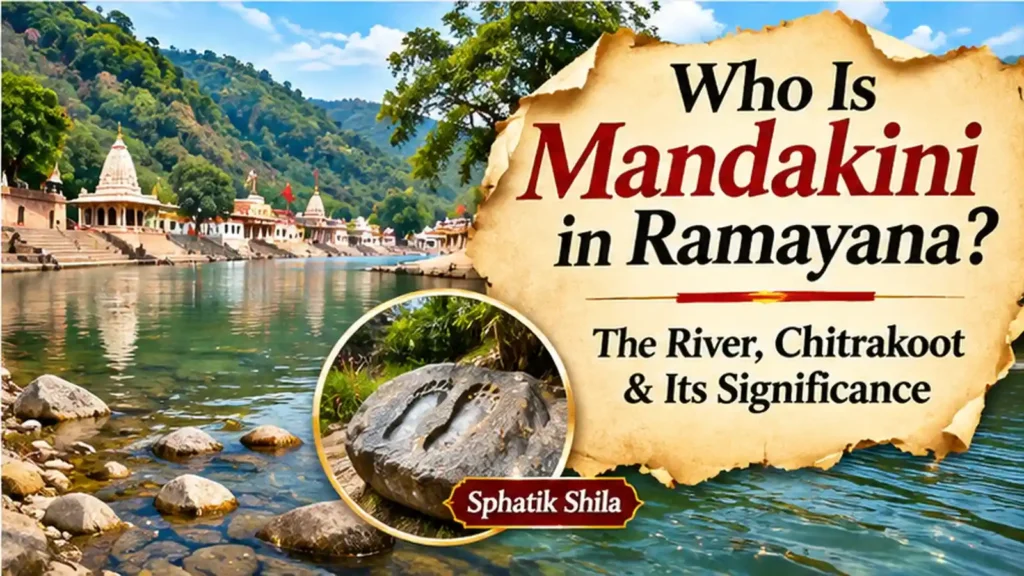
The phrase “who is Mandakini in Ramayana” sounds as though the answer must be a character biography. But wording can be misleading. In the Chitrakoot-centered Ramayana context, Mandakini is the name of a river that is closely connected to the landscape of exile. Chitrakoot’s district administration explicitly describes Ram Ghat as a set of steps leading into the Mandakini River. A modern reader can therefore verify that the geographical place exists. District Chitrakoot: Places of Interest.
The name Mandakini can appear in different religious and geographical discussions, so context matters. Search engines may also return people who share the name, contemporary performers or unrelated entertainment stories. None of that makes the Chitrakoot river a newly announced female character in a 2026 film. The correct answer should start with the context of the specific query and avoid inventing a performer or role.
This is a useful reminder that not every keyword beginning with “who is” describes a person. When information is ambiguous, direct, well-sourced clarification is more valuable than a sensational biography manufactured to fit the grammar of a search term.
Where is the Mandakini River located?
Chitrakoot is a region associated with the northern Vindhya hills and extends across cultural and geographical landscapes linked with Uttar Pradesh and Madhya Pradesh. The Chitrakoot district website describes the area’s famous sacred sites and the Mandakini as part of its pilgrimage identity. Its tourism pages identify the river as passing through the Chitrakoot area and connect it with established riverside worship locations. About Chitrakoot district · Chitrakoot tourism.
Travel descriptions often use Chitrakoot as the main locator rather than a single street address. That is appropriate for a river and pilgrimage landscape with several points of interest. Visitors should distinguish a named river from a particular ghat, bridge or shrine along its banks, because directions to one do not automatically lead to every site associated with the wider tradition.
The official tourism material also connects the Mandakini with the larger regional drainage landscape, describing its passage through Chitrakoot and eventual relationship to the Yamuna river. Such geographical statements concern a contemporary location and can be evaluated independently of the religious stories attached to it.
Why is Chitrakoot important in the Ramayana?
Chitrakoot is a major place in the traditional account of Rama, Sita and Lakshmana’s forest exile. The region represents a significant change from the royal world of Ayodhya: a setting of nature, hermitages, spiritual encounters and family decisions. Its importance is not merely that characters traveled through an identifiable landscape, but that the narrative uses the setting to explore the meaning of duty outside the security of a royal court.
Chitrakoot’s official district website preserves and describes several local traditions that connect the area with Rama and his companions. These accounts form part of the area’s living pilgrimage culture. They should be represented as traditions, not silently converted into archaeologically verified diaries of every step taken by epic characters. District tourism.
For readers unfamiliar with the Ramayana, geography can be a useful way to understand the story. The movement from a palace to forest communities changes the kinds of relationships and challenges the protagonists confront. The Mandakini River is memorable partly because it belongs to that emotionally and spiritually significant landscape.
What is Ram Ghat on the Mandakini River?
Ram Ghat is one of Chitrakoot’s most visited riverfront sites. According to the local district government’s visitor information, it features steps reaching the Mandakini River, boats along the waterfront and an evening aarti tradition. Aarti is a form of ritual worship involving light and devotional practices. The contemporary ghat is an observable place: people can visit its steps and see its activity. Official Ram Ghat page.
The ghat’s significance is also religious. Local narratives connect the riverfront with Rama, Sita, Lakshmana and the later poet-devotee Tulsidas. These narratives belong to devotional time and performance traditions. They are not a claim that people separated by different historical periods met in an ordinary, independently documented encounter. That distinction is important when a tourism page repeats a sacred story.
Visitors interested in the river may find the ghat a practical starting point, while recognizing that its modern architecture, festivals and visitor arrangements evolved over time. The fact that a place is important today does not mean every structure currently visible existed during the time in which an epic locates its story.
What does the Ramayana say about life near Chitrakoot?
The forest material in the Ramayana emphasizes a landscape very different from Ayodhya’s palace setting. It includes natural surroundings, hermitages, journeys and exchanges that test relationships. In a tradition of oral and textual storytelling, rivers provide more than direction on a map: they can symbolize transition, purification, beauty and the conditions of a life away from royal privilege.
The Mandakini and surrounding Chitrakoot landscape have acquired lasting devotional importance through their association with those themes. The details of what any particular version says should be checked in the actual text or translation being used. A later local devotional tradition may preserve an image or story not emphasized in exactly the same way in a particular Sanskrit recension.
Rather than claiming a specific line of dialogue without citation, an educational guide can explain the narrative function of place and direct readers to reliable translations. That is more valuable than a dramatic but unsupported quote placed between quotation marks for SEO effect.
How does the Mandakini connect to Rama and Sita?
Chitrakoot tourism materials identify the river and nearby sites with the memories of Rama and Sita. The river’s banks play a role in the local sacred landscape, and traditions associate particular stones, ghats and routes with their presence. This creates an enduring connection between a literary-religious narrative and a contemporary pilgrimage destination. District Chitrakoot places of interest.
A reader should be aware of the difference between the three layers involved: what a literary version narrates, what a pilgrimage tradition remembers, and what a modern visitor can physically observe. An observable stone or riverbank is evidence of the location’s existence. A tradition linking it to Rama and Sita is evidence of religious memory. Neither automatically amounts to independent historical confirmation that a specific ancient conversation happened there.
Such distinctions do not reduce the significance of the site. In fact, they explain why Chitrakoot can be important for faith, culture, literature and tourism at the same time.
What is Sphatik Shila, and how is it connected to Mandakini?
The Chitrakoot district government describes Sphatik Shila as a boulder on the banks of the Mandakini upstream from Rama Ghat. Local tradition associates the stone with Sita and with a remembered episode involving a bird. The official tourism page frames the account as belief and legend, which is the appropriate way to report it. Official tourist information.
A boulder can be photographed, visited and accurately located. Its devotional meaning comes from the narratives attached to it. A well-written article should describe both facts without collapsing them into an assertion that the story’s events have been documented by modern witnesses or verified by archaeological testing.
For readers planning a visit, Sphatik Shila can be presented as one of several linked locations along the river, with the advice to consult local official tourism updates about access and conditions. No precise opening hours, prices or boat schedules should be invented if the information has not been checked.
Is Mandakini River connected with Tulsidas?
Tulsidas is a much later poet and devotional figure than the ancient period traditionally associated with Rama. The Chitrakoot district tourism website recounts local stories of Tulsidas receiving a vision of Rama at Ram Ghat. These are devotional traditions associated with the poet’s spiritual life, not claims that Tulsidas was an ordinary contemporary of the epic’s protagonists. Official Chitrakoot tourism narrative.
This distinction becomes essential when a quick internet summary says Rama, Sita, Lakshmana and Tulsidas “met” at the riverbank without explaining the religious context. Such wording could mislead a reader into imagining a straightforward historical gathering. Religious tradition can describe miraculous visions; history asks different evidentiary questions. A respectful article makes that framing explicit.
Tulsidas is also associated with the Ramcharitmanas, a famous devotional retelling of the Rama story. That work is distinct from the ancient Sanskrit Valmiki Ramayana. Understanding the difference helps connect Chitrakoot’s contemporary devotional identity with the longer history of Rama’s literary reception.
What is the Mandakini Aarti?
The local tourism website describes an evening aarti at Ram Ghat on the Mandakini. This practice is part of the present-day religious activity of the riverfront. Visitors may encounter lamps, devotional music and gatherings of worshippers, and the district’s official information highlights the event as an attraction. District Chitrakoot’s Ram Ghat description.
The presence of religious activity does not make the ghat a theatrical performance set staged for tourists. It remains a place of worship for many participants. Visitors should follow local guidance on footwear, respectful photography, crowd movement and the use of boats or riverside steps. The exact start time can vary and must not be guessed from a general guide without a current official schedule.
For international readers, explaining what aarti is may be more useful than listing a speculative hour. It is a devotional offering of light performed as part of worship, and understanding that context helps readers approach the site respectfully.
Is the Mandakini a real geographical feature?
Yes. The Chitrakoot district government’s official visitor materials name the Mandakini River, describe its ghats and identify its relation to the region. Those are contemporary geographical facts. The river’s existence is not disputed simply because it also has a sacred role. Official district information.
However, the existence of a real place associated with a sacred story does not verify every event within that story. Many cultural traditions attach narratives to identifiable mountains, rivers and cities. The geographical location can be real, the religious importance can be enduring, and the historical status of individual narrated episodes can remain unresolved.
An accurate editorial image should therefore show the actual present-day river or a properly labeled historical painting. An AI fantasy landscape may be attractive as illustration, but it should not be captioned “real photo of the Mandakini during Rama’s lifetime.” That would be impossible to document.
How old is the Mandakini River?
A river’s geological development is a different question from when it acquired a particular sacred name or became associated with a literary narrative. The official tourism material verifies the modern geographic feature and its cultural importance, but it does not provide a scientifically established date of origin for the river in the sense of an exact number of years. A responsible article should not invent one.
The Ramayana story itself is ancient, with scholarly dates for the Sanskrit epic varying across educational sources. That literary chronology cannot simply be transferred to the age of the river. Natural landscapes may predate surviving human records, but calculating a particular river’s history requires geological and hydrological evidence rather than assumptions derived from mythological narrative dates.
For readers asking “how old is Mandakini in Ramayana,” the best response is to identify whether they mean the text’s age, the river’s physical development or the period of its devotional association. These are distinct research questions with different methods.
Is Mandakini River in Uttar Pradesh or Madhya Pradesh?
The Chitrakoot cultural and geographical region is associated with both Uttar Pradesh and Madhya Pradesh. Visitors will see descriptions of Chitrakoot attractions that reference different administrative jurisdictions, because the wider pilgrimage landscape is not limited to one convenient modern map pin. The Uttar Pradesh district government’s official site is one reliable source for the region’s main Ramayana-related places. About Chitrakoot.
For practical travel, users should verify the exact destination: Ram Ghat, a particular ashram, Sphatik Shila or another riverside site. It is not enough to navigate simply to “Mandakini” and assume that all attractions are one short walk away. Road access and local transport conditions depend on the chosen point.
A travel-oriented page may offer current directions and estimated journey times, but such information should come from actual mapping results rather than invented travel durations. This article focuses on historical and cultural explanation rather than claiming live local transport details.
What is the link between Mandakini and the Yamuna?
Chitrakoot’s district tourism overview describes the Mandakini’s passage through the region and its eventual relationship with the Yamuna river system. This is useful geographical context because it places a pilgrimage river within a broader hydrological landscape rather than portraying it as an isolated lake invented for a mythological setting. District tourism overview.
Hydrological details can vary depending on the naming conventions used for different stretches, tributaries and local waterways. Rather than provide invented kilometer totals, depths, discharge rates or coordinates, a general guide should cite a trustworthy map or government source and recognize that seasonal conditions alter how a river looks.
For people reading about the epic, the central relevance is that the Mandakini is linked to a real landscape through which a long-standing sacred tradition is remembered. Technical water-management data would merit a separate environmental study with its own sources.
What are the main Chitrakoot sites associated with Rama?
The Chitrakoot district site lists Ram Ghat, Sphatik Shila, Bharat Milap, Bharat Koop and other places tied to regional narratives. These are contemporary pilgrimage sites whose explanations often incorporate religious traditions about Rama’s exile and family. Each place has a specific meaning, so grouping them as “the exact spot where every Ramayana event occurred” would be misleading. Official places of interest.
The Bharat Milap tradition, for example, concerns a meeting of Rama and Bharata and has a particular role in the story of exile and duty. Such sites create a geographic route through the region’s devotional memory. They also offer visitors a way to encounter the Ramayana through landscape, ritual and local interpretation rather than only through a printed book.
A practical reader should first identify the site by its official name and consult current visitor arrangements. A page like this can explain cultural significance without pretending to provide verified live hours or prices for every location.
Where does the Mandakini appear in a literary discussion?
The Mandakini is often introduced through Chitrakoot’s association with the early exile story, but precise textual questions require identifying the specific Ramayana version and translation under discussion. Valmiki’s Sanskrit epic, later devotional poetry, regional oral narratives and modern films are not word-for-word identical. It is therefore risky to claim that a popular line appears in the earliest text without looking up the source passage.
University materials on the Ramayana emphasize its long development through oral and written traditions. Readers who want exact Sanskrit passages should use a reputable edition or scholarly translation and cite the book, chapter and verse. Berkeley’s Ramayana materials.
A contemporary movie may shorten or omit a landscape-related episode altogether. That does not eliminate the river’s place in religious memory, and it should not lead an article to invent a film scene simply to satisfy a keyword about Mandakini in the movie.
Is Mandakini a character in the 2026 Ramayana film?
The official materials checked for Ramayana: Part One identify the central cast, including Ranbir Kapoor, Sai Pallavi and Yash, but do not establish a character credit called Mandakini. The word should therefore not be presented as the name of a confirmed actress, heroine or surprise character in that film. The user query may instead have originated from interest in the traditional Chitrakoot landscape. Prime Focus Studios film release.
A lack of an official credit does not prove the word can never be spoken or referenced in the film. It simply means that the available evidence does not support turning it into a casting announcement. Strong factual writing is comfortable with that distinction: “not confirmed in the materials checked” is more precise than a sweeping assertion about every possible shot or line of dialogue.
If an official studio release later confirms a particular Mandakini sequence or named character, the page can be updated with that new citation. Until then, the geographic and cultural answer is the accurate primary focus.
Did Ramayana really happen at the Mandakini River?
For many devotees, Chitrakoot and the Mandakini are sacred places connected with Rama’s life. Religious texts and local traditions present their significance in a framework of faith. Historical scholarship has not independently verified every episode of the Ramayana in the precise form in which literary narratives present it. Both statements can be communicated respectfully without disguising their different evidence standards.
The modern river is observable. Its devotional place is supported by the long continuity of local worship, pilgrimage and storytelling. Whether a particular scene happened exactly as described in a particular version of the epic is a different historical question. A photograph of Ram Ghat can document today’s ghat; it cannot serve as a photograph of the ancient episode itself.
Readers benefit from distinguishing geographical reality, religious tradition and historical verification. Doing so protects the subject from careless sensationalism while respecting why the location matters deeply to people who visit it.
Mandakini and the historical date of the Ramayana
Scholars do not agree on a single exact composition year for the Sanskrit Ramayana. Oxford Bibliographies, UCLA and Columbia offer different ranges and ways of characterizing its textual history. None of these scholarly ranges is an exact date for Rama’s narrated journey to a particular riverbank. Oxford · Columbia.
In Hindu religious chronology, Rama is associated with Treta Yuga. A modern Gregorian date calculated from one interpretive framework should not be described as universally confirmed archaeological fact. This matters especially on entertainment sites, where an ancient-history keyword may be mixed with current-film news and generate erroneous dates.
If a page wants to answer “when did Rama visit Mandakini,” the careful response is that the tradition places it within the exile narrative, while no exact independently established historical calendar date has been verified. That statement is more useful than an unsupported numeric claim.
How should a film website illustrate the Mandakini topic?
For this article, a genuine modern photograph of Ram Ghat and the Mandakini River, subject to appropriate licensing, is more informative than a synthetic portrait of someone falsely called Mandakini. The official district tourism website includes documentary descriptions of the river, and image licensing can be checked separately from the factual text. Chitrakoot government tourism.
A second useful visual is a clearly labeled historical Ramayana painting depicting Rama, Sita and Lakshmana during exile. The Metropolitan Museum of Art lists a relevant eighteenth-century folio as public domain, which makes it a strong legitimate alternative for illustrating the source tradition. The Met painting.
Suggested alt text for a genuine river photograph should describe the depicted scene rather than imply an unverified ancient event: “Ram Ghat on the Mandakini River at Chitrakoot, associated with Ramayana pilgrimage traditions.” Accurate captions help both readers and image search systems understand what an illustration actually shows.
Why is the Mandakini associated with pilgrimage?
Sacred geography often develops through the relationship between an important narrative and a community’s repeated visits to a place. At Chitrakoot, riverfront worship, local pilgrimage routes, festivals and oral traditions reinforce the region’s association with Rama. The contemporary practice is itself a cultural fact that visitors can observe and scholars can study, irrespective of debates about the exact historical dating of the epic’s events.
The district’s tourism material describes bathing traditions, riverfront worship and an active religious landscape. These details explain why people continue searching for the Mandakini even if they have never read the Sanskrit text directly. Chitrakoot tourism.
The most helpful editorial tone is neither dismissive nor credulous. It explains why devotees find meaning at the site while keeping claims about ancient history and physical geography appropriately sourced. That balance is especially important for a global audience encountering the place for the first time.
Travel and respect: what should readers know?
Visitors should treat Ram Ghat and adjacent areas as active places of worship rather than empty film sets. Photography, clothing, behavior at rituals and interactions with worshippers should follow local guidance. A riverbank may be slippery, crowded or affected by seasonal water levels; a visitor should make practical decisions from current conditions, not assume that a picturesque article photograph represents the situation on every day of the year.
Official local pages provide the broad orientation to places of interest. For up-to-date transport, safety advisories or accessibility needs, visitors should consult local authorities and service providers. This article does not invent opening hours, river depth, boat prices or travel-time estimates. Official district places.
A visitor can appreciate the river’s natural appearance and the religious meaning attached to it without claiming to have verified the exact historical date of every associated episode. That is a more respectful and informative approach to cultural travel.
Final answer: who is Mandakini in Ramayana?
In the context of Rama’s exile and Chitrakoot, Mandakini is a real river with major sacred and cultural importance, especially around Ram Ghat. Official district tourism resources document its presence and the modern pilgrimage landscape. The Ramayana tradition associates the region with Rama, Sita and Lakshmana. These beliefs should be described as religious and literary traditions where appropriate, while the modern geographic location can be stated as a directly identifiable fact.
It is misleading to manufacture a “Mandakini actress in Ramayana 2026” based solely on the grammar of a search phrase. Readers looking for cast information deserve confirmed names; readers looking for sacred geography deserve an explanation of Chitrakoot and the river. This distinction is what makes the article both relevant to the query and credible enough to remain useful long after the movie’s immediate release week.
Frequently Asked Questions
1. Who is Mandakini in Ramayana?
In the Chitrakoot context, Mandakini is the name of a sacred river associated with Rama, Sita and Lakshmana’s exile traditions. It is not automatically the name of a person or a confirmed actress in the 2026 film.
2. Is Mandakini a goddess or river?
The specific Mandakini discussed in Chitrakoot pilgrimage references is a real river with sacred associations. Other religious uses of the name can have different contexts, so readers should identify which text or place they mean.
3. Where is Mandakini River located?
It is associated with the Chitrakoot region, which spans cultural and geographical sites in Uttar Pradesh and Madhya Pradesh. Chitrakoot’s government tourism material describes Ram Ghat along the river.
4. Is Mandakini River real?
Yes. It is a contemporary geographical feature described in official Chitrakoot district information. The existence of the river and the historical status of individual epic episodes are different questions.
5. Is Mandakini a movie character in Ramayana 2026?
The official film materials checked do not establish a cast credit under that name. Do not treat an ambiguous search query as proof that a specific performer has been announced.
6. Did Rama visit the Mandakini River?
The Ramayana tradition associates Rama’s exile with Chitrakoot and its sacred landscape. Whether a specific narrated visit can be independently dated or proven by modern historical methods is a separate question.
7. What is Ram Ghat?
Ram Ghat is a prominent riverside pilgrimage location on the Mandakini in Chitrakoot. District tourism information describes its steps, boats and evening devotional activity.
8. What is the Mandakini Aarti?
It is a devotional worship practice associated with the riverfront at Ram Ghat. Local timing and visitor arrangements should be checked through current reliable sources rather than assumed from an undated article.
9. What is Sphatik Shila?
Sphatik Shila is a boulder near the Mandakini identified in Chitrakoot’s official places-of-interest guide. Local tradition connects it with Sita and specific Ramayana stories.
10. Is Mandakini connected to Sita?
Yes, through Chitrakoot traditions associating the river and nearby sites with Sita and Rama’s exile. The details vary depending on the religious narrative or local account cited.
11. Did Tulsidas live at the same time as Rama?
No historical chronology places the later poet Tulsidas as an ordinary contemporary of the ancient epic’s characters. Chitrakoot traditions describing visions of Rama experienced by Tulsidas belong to devotional narrative.
12. Is the Mandakini near the Yamuna River?
The official Chitrakoot district tourism overview describes the Mandakini’s path and its relationship to the wider Yamuna river system. Consult a reliable map for the precise modern hydrology.
13. Is Chitrakoot in Uttar Pradesh or Madhya Pradesh?
The wider Chitrakoot region is connected with both states. Particular temples, ghats and travel destinations should be identified by their exact current location.
14. How old is Mandakini River?
An exact geological age is not established by the tourism sources cited here. The age of the Ramayana literary tradition should not be presented as a measured age of the river itself.
15. When did Rama visit Chitrakoot?
Religious narratives place the visit during Rama’s exile, traditionally associated with Treta Yuga. No universally agreed independently verified modern calendar date is established for the episode.
16. What is Bharat Milap in Chitrakoot?
It is a pilgrimage tradition and site associated with Rama and Bharata’s meeting during exile. The district’s official visitor guide describes the temple and its local beliefs.
17. Can tourists visit Ram Ghat?
Yes, Ram Ghat is a contemporary pilgrimage and visitor location described by the Chitrakoot district tourism department. Travelers should check current local access, conditions and safety guidance.
18. Are photographs of Mandakini available?
Yes, modern photographs of the river and Chitrakoot ghats exist. A publisher must verify the photographer’s license or obtain permission before using a third-party picture on a commercial website.
19. Does the 2026 film show the Mandakini River?
The official sources consulted do not establish a specific confirmed Mandakini scene. Do not assert a particular sequence or filming location unless supported by production credits, official material or verified coverage.
20. Where can I read reliable information about Mandakini?
The Chitrakoot district’s official tourism and places-of-interest pages offer the best starting point for contemporary geography and local traditions. Reputable Ramayana scholarship can help distinguish different literary versions and historical claims.
Sources and editorial notes
- District Chitrakoot — Official places of interest
- District Chitrakoot — Tourism overview
- District Chitrakoot — About the district
- District Chitrakoot — Ram Ghat
- UC Berkeley ORIAS — Ramayana tradition
- Oxford Academic — Ramayana in the Hindu tradition
- The Metropolitan Museum of Art — Public-domain Ramayana folio
- Prime Focus Studios — Film release announcement
Editorial note: Geographical descriptions, contemporary religious practice, devotional tradition and historical verification are distinguished deliberately. No fictional Mandakini actress or unsupported film scene is claimed.