
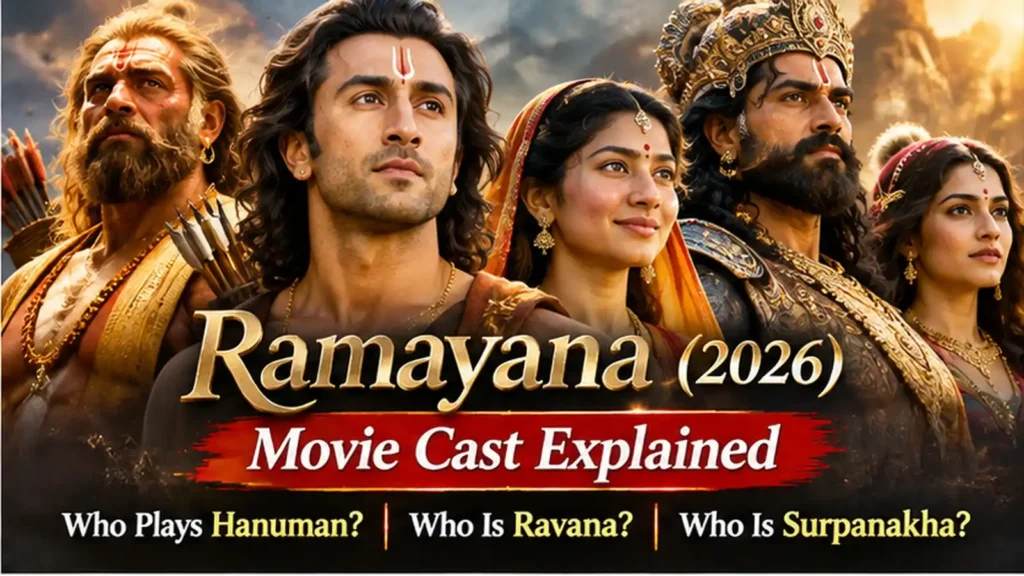

Ramayana 2026 movie cast: Nitesh Tiwari’s Ramayana: Part One brings Ranbir Kapoor as Rama, Sai Pallavi as Sita, Yash as Ravana, Ravie Dubey as Lakshmana and Sunny Deol as Hanuman. The official Sony Pictures trailer names these five leading roles; additional cast assignments, including Rakul Preet Singh as Surpanakha, have been reported in established entertainment coverage. This guide identifies who plays whom, explains the characters’ places in the original epic, and separates confirmed credits from interpretations that cannot be established without a particular film scene or an official statement.
Because searches such as “who is Hanuman in Ramayana movie 2026” or “who is Ravana in Ramayana movie” can mean either which actor was cast or what role the character plays, the article answers both. It also explains the difference between the film’s production choices and the wider literary tradition. The movie opened worldwide on November 5, 2026, and its official trailer was released in July; neither should be described as an unreleased upcoming production as of this article’s November 6 research cutoff. Official studio release · Sony Pictures official trailer.
Ramayana 2026 movie cast: quick reference table
| Character | Actor | Source status |
|---|---|---|
| Rama | Ranbir Kapoor | Official Sony Pictures trailer |
| Sita | Sai Pallavi | Official Sony Pictures trailer |
| Ravana | Yash | Official Sony Pictures trailer |
| Lakshmana | Ravie Dubey | Official Sony Pictures trailer |
| Hanuman | Sunny Deol | Official Sony Pictures trailer |
| Dasharatha | Arun Govil | Published trailer/cast coverage |
| Kaikeyi | Lara Dutta | Published trailer/cast coverage |
| Manthara | Sheeba Chaddha | Published trailer/cast coverage |
| Kausalya | Indira Krishnan | Published trailer/cast coverage |
| Surpanakha | Rakul Preet Singh | Published trailer/cast coverage |
| Mandodari | Kajal Aggarwal | Published trailer/cast coverage |
| Indra | Kunal Kapoor | Published trailer/cast coverage |
The main cast entries above are directly named in the verified Sony Pictures Entertainment trailer description. Supporting parts are identified by Scroll’s July 30 cast report and other press coverage. Credits can contain additional performers or differ in prominence across edited film versions; this table is a useful source-based guide, not a claim that every listed actor has equal screen time.
Who is Hanuman in Ramayana movie 2026?
Sunny Deol plays Hanuman in Nitesh Tiwari’s 2026 Ramayana adaptation. This is not simply a rumor inferred from fan posters: the verified Sony Pictures Entertainment official trailer description expressly identifies Sunny Deol as Hanuman. A reader searching for the answer should not have to scroll through pages of speculation before finding this basic fact. Sony Pictures trailer.
Hanuman is one of the Ramayana’s most important figures. In devotional and literary traditions, he embodies courage, steadfast service and deep devotion to Rama. His central contribution to the broader narrative is not limited to physical power: loyalty, observation, persuasion and judgment are equally important. Someone unfamiliar with the epic can understand Hanuman as a remarkable ally without reducing the character to a generic action sidekick.
The presence of a major actor in the declared ensemble should not be used to invent an exact entrance scene, dialogue, action sequence or number of minutes on screen. Publicly reported preview material noted that the July trailer did not prominently show Sunny Deol’s Hanuman, even though his casting was confirmed. Therefore a thumbnail with an invented “first official Hanuman look” should not be represented as authentic film footage unless the studio actually released that image. Cinema Express trailer report.
Why Sunny Deol as Hanuman is a major casting choice
Sunny Deol is associated with emphatic dialogue delivery and a forceful screen presence. Casting him as Hanuman invites public expectations about authority and action, but those expectations are not themselves evidence of the film’s exact characterization. The important cinematic question is how the film interprets devotion and strategic intelligence alongside physical strength.
Hanuman can be written as both an immense physical force and an emotionally grounded character whose purpose is devotion rather than personal ambition. In cinema, the balance depends on screenplay, performance, costume, visual effects and dialogue. A successful characterization does not require every appearance to become a fight scene; quieter moments may communicate why the character has endured in religious practice and cultural memory.
Readers should distinguish promotional attention from critical evaluation. An official casting announcement proves an actor has been assigned a part. It does not prove that every viewer will love the interpretation or that any particular scene exists. For a factual entertainment website, clearly marking that difference protects both credibility and readers’ expectations.
Who is Ravana in Ramayana movie 2026?
Yash plays Ravana, the powerful ruler of Lanka and central adversary in the Ramayana narrative. His role is confirmed by the official Sony Pictures trailer and Prime Focus Studios’ release announcement. Yash’s fame through the KGF films helps explain why casting news about Ravana attracted attention far beyond Hindi cinema, particularly among Kannada and other Indian-language audiences. Prime Focus Studios.
Ravana is a complex character in the literary tradition. He is widely associated with power, learning, religious devotion and pride, as well as decisions that drive the central conflict. A movie’s particular costume, dialogue or visual effects do not define the only possible understanding of this figure. Different communities have interpreted Ravana with varying emphases for centuries.
The central cinematic contrast is between a protagonist associated with restraint and an antagonist associated with dominance and excess. That difference creates powerful opportunities for actors, but it can also encourage simplistic writing if the character is reduced to a single angry expression. A review can criticize or praise the finished interpretation; a factual cast guide should simply explain the verified casting and the role’s narrative significance.
Who plays young Ravana in the film?
A separate casting report has identified Raghav Malhotra, son of producer Namit Malhotra, as the performer portraying a younger Ravana. This information should be attributed to the publication that reported it rather than represented as a first-hand interview or independent credit verification. It is important not to invent details about an actor’s age, training, auditions or earlier filmography simply because readers are curious about the character’s background. NDTV’s young Ravana report.
A younger-version casting decision can help a production convey a character’s history across time, but it does not by itself establish that the film contains a detailed origin story of a particular duration. The safest presentation is to distinguish what was reported about casting from what viewers or reviewers have described of the finished film.
If Epicofilm publishes a dedicated young Ravana article, this paragraph should link to that existing page instead of repeating an entire second biography here. A well-connected collection of accurate posts is more useful than placing the same unsupported background details on multiple URLs.
Who plays Rama? Ranbir Kapoor and the meaning of the role
Ranbir Kapoor plays Rama, the prince of Ayodhya who is the epic’s central figure. That identity is official and unambiguous. The character’s cultural importance creates unusually high expectations: within many Hindu traditions, Rama is revered as an embodiment of moral discipline, compassion and righteous conduct, not merely as an exceptional warrior.
The production’s own introduction to Rama emphasizes difficult choices, duty and restraint. In its April 2026 first-look announcement, Prime Focus Studios focused on the character’s willingness to place moral obligation above personal convenience. That is a public statement of the filmmakers’ creative intent, not a complete independent review of how every scene succeeds. Prime Focus Studios: Rama Unveiled.
An informative cast article can help readers understand why certain performances are difficult to compare. Rama’s deliberately restrained manner may be very different from the theatrical force assigned to Ravana. The contrast is part of the narrative structure. A fair critical evaluation would consider whether the actor makes Rama’s emotional decisions legible rather than demand that the character dominate every scene through loud dialogue.
Who plays Sita? Sai Pallavi’s character
Sai Pallavi plays Sita, one of the story’s central characters. The official trailer description lists her by name, and the studio’s release announcement includes her among the three primary performers. Sita’s importance extends well beyond her relationship with Rama. She is a figure through whom the epic examines dignity, endurance, courage, love and the moral consequences of decisions made by powerful people.
A film with spectacular effects and large battle sequences faces a particular challenge in giving quieter characters enough narrative agency. Yet a factual cast article should not claim that Sita was “ignored” or “perfectly portrayed” without grounding those judgments in a specific published review or a clearly declared first-hand screening. The cast announcement proves the role; criticism requires a separate evidentiary basis.
Readers interested in the original Sita character can benefit from knowing that different Ramayana tellings place different emphases on her experiences. A film cannot necessarily represent every version. Understanding that background makes discussion more informed than assuming a single screen adaptation is identical to all the traditions associated with Sita.
Who plays Lakshmana? Ravie Dubey’s role
The official Sony Pictures trailer lists Ravie Dubey as Lakshman, an English spelling variation of Lakshmana. The character is Rama’s brother and an essential companion during exile. He is associated with protective loyalty, decisiveness and deep family commitment, making him central to the relationships that carry the early part of the epic.
A common search mistake is to treat every character as an independent superhero whose function can be explained without reference to anyone else. Lakshmana’s significance comes particularly from relationships—with Rama, Sita and the surrounding royal family—and from how his responses differ from Rama’s restraint. A cast guide adds value by explaining that relational dimension alongside the actor’s name.
The movie’s Indian-language and English presentations can use different transliterations in subtitles or marketing. Readers may see “Lakshman,” “Lakshmana” or similar spellings. They refer to the same central character in this context. Consistency in the article’s main heading can coexist with natural alternate spellings in the body and FAQs.
Who plays Surpanakha in the Ramayana film?
Rakul Preet Singh has been reported as playing Surpanakha, also frequently spelled Shurpanakha or Shoorpanakha. The July 2026 trailer coverage by Scroll and Cinema Express includes the role among the announced supporting cast. This is sufficiently grounded to report with appropriate attribution, without fabricating the exact extent or emotional tone of her scenes. Scroll cast report.
Surpanakha is associated with an important sequence in the epic’s forest narrative and with the chain of events that develops the conflict between Rama and Ravana. Her relationship to Ravana is part of why the character carries significance despite not always receiving as much time as the leading figures in popular retellings.
A responsible guide should avoid reducing Surpanakha to a caricature or claiming that one version of her encounter represents every textual tradition. Her depiction has been reassessed in literature and performance, including from perspectives concerned with power, desire and gender. That context helps explain why her portrayal can be controversial, while still keeping the actor identification direct and factual.
Is it Shurpanakha or Surpanakha?
Both spellings are used in English media and searches. Sanskrit-derived names often appear in multiple romanized forms because different transliteration systems represent sounds differently. For SEO, using the most common conversational spelling in a heading and acknowledging a close variant in the first paragraph can help readers without turning the page into a repetitive keyword list.
What matters most is that the article identifies the same mythological character and cites a reliable source for the film’s casting. A fabricated claim that “two separate Surpanakha characters” appear because the name is spelled differently would be inaccurate. Similarly, a page does not need a different article for every spelling variation.
The title of a film, a source character’s name and the performer assigned to that character are three distinct pieces of information. Consistent editorial practice separates them and updates the actor information only when a trustworthy production or press source supplies new evidence.
Who plays Dasharatha, Kaikeyi and Kausalya?
Arun Govil is reported as playing King Dasharatha, Rama’s father. Lara Dutta is identified as Kaikeyi, one of Dasharatha’s queens, and Indira Krishnan as Kausalya, Rama’s mother. These royal-family roles matter because the dramatic crisis leading to exile emerges from decisions and obligations within Ayodhya’s household.
A first-time viewer may be tempted to regard the succession conflict as an introductory diversion before more spectacular events begin. In the Ramayana tradition it is foundational. Promises, inheritance, filial responsibility and relationships between family members create the moral conditions that shape everything after the departure from the city.
Reporting these supporting roles accurately helps readers follow the story without confusing actors and characters. Where the film or trailer provides a particular scene, it is better to link to the official footage than to invent dialogue or detailed interactions from memory. Scroll’s trailer breakdown.
Who plays Manthara, Mandodari and Indra?
Supporting-role coverage identifies Sheeba Chaddha as Manthara, Kajal Aggarwal as Mandodari and Kunal Kapoor as Indra. Each character belongs to a different part of the story’s moral and political world, and it is easy to mislabel their relationships when writing only from an image collage.
Manthara is connected with the royal-household decisions that shape Rama’s exile. Mandodari is associated with Ravana’s household and is significant in several tellings for her perspective within Lanka. Indra is a major deity within wider Hindu traditions and is represented in related narrative contexts. Their roles should not be collapsed into a generic list of “villains” or “gods” without explanation.
Because supporting cast reporting may include figures with limited screen presence, this guide avoids claiming their exact number of scenes or importance in the final edited film. The correct editorial technique is to distinguish public cast attribution from scene-by-scene analysis and to update the page when official credits provide greater detail.
Are all these actors visible in the official trailer?
Not necessarily. A film can announce a performer and still choose not to reveal the character in a particular promotional video. Cinema Express, for example, reported that Sunny Deol’s Hanuman was not shown in the July full-length trailer even while his place in the cast was public. This is common promotional practice, especially for large productions seeking to preserve particular character reveals. Cinema Express.
That means an AI-generated image circulating with a headline such as “exclusive first look” is not equivalent to an official publicity still. If a reader asks what Hanuman looks like in the film, the article should identify whether the specific image came from Prime Focus Studios, a licensed publication or an independent fan edit. This distinction is especially important for websites trying to build trust through search.
The absence of a particular character from a trailer is also not evidence that the character has been cut from the movie. Trailers are selected marketing assets, not comprehensive indexes of the finished film’s cast or narrative.
Who directed and produced Ramayana Part One?
The director is Nitesh Tiwari, and the producer prominently identified by Prime Focus Studios is Namit Malhotra. The film is made through Prime Focus Studios in association with DNEG and Monster Mind Creations, with global distribution involving Sony Pictures. These are official production facts rather than estimates about the project’s commercial outcome.
The screenplay credits in the Sony trailer description identify Shridhar Raghavan and Nitesh Tiwari as adapting the material for the screen. That is relevant to a frequent search confusion: although the source Sanskrit Ramayana is traditionally attributed to Valmiki, a modern film has its own screenwriters, editing decisions and creative team. Crediting one does not erase the other.
Music credits include Hans Zimmer and A. R. Rahman. The participation of internationally known musicians and visual-effects companies explains some of the film’s global positioning, but readers should not mistake celebrity collaborators for evidence of a particular review score or box-office total.
When was the film released, and in what languages?
Prime Focus Studios confirms that Ramayana: Part One began its worldwide theatrical release on November 5, 2026, with Hindi, Tamil, Telugu, Kannada, Malayalam and English presentations. The official worldwide announcement is an especially useful source because earlier articles often used broad seasonal terms such as “Diwali 2026.” As of November 6, the exact release date is not a future forecast. Official announcement.
The film’s international and Indian marketing sometimes use different title styles, including Ramayana: Rise of a Legend in international coverage. Those titles should not be treated as evidence of two unrelated movies. A cast guide can use both names naturally and make the equivalence clear near the start.
Availability of a language in the overall release announcement does not guarantee that every theater in every country has every audio version. Readers should check local cinema listings for actual showtimes, audio tracks and subtitles rather than relying on a generalized global statement.
Does the English-language presentation have a different edit?
Producer Namit Malhotra has discussed the development of two master versions of the first installment, with a separate English-oriented adaptation and different runtimes. This is a reported production distinction rather than simply an assumption that every English subtitle follows the Hindi screenplay word for word. The Indian Express report.
For casting purposes, the same five principal performers remain named in the official publicity. For performance evaluation, however, voice presentation, editing and localization can affect how an audience experiences a character. That is one reason different countries’ critic reactions should be attributed to the version actually reviewed whenever the information is available.
A cast guide should not claim that one edit includes or excludes a specific scene unless the difference has been verified. It is enough to state that the producer has publicly described multiple master versions and to advise readers to check which one is playing locally.
What is the difference between the Ramayana epic and the 2026 cast?
The original Sanskrit epic is traditionally associated with Valmiki and developed through a much longer history of transmission, commentary and retelling. The 2026 movie is an adaptation created for modern theaters. Its actors perform characters whose cultural lives extend far beyond any single cinematic depiction.
This distinction is essential when discussing “who is Hanuman” or “who is Ravana.” There are two different answers: who the character is in a sacred literary tradition, and who portrays that role on screen in a particular release. A good page provides both, but does not pretend that a film casting announcement can settle historical or theological debates about the source story.
Readers interested in the broader tradition can consult academic resources such as Oxford’s bibliography on Ramayana. That outside reference helps ground the character explanations independently of the current film’s marketing language.
Where can audiences check authentic film photos?
The most reliable starting points are the production studio’s releases and the verified distributor’s trailer and promotional materials. Prime Focus Studios publishes dated announcements with original production context; Sony Pictures hosts the verified trailer. Established press outlets may license and caption publicity stills, but the presence of an image on a news website does not automatically transfer reuse rights to another publisher.
For Epicofilm, the strongest featured image is a licensed, authentic official movie still identifying the film and its cast accurately. A fake photo of a performer in costume can undermine trust, even if the associated written casting fact is correct. Original nonphotographic diagrams can also add value, but should be labeled as editorial illustrations rather than movie stills.
Every image should have an alt description based on what it actually shows. For example, a genuine studio group poster can be described as a promotional image of the cast. An original typographic table is better described as an editorial cast guide, not an authentic scene from the film.
How to avoid incorrect cast information in social posts
First, look for official distributor, studio or clearly attributed press reporting. Second, distinguish between announced cast, characters visible in trailers, and roles verified in the finished credits. Third, avoid treating fan casting, edited photos and anonymous social media lists as definitive evidence. These checks are simple, but they prevent a surprising number of false announcements.
If a supporting actor’s role is disputed, a page should explain the source of uncertainty instead of selecting the most exciting version. Readers may appreciate the direct answer, but trust is damaged when a purported “exclusive” later turns out to be a speculative image or invented credit.
Another common error is publishing outdated release information. The first part is already in cinemas as of November 6, while producer interviews say the sequel’s planned year moved to 2028. Publishing “Part Two in 2027 confirmed” alongside an up-to-date cast table would create an unnecessary credibility problem.
Ramayana Part Two and the future of the cast
Producer Namit Malhotra has said that the second installment is now planned for 2028 rather than the previously discussed 2027 schedule. He has also publicly discussed the possibility that the wider cinematic plan might be reconsidered depending on the response to the first film. These are production developments, not proof that a third film has been formally greenlit. E! News interview.
This matters to cast searches because a viewer may assume every promised character arc must be completed within one installment. The cinematic project was announced in multiple parts, and reporting describes its structure as potentially evolving. Without an official announcement, however, it is unwise to claim a particular actor has signed for an unconfirmed third film or to invent future scenes.
The best editorial practice is to keep the Part One cast table focused on verified present production credits, while noting the producer’s stated plans for the next chapter in a separate clearly dated section. That prevents future-facing speculation from contaminating a useful informational guide.
Where to read an independent review
An actor list tells readers who plays whom; it does not answer whether the performances are successful. Those are different search tasks. Epicofilm’s existing Ramayana: Rise of a Legend review discusses critics’ responses and the film’s artistic choices. The present page intentionally avoids inventing a firsthand theater experience or an unsupported aggregate star rating.
For readers searching for a specific character, the most helpful structure is a short direct answer followed by background, source attribution and related links. This also supports a cleaner content cluster: the cast guide handles identities, the review handles criticism, and a separate OTT guide handles where the film can legally be watched at home.
Editorial separation does not mean pages cannot link to one another. It means each page should contribute a distinct answer that readers cannot get as conveniently from a duplicated introduction on another URL.
Final verdict on the film’s cast information
The five principal roles are well supported by official publicity: Ranbir Kapoor as Rama, Sai Pallavi as Sita, Yash as Ravana, Ravie Dubey as Lakshmana and Sunny Deol as Hanuman. Supporting casting widely reported around the official trailer includes Rakul Preet Singh as Surpanakha, along with members of the royal households of Ayodhya and Lanka. The important distinction is what each source actually establishes.
For anyone searching “who is Hanuman in Ramayana movie 2026” or “who is Ravana in Ramayana movie,” these direct identities are the central answers. More complicated questions about individual scenes, backstories or later installments need their own evidence. That source-conscious approach is the most useful way to build a reliable cast article and maintain credibility as the film continues its international run.
Frequently Asked Questions
1. Who is Hanuman in Ramayana movie 2026?
Sunny Deol is officially listed as Hanuman in the verified Sony Pictures trailer description. The character is revered within the Ramayana tradition for devotion to Rama, courage and service. A cast credit should not be confused with a claim about the actor’s exact on-screen duration.
2. Who is Ravana in Ramayana movie 2026?
Yash plays Ravana, as confirmed by Prime Focus Studios and Sony Pictures. Ravana is associated with Lanka and is the major adversary in Rama’s epic story. His traditional literary character is more complex than a modern film villain label alone suggests.
3. Who plays Surpanakha in Ramayana Part One?
Rakul Preet Singh has been identified as Surpanakha in published trailer and cast coverage, including Scroll’s July report. The character’s name also appears as Shurpanakha in English-language searches. Both spellings refer to the same figure here.
4. Who plays Rama in the 2026 Ramayana film?
Ranbir Kapoor plays Rama. Prime Focus Studios officially introduced his portrayal in April 2026 and named him in the November 5 worldwide release announcement.
5. Who plays Sita?
Sai Pallavi plays Sita, confirmed in the studio’s formal announcement and official trailer. Sita is one of the epic’s central figures and a significant focus of its moral and emotional narrative.
6. Who plays Lakshmana?
Ravie Dubey plays Lakshmana, spelled Lakshman in the Sony Pictures trailer description. The character is Rama’s brother and companion during exile.
7. Is Sunny Deol actually in Ramayana 2026?
Yes. His Hanuman casting appears in Sony Pictures Entertainment’s official trailer credits. Some trailer coverage reported that the character was not shown prominently in the July promotional video, but that does not negate the casting.
8. Who is Rakul Preet Singh playing?
Press coverage of the official trailer identifies Rakul Preet Singh as Surpanakha. It is better to cite that published attribution than to rely on unlabeled fan art.
9. Who plays King Dasharatha?
Arun Govil has been identified as Dasharatha in published cast coverage. Dasharatha is Rama’s father, and royal-family obligations shape the story’s exile crisis.
10. Who plays Kaikeyi?
Lara Dutta is identified as Kaikeyi in cast reporting. The character is important to events surrounding the succession of the Ayodhya throne.
11. Who plays Mandodari?
Kajal Aggarwal is identified with Mandodari in published cast coverage. Mandodari belongs to Ravana’s household in the epic tradition.
12. Who plays Manthara?
Sheeba Chaddha is identified as Manthara in the published ensemble list. The character is associated with important events in Ayodhya’s royal household.
13. Who plays young Ravana?
NDTV reported that Raghav Malhotra portrays a younger Ravana. Treat that as a sourced news report and do not invent biographical details about auditions or training not disclosed by the reporting.
14. Who directed Ramayana Part One?
Nitesh Tiwari directed the 2026 movie. Prime Focus Studios identifies Namit Malhotra as producer, with DNEG and Monster Mind Creations involved in the project.
15. When did Ramayana Part One release?
The film opened worldwide in cinemas on November 5, 2026, according to Prime Focus Studios. It has been promoted in Hindi, Tamil, Telugu, Kannada, Malayalam and English.
16. When was the official Ramayana trailer released?
Prime Focus Studios dates the trailer announcement to July 30, 2026; the verified Sony Pictures upload is dated July 29 in its own listing. Regional scheduling and upload timestamps can differ, so cite the source when providing a precise date.
17. Is Surpanakha a different character from Shurpanakha?
No. These are common variations in English spelling for the same named figure. A single sourced character explanation can capture both without separate duplicate articles.
18. Is Ramayana 2026 based on Valmiki’s Ramayana?
It is a contemporary film adaptation of the Ramayana story. The Sanskrit epic is traditionally attributed to Valmiki, while the film has its own screenwriters and creative decisions. The two should not be treated as identical works.
19. When is Ramayana Part Two coming?
Producer Namit Malhotra has said that the next installment is being moved to 2028. Discussions of a possible expanded series should not be interpreted as confirmation that an additional film has already been ordered.
20. Where can I find official Ramayana movie images?
Start with Prime Focus Studios’ official announcements and the verified Sony Pictures trailer. Check reproduction permissions before posting film stills on a commercial website, and do not label AI-generated lookalikes as genuine actor photographs.
Sources and attribution
- Sony Pictures Entertainment — Verified official trailer
- Prime Focus Studios — Worldwide release
- Prime Focus Studios — Rama first look
- Scroll — July trailer and cast breakdown
- Cinema Express — Trailer details
- E! News — Producer on sequel timing
- Oxford Academic — The Ramayana tradition
Editorial note: Principal casting is confirmed by official distributor/studio materials; secondary cast details are attributed to published coverage. No first-hand interview, film screening or exclusive set photograph is claimed.



Pingback: Ramayana Movie Review (2026): Is Rise of a Legend Worth Watching?