Ramayana Rotten Tomatoes: 7 Essential Rating Facts
Ramayana Rotten Tomatoes: This is Epicofilm’s research-based, source-attributed guide updated November 5, 2026. It distinguishes verified facts from opinions, preliminary reports and changing figures.
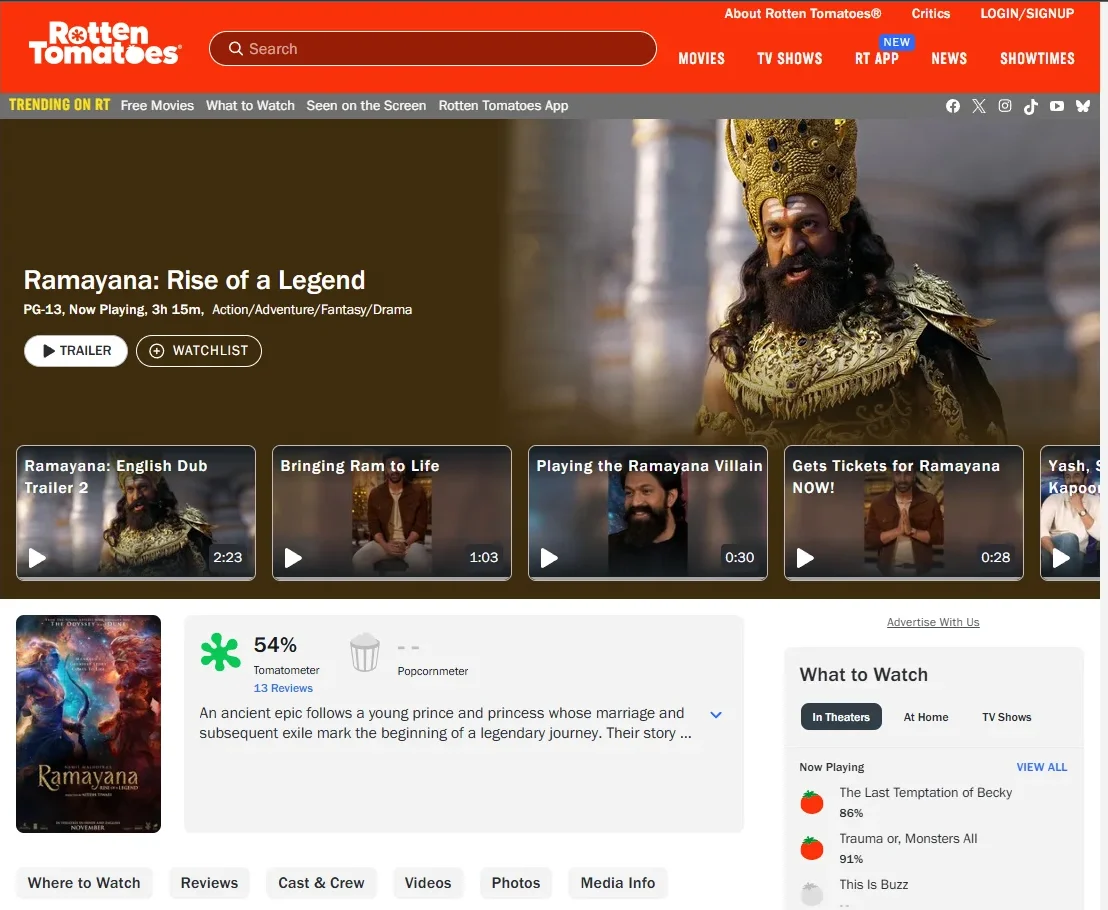
The short answer: On the Rotten Tomatoes page checked November 5, 2026, Ramayana: Rise of a Legend showed seven professional critic reviews and zero verified audience ratings in the displayed listing. The accessible page did not provide a dependable aggregate Tomatometer percentage to quote. Individual published ratings included Screen Rant’s 7/10, IndieWire’s B, and Next Best Picture’s 5/10; IGN separately gave 4/10, as documented by contemporary coverage. IMDb had a film listing, but the accessible version reviewed here did not display a verified numerical user score suitable for a dated headline. We will not invent one.
These distinctions may disappoint readers searching for a single star rating, yet they are the difference between responsible film reporting and misleading score aggregation. On release day, ratings can change several times as critics submit reviews and audiences attend more screenings. A single screenshot may become outdated within hours. A published score can also be misinterpreted when readers confuse a Tomatometer percentage with an average star rating or mistake a user score for a professional critical consensus.
The new Ramayana is a particularly interesting case because early responses are divided. Some reviewers have emphasized its production ambition and technical spectacle, while others have criticized pacing, characterization and aspects of its CGI. A number alone conceals those differences. This guide explains how Rotten Tomatoes and IMDb work, what the currently cited reviews say, and how readers can make a more informed decision without relying on a fabricated or premature consensus.
Original editorial artwork; not an official film still, actor photograph, or authenticated documentary image.
Ramayana Rotten Tomatoes: First, confirm which Ramayana movie you are looking at
The movie has appeared under more than one title. Prime Focus Studios officially refers to the 2026 theatrical release as Ramayana: Part One. Rotten Tomatoes lists it as Ramayana: Rise of a Legend. Both refer to Nitesh Tiwari’s project starring Ranbir Kapoor as Rama, Sai Pallavi as Sita and Yash as Ravana. The worldwide release date confirmed by the studio is November 5, 2026.
This matters because searching for the shorter term ‘Ramayana’ can also return unrelated films, animated features, television adaptations and information about the ancient epic itself. Readers checking an IMDb page should confirm the year, director and main cast rather than assume the first result necessarily belongs to the production they mean. The specific IMDb listing checked for this article is https://www.imdb.com/title/tt27988879/.
The film’s different public titles also explain why searches for ‘Ramayana movie review IMDb’, ‘Rotten Tomatoes Ramayana’ and ‘Ramayana Rise of a Legend review’ overlap. These are related queries about one movie and its reception, not an argument for publishing multiple near-identical pages. A single ratings explainer can answer them clearly while a separate comprehensive review provides a different editorial function.
What Rotten Tomatoes actually measures
The Tomatometer represents the percentage of approved critical reviews that Rotten Tomatoes classifies as positive. Its purpose is to summarize the balance of positive and negative reviews, not to tell readers the average amount of praise expressed. A movie with 90% positive notices is not necessarily a movie that received an average numerical grade of nine out of ten. Many critics may have considered it good but not extraordinary.
The distinction becomes clearer with a hypothetical example. Suppose ten critics review a film. Nine express a modestly positive opinion and one strongly dislikes it. A positive-review percentage could reach 90%, even if the nine favorable critics mostly rate the movie just above their own threshold for positivity. Conversely, a highly polarizing movie might receive passionate praise from some critics and strong criticism from others, producing a lower percentage despite its admirers’ intensity.
Rotten Tomatoes also displays additional information, including critic review counts, excerpts, audience ratings where available and sometimes an average numerical rating from critics whose scoring formats permit comparison. Each metric answers a different question. For an informed choice, the most useful practice is to read several full reviews rather than assume a headline percentage contains every relevant judgment.
What was available for Ramayana on November 5?
The page checked for this research displayed seven professional reviews. It included published responses from IndieWire, Culture Mix, Sucharita Tyagi, NYC Movie Guru, Screen Rant and Next Best Picture among those accessible in the listing. The visible material ranged from praise for technical achievement to sharp criticisms of dialogue, performances, CGI and narrative density. The count is a snapshot and may increase as the film reaches more markets.
The Popcornmeter area showed zero verified audience ratings in the accessible listing at the time checked. That is not evidence that no one has seen the movie, that audiences disliked it, or that the film failed to sell tickets. It simply describes the platform’s displayed verified-rating status at that moment. A score cannot be responsibly calculated from zero verified responses. Other online reaction sources may exist, but they are not interchangeable with Rotten Tomatoes’ verified audience system.
The page did not provide a numerical aggregate Tomatometer percentage that could be confidently quoted from the accessible snapshot. An article claiming a specific overall percentage would therefore require a fresh check of the live page. Since the main purpose here is reliable information, the correct editorial choice is to show individual documented opinions and explain why aggregate figures may be unavailable or unstable.
What is IMDb’s user rating?
IMDb is a large film and television information platform whose title pages can display weighted user ratings. Unlike Rotten Tomatoes’ main critic measure, the prominent IMDb rating is based on the platform’s user-voting system rather than a direct percentage of positive professional reviews. IMDb applies weighting procedures, so the displayed result should not be assumed to equal a simple arithmetic mean of every vote.
The IMDb page reviewed for this article confirmed the movie listing, title, principal performers and a separately displayed runtime, but it did not supply a reliable live numerical user rating suitable for publication here. We do not fill that absence with a guessed number based on social-media chatter or a generated infographic. Readers seeking the most recent score should check the live title page and inspect the number of votes and rating distribution where available.
Early user scores can be especially volatile. Fans may vote enthusiastically after preview screenings, while others may submit negative scores for reasons unrelated to a carefully observed performance. Platforms use their own methods to calculate and moderate ratings, but no publicly visible single number can fully explain voter motivations. A trustworthy article reports what is displayed with a date rather than treating it as an unchanging judgment.
Rotten Tomatoes and IMDb measure different things
The most important conceptual error in online entertainment coverage is treating IMDb and Rotten Tomatoes as if they are two versions of the same scoring system. They are not. A Tomatometer percentage summarizes the proportion of classified positive professional reviews. IMDb’s featured score reflects weighted user votes on a numerical scale. These are different samples, different calculation processes and different definitions of success.
Imagine a film receives favorable reviews from most professional critics but attracts polarized fan voting. Its Tomatometer and IMDb scores could be very different without either platform being mathematically incorrect. They would be sampling different opinions. The reverse is also possible: an enthusiastic audience may embrace a movie that many critics consider uneven. Such a discrepancy is often part of a film’s cultural story, not necessarily evidence that one group is dishonest.
When comparing these metrics, a clear article should label them separately and include the relevant sample size if available. It should never convert 7/10 from one reviewer into a supposed 70% Tomatometer score for the entire film. Nor should it create an ‘average movie rating’ by adding letter grades, stars, critic percentages and public votes as if they used the same units.
Screen Rant’s 7/10: praise for technical ambition
Screen Rant’s Brandon Zachary rated Ramayana: Rise of a Legend seven out of ten and highlighted its visual and technical accomplishments. The general thrust of that review is that the film achieves a notable scale of cinematic presentation. Such praise is consistent with the production’s stated ambition to render an ancient epic through elaborate effects and large-scale international filmmaking resources.
That review is valuable because it identifies a specific area where the film has persuaded at least one professional critic. The reader should understand, however, that a positive reaction to technical craft does not automatically settle the question of screenplay quality. It is entirely possible to find a movie visually impressive while remaining uncertain about its narrative choices or emotional detail.
A ratings explainer should preserve that distinction. A 7/10 is one critic’s published judgment, not an official rating from the studio or a platform-wide consensus. The correct editorial practice is to attribute it by publication and critic, ideally linking to the original or its aggregator entry so readers can examine the reasoning themselves.
IndieWire’s B: admiration with reservations
IndieWire’s Christian Zilko gave the film a B grade. The accessible Rotten Tomatoes excerpt emphasizes the epic scale, while broader contemporary reporting notes that the movie’s expensive presentation may limit the distinctiveness of its dramatic voice. This is a useful example of how a generally positive review can still contain meaningful criticism.
Letter grades cannot always be translated cleanly into stars or decimal scores. Publications and writers may apply them differently, and an attempt to calculate a universal average from mixed grading systems introduces assumptions. A B is best preserved as a B, accompanied by a short description of the reviewer’s main argument.
The film’s scale is central to the disagreement. A production can be admired for undertaking an enormous story while still being questioned about its pacing or originality of interpretation. If a news page extracts only the favorable sentence and removes the reservations, it stops informing readers about the review and starts using the critic as promotional decoration.
Next Best Picture’s 5/10: too much material?
Next Best Picture’s Giovanni Lago gave the film five out of ten and raised concerns about the amount of narrative material compressed into its structure. The underlying criticism is about adaptation. A story involving many characters, locations, relationships and moral decisions can become difficult to dramatize coherently when a feature attempts to cover too much ground.
This response is especially relevant for readers new to the Ramayana. Those audiences may not already know why a relationship matters, so they depend on the film to build emotional meaning. A knowledgeable viewer might supply context from familiarity with the epic, while a newcomer may experience the same sequence as rushed. That difference does not prove either audience is wrong; it helps explain why adaptations of beloved texts can generate dramatically different reactions.
The five-out-of-ten grade is not proof that all elements of the production are unsuccessful. The cited review acknowledges that viewers can still be swept up in the experience. The relevant takeaway is a reservation about narrative density rather than an absolute rejection of every filmmaking achievement.
IGN’s 4/10: action, CGI and localization concerns
IGN’s review, reported in contemporary coverage, rated Ramayana four out of ten. It criticized awkward action, unsatisfying CGI and AI-assisted lip-syncing in the English-language presentation. These are concrete concerns that give readers more actionable information than a vague negative adjective. They suggest that the viewing experience may depend partly on tolerance for digital imagery and, potentially, which language version is shown.
The localization point deserves attention. The original film includes Hindi as a release language, while the worldwide rollout also offers English. Dialogue adaptation and visual lip movement can shape how performances feel. If a critic finds digitally altered mouth movement distracting, their response may not apply in exactly the same way to every presentation. That does not invalidate the criticism; it defines its scope.
A fair ratings roundup should include this negative review alongside favorable ones, without exaggerating either. Ignoring the criticism would mislead readers, while presenting it as a unanimous verdict would be just as inaccurate. The goal is to describe the real published disagreement.
Other critical reactions and why the range matters
Rotten Tomatoes also displayed more skeptical opinions from Culture Mix and NYC Movie Guru, along with a mixed assessment from Sucharita Tyagi. Their excerpts focus on matters such as dialogue, performance, emotional engagement, production density and watchability. These are substantive artistic criteria, not simply an expression of whether an individual critic likes mythology.
A film’s cultural significance can amplify reactions. Some viewers may approach it with devotion, nostalgia or great expectations; others may judge the cinematic presentation against international fantasy productions. Professional critics can also disagree about what a film’s most important task is. One might prioritize cultural resonance, another narrative concision and another technical quality. An honest ratings page should not collapse these judgments into a fraudulent consensus.
The small early sample makes nuance especially important. When just a handful of critics have written, each new review can change the aggregate picture significantly. Readers should regard a first-day snapshot as provisional rather than the definitive critical reputation of a production that may remain in theaters for weeks.
Why audience reactions can differ from professional reviews
Professional critics often evaluate cinematic structure, acting, composition, sound, editing and how a film relates to its genre. General audiences may care most about emotional attachment, entertainment value, star appeal or seeing a beloved story brought to a large screen. These priorities overlap but are not identical. A movie can achieve a powerful sense of cultural celebration for its audience while leaving a reviewer dissatisfied with pacing.
Social-media posts add another layer. People who attend premieres or opening-day screenings are often unusually enthusiastic, and very negative reactions may spread because controversy attracts attention. Neither group automatically represents everyone who will eventually watch the movie. A viral thread is not a scientific survey. A platform’s verified audience rating, once it exists, is still limited to people who choose to rate the film under its rules.
This is why a user-ratings article should explain both the benefits and limitations of crowd-sourced data. A large number of independent votes can reveal broad patterns, but those patterns do not replace careful interpretation. The most helpful advice is to look at how different viewers explain their reactions, not merely whether their votes produce a high or low average.
How review bombing can distort first impressions
The term ‘review bombing’ describes a pattern in which a large number of ratings may be submitted to influence the public perception of a title for reasons that are not necessarily related to normal viewing experience. It is a known concern in online entertainment, but it is important not to accuse any particular audience or film of this behavior without evidence. Disagreement, intense fandom and high voting volume do not automatically prove manipulation.
When a movie releases, the quality of the user-score signal depends on how many votes exist, whether they are verified, when they were submitted and how the platform processes them. IMDb and Rotten Tomatoes have different systems, so a reader should not assume all ratings are equally authenticated. In the case of the Ramayana snapshot reviewed here, a verified Rotten Tomatoes audience aggregate was not yet available to interpret.
The responsible editorial response to uncertainty is to describe it directly. A page can tell readers that ratings may become more stable as the audience grows without inventing allegations about organized campaigns or attributing intentions to anonymous voters.
The role of runtime and language versions
Rotten Tomatoes listed the movie at three hours and fifteen minutes, while IMDb’s accessible listing displayed a shorter duration. These figures may reflect differences in versions, but the exact reason should not be asserted without a verified distributor explanation. The useful practice is to preserve the source context and tell readers to check their local theater’s running time.
Runtime can affect review reception because pacing is a relationship between length and what the story accomplishes. An extended epic may be deeply rewarding when its added scenes develop character and theme. The same duration may feel laborious when exposition or action repeats information without increasing the stakes. Critics’ concerns about density are therefore more informative than the raw number of minutes by itself.
The language question is equally significant. When a film is released in multiple versions, dialogue, vocal acting and technical localization can alter the experience. A critic’s comments about an English version should be identified as such when possible. Readers who understand Hindi may wish to compare an original-language performance with a dub, but the value of either choice is ultimately personal.
Why the film’s budget does not determine its rating
Large productions generate expectations because audiences assume substantial expenditure will translate into exceptional results. But cost is not an artistic category. A movie may spend heavily on sets and digital environments while delivering a screenplay that some critics find underdeveloped. Conversely, a less expensive film can create enormous emotion through simple imagery and strong performances.
Reports about Ramayana‘s financial scale vary in how they describe the production, and some figures appear to include more than one planned installment. An accurate ratings article should not insert a single unverified budget figure and then infer quality from it. Rotten Tomatoes and IMDb measure reactions, not return on investment. A high ticket price also does not guarantee that a viewer will enjoy the result.
The film’s international production strategy remains noteworthy. Its collaboration across studios and its multilingual rollout represent significant industrial ambitions. These are relevant background facts, but they do not resolve critics’ disagreements about acting, pacing or technical presentation. The right approach is to recognize the achievement of making the film while keeping the evaluation of its craft independent.
Should readers trust the highest or lowest review?
Neither automatically. An extremely favorable review may identify genuine achievements that other critics undervalue. A strongly negative review may identify weaknesses that are particularly important to a certain viewer. The most useful approach is to read a range of credible responses and ask which aspects matter personally. For someone interested in large-scale production design, a technically focused positive review may be informative. For someone sensitive to pacing, a detailed structural criticism may be more useful.
A star rating can guide attention but cannot communicate the full texture of an argument. It says nothing by itself about whether a critic saw an original-language screening, whether the audience responded emotionally or whether a single sequence dominated the review. Those circumstances often appear in the written analysis, not the headline score.
For Epicofilm, presenting the range of published criticism is not indecision. It is the appropriate response to genuinely mixed evidence. A reader can make a more informed choice when the site explains conflicting assessments instead of pretending that one number settles every question.
What to do when a Google search displays an outdated number
Search snippets and AI-generated summaries can reflect information retrieved at an earlier time. If a score changes, the short answer displayed in search may temporarily differ from the live platform page. A publisher should include a visible update date and link directly to the authoritative listing. That gives readers a way to verify whether a quoted number is current.
The same rule applies to screenshots circulating on social media. A still image of a score may have been captured when the sample was smaller, and a caption may omit that context. Before sharing a number, check the date, review count and whether the screenshot depicts critic or audience ratings. A plausible-looking graphic is not proof of current platform data.
AI search visibility is not improved by publishing confident but false numbers. Google’s own Search Central guidance emphasizes unique, useful, reliable content and ordinary SEO fundamentals rather than special tricks. A ratings page that correctly explains its methods and sources is more valuable than one attempting to claim authority through unsupported figures.
Film ratings and a reader’s actual decision
The decision to watch Ramayana can involve more than critical approval. Someone interested in Indian mythology may value the chance to see a large adaptation in a cinema. A viewer who primarily enjoys compact thrillers may find the experience less suited to their preferences. Families may consider cultural significance, language access and the PG-13 content classification. Film enthusiasts may be especially interested in large-scale visual-effects production and the debate around AI-assisted localization.
No single metric captures those motivations. Even a large and stable critic aggregate would not tell a prospective viewer whether the story’s themes resonate with them. This is why our separate long-form review examines the production’s strengths and criticisms in context, while this page concentrates on rating systems, verified scores and how to interpret the evidence.
For practical use, check the current local listing, read a few full reviews from different perspectives and decide what kind of experience you want. The goal of rating information is not to outsource taste. It is to help people make decisions with accurate expectations.
Our ratings verdict as of November 5, 2026
The early professional response to Ramayana: Rise of a Legend is mixed. Some critics praise its visual ambition and spectacle, while others criticize narrative density, dialogue, characterization and certain CGI choices. The evidence includes notably different individual grades: 7/10 from Screen Rant, B from IndieWire, 5/10 from Next Best Picture and 4/10 from IGN. These ratings should remain attributed to their respective reviewers rather than averaged into an invented Epicofilm score.
The accessible Rotten Tomatoes page showed seven critics and zero verified audience ratings, while the IMDb listing did not provide a verified numerical user score available for quotation here. The responsible headline is therefore not an unverified percentage; it is an explanation of an evolving and divided reception. Update the article when the live platforms provide new information, with a visible modification date and precise definitions of each number.
Bottom line: Use Rotten Tomatoes and IMDb as complementary signals, not interchangeable verdict machines. Ramayana has generated significant disagreement among early critics, and an accurate understanding of that disagreement is more helpful than any fabricated consensus.
Frequently asked questions
1. What is the Rotten Tomatoes rating for Ramayana 2026?
The accessible November 5 listing showed seven professional reviews but did not provide a reliable overall percentage suitable for quoting in this article. Check the live page for newer numbers.
2. How many Rotten Tomatoes critics reviewed Ramayana at the time checked?
Seven professional reviews were visible in the November 5 research snapshot. The count may change as more reviews are added.
3. What was the Rotten Tomatoes audience score?
The accessible listing displayed zero verified audience ratings, so this article does not invent an audience percentage. That status is a snapshot, not a prediction of later reception.
4. What is Ramayana’s IMDb rating?
The IMDb listing reviewed did not display a numerical score that could be reliably reported here. Consult the live film page for its current weighted user score and number of votes.
5. What is the movie’s IMDb title page?
The film’s IMDb listing is https://www.imdb.com/title/tt27988879/. Confirm the title, year, director and cast to avoid confusing it with another adaptation.
6. Is Ramayana: Rise of a Legend the same as Ramayana: Part One?
Yes. They refer to the same Nitesh Tiwari film. The official studio and review platforms use different public-facing names.
7. What did Screen Rant rate Ramayana?
Screen Rant gave it 7/10 in the published review reflected in the Rotten Tomatoes listing. The critic emphasized notable technical and visual achievement.
8. What did IndieWire rate Ramayana?
IndieWire graded it B. That letter grade should not be converted casually into an invented universal numerical rating.
9. What did Next Best Picture rate Ramayana?
Next Best Picture gave it 5/10 and expressed reservations about the density of the storytelling and space for character development.
10. Did IGN criticize the movie?
Yes. IGN’s 4/10 review criticized action presentation, CGI and the AI-assisted lip-syncing associated with the English-language version, according to contemporary reporting.
11. Does 90% on Rotten Tomatoes mean nine out of ten stars?
No. The Tomatometer is the share of qualifying reviews classified as positive, not the average star grade. The numerical example is hypothetical and not a reported score for this film.
12. Is IMDb the same as the Rotten Tomatoes audience score?
No. They use different user-rating systems and methods. A score from one should not be presented as the other.
13. Can early IMDb user scores change quickly?
Yes. Release-day ratings can shift as more viewers vote and platforms update weighting or eligibility. Always provide a date and sample size when reporting a numerical score.
14. Was the movie released in English?
Prime Focus Studios confirmed English among its release languages, alongside Hindi and several other Indian languages. Availability depends on the local theater.
15. Does Ramayana have mixed reviews?
Yes. The documented early professional responses include both favorable and negative assessments, with significant disagreement over spectacle, story and technical quality.
16. Should I trust one star rating when deciding to watch?
A single score provides limited context. Reading multiple reviews and understanding your own preferences about pace, scale and mythology offers a more useful basis for choosing.
17. Is this an original firsthand review?
No. It is a research-based ratings and critical reception explainer. It does not pretend that the writer attended a screening or conducted an interview.
Authoritative and supporting sources
- Rotten Tomatoes film listing: https://www.rottentomatoes.com/m/ramayana_rise_of_a_legend
- IMDb film listing: https://www.imdb.com/title/tt27988879/
- Prime Focus Studios official worldwide release announcement: https://www.primefocusstudios.com/news/ramayana-premieres-in-los-angeles-ahead-of-worldwide-release
- Hindustan Times summary of international critics’ reactions: https://www.hindustantimes.com/entertainment/bollywood/ramayana-international-reviews-hail-visuals-overstuffed-exhausting-narrative-needed-game-of-thrones-style-tv-adaptation-ranbir-kapoor-yash-sai-pallavi-101793422642105-amp.html
- Google Search Central AI features guidance: https://developers.google.com/search/docs/appearance/ai-features
Editorial methodology and revisions: This is a time-stamped synthesis of published reviews, not a fabricated aggregate or firsthand score. Recheck the live platforms before publication. Update the visible date and citations whenever the published aggregate or critic sample changes.
Editorial standard: Figures, ratings and availability can change; consult the dated sources linked in this article. Generated illustrations are conceptual, not documentary evidence.