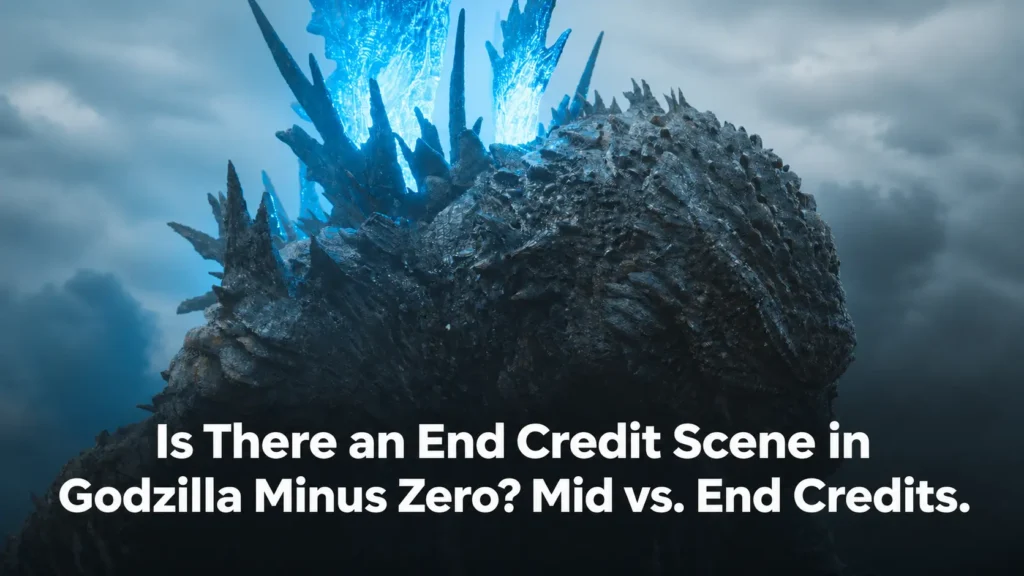

Godzilla Minus Zero end credits contain an audio tease at the very end. Neither the middle nor the end of the roll has an additional filmed scene. If you want the sound, wait through the final credits. SlashFilm screening report · GamesRadar credits report
For show planning, see Epicofilm’s Godzilla Minus Zero runtime guide and U.S. screening language guide. Watch the official GKIDS trailer.
Follow the roll from the last shot to the final sound
The key timing reference is the end of the Godzilla Minus Zero End credits itself. A clock time is less useful when a friend’s screening included different trailers or when the only number you have is a listed running time. Watch for the credits to finish if your goal is to catch the sound in a theater.
Below, the timeline and sound-design sections explain why viewers who left at different points can give different accounts. The discussion of the film’s last scene sits behind a clearly marked spoiler heading.
Godzilla Minus Zero End Credits at a glance
| What you are waiting for | What to expect |
|---|---|
| Mid-credits scene | None |
| Post-credits scene | None |
| Final audio | Godzilla’s footsteps and roar, as reported by GamesRadar |
Your decision about the Godzilla Minus Zero End credits comes down to what you want to catch. If your usual rule is to stay only for a substantial story scene, you already have your answer. If one last encounter with the sound of a giant monster is part of what you came for, there is a reason to stay seated through the end. You can make either choice without opening an ending explainer or learning the outcome of the battle.
Does Godzilla Minus Zero have a mid-credits scene?
ComingSoon reports that the Godzilla Minus Zero End credits have no mid-credits scene. You can watch the credits without waiting for the film to cut back to a character or location. The audio reported by GamesRadar comes at the far end of the credits, so viewers interested in hearing it should plan to sit through the whole roll. Waiting through the first part alone will miss the moment this guide is talking about. (GamesRadar, ComingSoon)
For the Godzilla Minus Zero End credits, it helps to distinguish the end of the story, the names rolling and the final sound. The main story concludes before the credits. The credits themselves give the production teams their screen time. Then the sound reported at the end gives the screening a small additional beat. The word “mid” describes where a scene would interrupt the roll, while “end” describes where the audio lands. Neither term changes the type of material involved.
Someone who leaves during the Godzilla Minus Zero End credits can honestly report seeing nothing extra. A credit sequence can keep its ordinary rhythm almost all the way through. The best cue for anyone waiting specifically for the sound is the completion of the credits, since the available reporting does not provide a dependable minute-and-second timestamp.
Should you stay until the credits finish?
Give the Godzilla Minus Zero End credits your time if a final sound in the auditorium is part of the experience for you. A sound that would take little time to describe in words can have much more presence in a cinema. It comes after the audience has spent a whole film learning to associate the creature with a particular scale and physical impact. That context is part of what makes the final cue worth hearing for fans.
You can leave when the Godzilla Minus Zero End credits begin if your main concern is missing another scene. There is also no need to treat the decision as a test of how much you like the film. Someone rushing for a train and someone who wants to sit with the ending are looking for different things. Both can leave having seen the full story.
If you’re with a group, agree on whether to stay through the Godzilla Minus Zero End credits before the names start rolling. A quick “there’s a sound at the end if you want to wait” does the job. Describing exactly where Godzilla ends up would give away information that a first-time viewer does not need to make the choice. The same goes for posting about the film on release weekend. The credits answer can stand alone, and a separate spoiler warning can carry the discussion of the finale.
Where does the sound land in the credits?
GamesRadar places the cue at the end of the Godzilla Minus Zero End credits. That is more useful than a guessed timestamp because the clocks on a screening, ticket listing, player or social clip can start in different places. Pre-show material also varies. If you are listening for the cue, let the credits finish and listen for the short burst of sound that the outlet describes. (GamesRadar)
Descriptions of the Godzilla Minus Zero End credits vary slightly in how they place the sound relative to the end of the roll. Those phrases place it in the same part of the experience for a theatergoer deciding how long to wait. The available coverage supports the placement at the very end. It does not give a reason to expect a second wait for a visual tag after the sound.
How the last sound changes the theater experience
the Godzilla Minus Zero End credits change what the audience pays attention to. During a fight, the picture tells you what caused a sound and where to look next. When the picture has given way to names and production credits, a heavy footfall has more room to register on its own. You hear the impact first and supply the image yourself. The next sound can make that imagined presence feel closer even though the film offers no geography to work with. That shift in attention helps explain why people remember a few seconds of audio after a screening.
In the Godzilla Minus Zero End credits, there’s a difference between hearing the score and hearing a sound associated with the creature. Music can preserve the emotional rhythm of a finale as viewers settle back into the auditorium. A monster cue can briefly interrupt that feeling of departure. When somebody describes the credits as worth sitting through, they may be responding to the combination of those experiences. The score has value for a viewer interested in how the film ends musically, while the short stinger offers a specific reason for a Godzilla fan to stay until the last moment.
the Godzilla Minus Zero End credits give viewers a specific sound to compare after the screening. One viewer might hear a final threat. Another might take it as a familiar franchise flourish. A third might simply enjoy the physical effect of the speakers. Those readings can coexist because the cue is brief and offers little story detail. The interesting disagreement is about how the sound makes the ending feel, while the basic description of the screening remains the same.
On a rewatch, see whether knowing what to listen for changes your reaction to the Godzilla Minus Zero End credits. On a first viewing the most immediate question may be whether the credits contain a surprise. On a second viewing, with the plot settled in your mind, you can pay attention to how long the film lets its final images sit with you before the audio arrives. That spacing is part of the viewing experience. You can decide for yourself whether the sound carries the tension forward or gives it one last release.
Does Godzilla Minus Zero have a post-credits scene?
the Godzilla Minus Zero End credits contain no additional filmed scene, according to GamesRadar, ComingSoon and The HoloFiles. GamesRadar, ComingSoon and The HoloFiles agree on the absence of an extra visual scene. GamesRadar gives the more specific audio detail. Its account describes stomping and a roar as the credits end. The HoloFiles also highlights Naoki Satō’s score as a reason for staying through the credits. Those are different parts of what an audience can experience while the names roll. (GamesRadar, ComingSoon, The HoloFiles)
For the Godzilla Minus Zero End credits, an extra scene would mean a new filmed or animated sequence. An audio stinger is a short sound cue. It can be memorable and it can carry meaning, even when it does not establish a new event in the story. That is the practical distinction to remember when a listing gives a simple yes or no.
Here’s what to tell someone in the ticket line about the Godzilla Minus Zero End credits. That gives them the choice without revealing the plot. The phrase “post-credits scene explained” often signals an ending breakdown, so readers who want to go in fresh can stop before the spoiler heading below.
Why some credits guides sound like they disagree
A yes-or-no question about the Godzilla Minus Zero End credits can hide two different questions. One job is identifying whether there is another scene. The other is finding out whether anything worth waiting for happens near the end. When an outlet answers only the first question, a reader may infer that the credits contain nothing beyond the usual roll and music. An article that includes the audio detail can sound like it has reversed the verdict, even though it has simply answered the second question as well.
Search results about the Godzilla Minus Zero End credits make this distinction easy to overlook. A headline often has room for the words “post-credits scene” and a short answer. A snippet may use “tease” to describe anything extra. In the article itself, check for specific language about what the audience sees and hears. A sound effect and an image of a monster moving through the water would provide very different evidence. In this case the reports support the former.
The publication dates help explain what each outlet reported about the Godzilla Minus Zero End credits. ComingSoon addressed the scene question on November 4. The HoloFiles discussed the ending on November 5. GamesRadar published its piece describing the sound on November 6. The later report supplies a detail about the audio, while all three agree on the visual scene question. The November 8 date on this guide reflects when those accounts were checked. (GamesRadar, ComingSoon, The HoloFiles)
A fan clip is a poor substitute for a screening report about the Godzilla Minus Zero End credits. A fan video can place an unrelated image over the sound, and a shortened upload can end before the final credit cue. The official trailer is valuable for verifying promotional footage and the distributor’s description of the movie. It is a different source from reporting about the theatrical credits, which is what the stay-or-go answer depends on here.
Before the ending discussion, where does the sequel fit?
Takashi Yamazaki returns to the world of the 2023 film Godzilla Minus One. GKIDS places the sequel in 1949, two years later, as the Shikishima family faces another disaster. The distributor’s description emphasizes the return of both the family and the giant threat. That continuity gives the title its context even for readers who have only seen the sequel’s poster or trailer. (GKIDS)
If you are deciding which film to watch first, Godzilla Minus One is the natural starting point. It gives the family’s earlier decisions their emotional weight and introduces the particular version of Godzilla that Minus Zero brings back. The viewing order is independent of the Godzilla Minus Zero End credits question. You do not have to watch an extra clip from a separate franchise to understand how these two films connect.
If you’re checking a report about the Godzilla Minus Zero End credits, make sure it names the 2026 sequel. An ending clip, a discussion of a regeneration shot or a recap labeled with the 2023 title can refer to a different moment. Check the year and full film name before treating any explanation as an answer about the new credits. Watch the official theatrical trailer.
Verified release context
Toho lists November 3, 2026, for Japan and GKIDS lists November 6 for the wide North American launch. The two dates refer to separate markets. They help explain why a viewer might have seen reviews or spoilers before their local opening. If you are sharing the Godzilla Minus Zero End credits answer with someone in another country, use the film’s title and year so they can distinguish the report from a local ticket announcement. (GKIDS, Toho)
The sources for the Godzilla Minus Zero End credits describe the theatrical film. This guide uses the announced Japan and North American dates for context. A theater listing for a particular country or city is the appropriate source for local showtimes. A guide written around a release in one market cannot establish whether a specific screening elsewhere is already taking bookings, what language it will use, or which presentation format is available.
Spoilers: What the final roar means after the ending
Spoiler warning. This section discusses the film’s ending and character outcomes.
The film lets Godzilla survive the encounter and return to the ocean. The HoloFiles reports that the creature’s retreat follows the fight with Ghidorah. With that ending in mind, hearing Godzilla during the Godzilla Minus Zero End credits reinforces information the main story has already provided. The roar works as an echo of a living threat, and the footsteps give that idea physical weight without showing where the creature is. (The HoloFiles)
the Godzilla Minus Zero End credits add a sound to the ending without showing what happens next. Without an image, the cue gives viewers no identifiable shoreline, no view of a city and no sense of elapsed time. The roar could be taken as a reminder of the threat that remains, or as a signature sound that leaves the audience with a final jolt. Neither reading requires a new sequence of events.
the Godzilla Minus Zero End credits work on a different level from the plot resolution. The story information is that Godzilla survives. The emotional effect is the reminder, after the story has closed and the credits have taken over, that the monster can still feel uncomfortably close. A sound can achieve the second effect without adding anything to the first. This is why the cue can feel satisfying even when a transcript of the last minutes would have no additional dialogue or action to describe.
How the family ending changes the way the roar lands
The Shikishima family’s decision at the end gives the film its human resolution. The HoloFiles describes a final image of the family traveling together, after they have wrestled with the possibility of separating to protect Akiko. The monster’s later sound does not answer what will happen to them next. It can instead underline how much uncertainty the characters carry with them even after deciding to stay together. (The HoloFiles)
the Godzilla Minus Zero End credits are especially effective after the quieter human resolution. The family’s decision is specific and visible. It answers a question about how these people will act under pressure. The roar is broad and unlocated. It recalls a threat that extends beyond any one household. Put together, the beats can leave a viewer with both a sense of personal resolution and a sense that the world around the family remains dangerous.
Imagine what a conventional extra scene would have done to the Godzilla Minus Zero End credits. The cue leaves the viewer with the choices already made in the film. For a discussion after the screening, that makes it more productive to ask how the sound changes the mood of the ending than to look for plot facts that would require an image or dialogue to establish.
Does the cue reveal anything new about King Ghidorah?
The sound reported at the end of the Godzilla Minus Zero End credits is associated with Godzilla. It does not supply a further visual appearance for Ghidorah. That matters because a phrase like “monster tease” can suggest an unidentified creature or another stage of the fight. The better source for Ghidorah’s role is the main film and the ending coverage that describes it. The audio is best understood in connection with the creature whose footsteps and roar are described.
Some viewers may listen to the Godzilla Minus Zero End credits for a clue to another monster. That can be a fun theory to discuss when everyone understands the limits of the evidence. This case gives fans an easier starting point because GamesRadar identifies the sound as Godzilla. A claim about a different kaiju would need some independent support, such as a clearly identifiable sound, official commentary or footage tied to the actual credits. (GamesRadar)
A discussion of the Godzilla Minus Zero End credits is clearer when it starts with what the audience can actually hear. Asking what the surviving threat means for the human characters follows from what the film shows. Asking which unrelated franchise creature the credits introduce starts with an assumption the coverage does not support. There is plenty to discuss in the ending without assigning the sound a hidden identity.
Does the credits audio set up a third movie?
The ending leaves room for another story because Godzilla survives. As of November 8, the sources used for this guide do not confirm a third film in Yamazaki’s continuity. GamesRadar reports that the director expressed openness to returning if Toho offered him the opportunity, while also saying he could be satisfied if this were his final Godzilla film. That is a statement about his interest and perspective, which carries a different weight from an announcement by the studio. (GamesRadar)
the Godzilla Minus Zero End credits leave room for interpretation, while production plans require separate evidence. The first is creative. The surviving characters and creature provide material that someone could develop. The second involves people and rights holders deciding to proceed. The third is public confirmation, which could take the form of a production announcement or a distributor naming a title or release window. A brief sound cue belongs to the first kind of evidence.
The official synopsis also uses language that frames the confrontation as final and urgent. Promotional copy tells viewers how to approach this film’s stakes. It cannot settle the studio’s future plans on its own. A director interview can help explain how the filmmaker feels about returning. A slate announcement would answer the production question. Treating each source according to what it actually says avoids promising a sequel that the coverage has yet to establish. That is relevant to the Godzilla Minus Zero End credits.
the Godzilla Minus Zero End credits offer little evidence for a crossover. An audience can recognize a creature from many different Godzilla films while still watching a story set within Yamazaki’s version of the world. A shared sound or recurring monster belongs to franchise vocabulary. It takes something more specific to establish a link between continuities. Nothing in the reports on these credits identifies such a link.
What kind of update would change the answer?
An official announcement from Toho, GKIDS or the relevant production partners would change the status of a sequel claim. A later interview could also clarify the intent behind the Godzilla Minus Zero End credits audio, if it directly addresses the sound. Those are two different updates. The first would confirm a future project. The second would explain a creative choice in the existing film. (GKIDS)
A later edition would need its own check if the distributor documents a change to the credits. The sensible starting point is to describe the film as reported during its theatrical release and date the coverage. A circulating screenshot or an enthusiastic social post can prompt a check, but it would need to connect to a verifiable edition before changing the answer readers rely on at the theater.
The useful takeaway from the credits is the final sound and the uncertainty it leaves behind. The credits carry a final piece of sound, the ending leaves Godzilla alive, and the reporting supports treating future film discussion as an open question. Readers can enjoy the tease and debate its tone while keeping those three pieces of information separate.
Godzilla Minus Zero after credits FAQs
1. Does Godzilla Minus Zero have an after-credits scene?
the credits have no additional visual scene. GamesRadar reports that the end of the roll includes Godzilla’s footsteps and roar. If you see the film with friends, that is the cleanest spoiler-free answer to give them before you decide whether to wait. (GamesRadar)
2. Is there a scene halfway through the credits?
the credits have no reported mid-credits scene. Viewers interested in the extra sound should stay until the final portion of the roll. Waiting briefly after the story ends will not necessarily take you to the cue described in release coverage.
3. Is it worth staying for the final sound?
That depends on what you enjoy. If you like hearing the monster’s signature sound in a theater, stay through the roll. If you are waiting for another plot scene or a piece of dialogue, you can leave when the credits start with the story complete.
4. What do you hear at the end?
GamesRadar describes the credits cue as heavy footsteps followed by a roar. The report places the cue as the credits come to an end. The description is of sound, and there is no accompanying story scene to watch for. (GamesRadar)
5. Will I miss part of the ending if I leave during the credits?
The main ending plays before the credits. Leaving during the roll means you may miss the final sound and some of the score. You will still have seen the events that resolve the family’s immediate story and show where the monster’s confrontation leaves things.
6. Is Godzilla shown again after the credits?
There is no reported visual return to Godzilla after the credits. The cue relies on the monster being recognizable by sound. It leaves any image of where the footsteps might be happening to the viewer’s imagination.
7. Is the roar at the beginning or end of the credit roll?
GamesRadar places the sound at the very end of the credits. It is therefore worth staying for the full roll if hearing it matters to you. The reporting used for this guide does not provide a precise playback timestamp. (GamesRadar)
8. Do I need to stay for another scene after the roar?
The release coverage identifies the audio as the final extra beat and reports no separate scene afterward. If you stayed specifically for the footsteps and roar, hearing the cue completes the extra part of the screening described here.
9. Does the audio confirm Godzilla survives?
The main ending is the source for Godzilla’s survival. The sound supports the impression that the creature is still a presence in this world. Its role is atmospheric because the film has already supplied the underlying plot information.
10. Does King Ghidorah return after the credits?
No reported scene in the credits brings Ghidorah back. The sound described in the credits coverage is associated with Godzilla. For Ghidorah’s role and fate, the relevant material is the confrontation shown before the credits.
11. Does the stinger confirm a third Godzilla Minus film?
It leaves room for further stories, and Yamazaki has discussed being open to returning. The reporting cited here does not establish that a third film has been commissioned. A studio or distributor announcement would be the relevant confirmation.
12. Is Godzilla Minus Zero a sequel to Godzilla Minus One?
Yes. The 2026 film follows the 2023 film and returns to the Shikishima family two years later. Watching the earlier movie first gives you the context for the family’s relationships and the significance of Godzilla’s return.
13. Do I need to watch the MonsterVerse movies first?
For this story, the relevant predecessor is Yamazaki’s Godzilla Minus One. The distributor describes Minus Zero as a continuation of that film. The reported audio cue does not require knowledge of the American Godzilla and Kong films to understand.
14. When did Godzilla Minus Zero open in Japan and North America?
Toho lists November 3, 2026, for Japan, and GKIDS lists November 6, 2026, for wide release in North America. International screenings follow local distribution schedules, so the date in one market does not establish the date elsewhere. (GKIDS, Toho)
15. Does the official trailer contain the credits moment?
The official trailer is promotional footage, and the distributor’s trailer release does not identify a credits sequence. The sound at the end of the theatrical credits is described in release coverage. Use the trailer to preview the movie and the credits reporting to decide whether to stay.
16. Why do some articles say there is nothing after the credits?
They may be using the phrase Godzilla Minus Zero end credits to ask only about another filmed scene. A guide that describes the sound can give a fuller answer while agreeing that there is no visual scene. Look for whether the article distinguishes footage, music and a discrete audio cue.
17. Will the audio also be on streaming?
This guide covers the theatrical presentation. The sources used here do not verify the final credits of a specific streaming edition. Once a home version is available, the way to confirm the sound is to check that edition through the end of playback.
18. What is the best spoiler-free answer to share?
Tell them the credits have one final audio cue and no extra scene. That is enough for someone to decide whether to wait. Save any discussion of the monster’s fate or the family’s final decision until after they have seen the film.
Sources
For official promotional art and the trailer, see GKIDS’ IMAX poster announcement. The poster depicts the film’s marketing artwork, while the credits bonus described here is heard at the end of the movie.
What the Credits Reveal About the Crew, Not the Plot
The credits are a record of the workers and organizations that made the film possible. In a technically ambitious production, they can also reveal the breadth of contributions that are not visible in a poster’s short list of stars. Editing, digital imagery, compositing, sound, production management, costumes, translations and theater distribution all involve specialized labor. Staying seated can be a way to acknowledge those contributions even when there is no additional story scene.
That purpose is different from waiting for an MCU-style surprise. If a viewer comes solely for a confirmed sequel teaser, the available sources offer no reliable reason to expect one. But an appreciation of the filmmaking process can justify watching the credits on their own terms. There is no need for a hidden scene to give that choice value.
For a film tied to Takashi Yamazaki’s distinctive visual-effects leadership, the credits may be particularly interesting to moviegoers who study how Japanese effects productions are organized. For individual names and job titles, consult the film’s actual screen credits; this guide does not reproduce a verified full crew list.
Plan your screening with our U.S. showtimes guide, runtime guide and English subtitles and dubbing guide. For a separate discussion of the story’s outcome, see our ending explainer, which contains spoilers.