
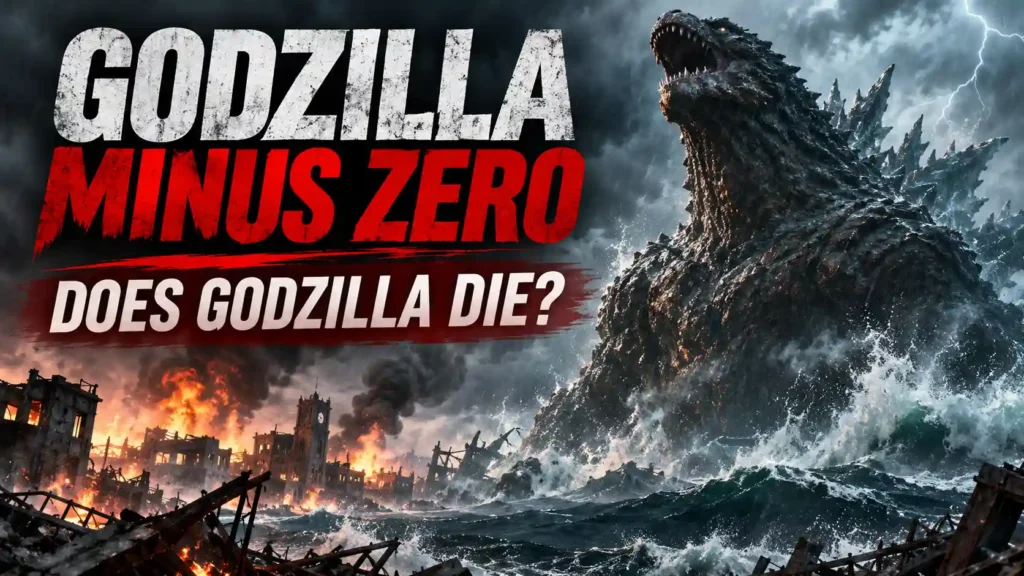

Does Godzilla Die in Godzilla Minus Zero: No: published ending analyses agree that Godzilla survives. This spoiler-heavy guide explains the Ghidorah battle, Noriko’s G-cells, the human characters’ choices, and what the ending does and does not confirm about future films.
Spoiler warning: This article discusses the ending and character fates in detail.
Does Godzilla Die in Godzilla Minus Zero? The Verified Answer
No. The ending explained reports consulted for this article agree that Godzilla survives the events of Godzilla Minus Zero. That answer is important because the film includes a large, destructive confrontation, and a viewer could reasonably mistake temporary defeat or apparent physical damage for permanent death. The reporting does not support describing Godzilla as killed off at the conclusion.
The HoloFiles and SlashFilm both provide detailed spoiler analyses of the final confrontation and its aftermath. Their accounts describe a fight involving Godzilla and Ghidorah, followed by events that leave Godzilla alive. The continued existence of the monster is distinct from the question of whether a further film has officially been approved. A surviving fictional character does not by itself establish a sequel order or release date.
The ending's significance also goes beyond whether the creature stops moving. The human story concerns Kōichi Shikishima, Noriko, and Akiko, whose experience of survival is connected to the violence inflicted on postwar Japan. A good ending explanation should therefore separate the monster's physical outcome from the moral and emotional outcome for the family.
Readers who only want the direct answer can stop here: Godzilla does not die, according to the verified published plot breakdowns. Everything below discusses the battle, Ghidorah, Noriko's condition, and the family's final decision in detail.
What Happens in the Final Godzilla vs. Ghidorah Battle?
The final conflict brings Godzilla into a direct confrontation with Ghidorah, the other giant creature threatening Japan in the sequel. According to The HoloFiles, Ghidorah's changing powers are central to the battle. The creature begins with an unusual form and develops into a more recognizable multiheaded opponent after an unsuccessful attempt to stop it.
The human characters attempt to exploit the creatures' opposition. Instead of relying entirely on conventional weapons, their plan involves attracting the monsters to the same location and allowing the conflict between them to create an opportunity. That approach is consistent with the movie's larger interest in the limits of military solutions and the hazards of treating living threats as instruments.
The published breakdown describes severe injuries during the fight, followed by regeneration and a decisive exchange of destructive energy. Godzilla ultimately defeats Ghidorah. That should not be confused with humanity eliminating Godzilla. The immediate monstrous opponent is removed, while the danger associated with Godzilla continues to exist.
There is a temptation in short viral summaries to reduce the climax to 'Godzilla wins.' That would omit the cost of the battle and the consequences for the humans who helped bring it about. The film's conclusion carries more moral ambiguity than a straightforward victory celebration, especially given what different characters want to do with the surviving creature.
Who Is Ghidorah and Why Does Its Origin Matter?
Ghidorah is a long-established character within the Godzilla franchise, although individual versions of the creature differ across continuities. This film introduces its own explanation of the monster's development. The HoloFiles describes an unusual substance arriving in Japan and interacting with nearby creatures, leading researchers to investigate the new entity.
That information is important because viewers should not automatically import every detail from earlier films into this continuity. A familiar monster name does not guarantee an identical origin, motivation, power set, or final fate. Godzilla stories have frequently reinterpreted their creatures according to the creative needs of a particular era.
Within the sequel, Ghidorah's changing physical form is part of the dramatic escalation. The monster's capacity to acquire new properties makes it difficult for scientists and planners to understand the threat with ordinary assumptions. A solution that seems to work at first can instead leave the enemy more dangerous. This is an established feature of the published plot analysis rather than a speculative prediction.
The broader theme is a familiar one in disaster cinema: humans mistake partial control for complete understanding. The characters' scientific and tactical decisions therefore contribute to the story, rather than merely providing a pause between monster battles. Whether this complexity works dramatically is a matter for critics, but the sequence of events should be accurately explained.
How Does Godzilla Return After Godzilla Minus One?
Godzilla Minus One concluded with implications that the monster's destruction was not necessarily permanent. The new movie builds on that unresolved threat instead of beginning an unrelated storyline. Official trailer coverage indicates that Godzilla was not fully destroyed, and the sequel's plot returns to Japan as the country tries to rebuild.
The HoloFiles describes Godzilla regenerating and reappearing in connection with the developing Ghidorah crisis. The exact mechanism linking those events is not fully explained in the report, so it would be misleading to assert a scientifically precise cause. The film presents a fictional creature with regenerative capabilities, not a real-world biological phenomenon that can be verified outside the story.
This distinction matters whenever plot explanations begin using technical-sounding language. G-cells are a narrative concept within the movie. They have an important role in the fate of Noriko and the strategy involving Godzilla, but they should not be described as an actual medical or genetics discovery.
The returning creature also reinforces the sequel's thematic structure. Japan has experienced war and devastation and is still vulnerable to another catastrophe. Godzilla's reappearance does not erase the previous film's characters or conflicts; it returns them to a society that has barely regained stability.
Noriko and the G-Cells: What Is Explained?
Noriko's survival after the earlier film has been a major narrative question. The ending reports say the sequel explains her resilience through exposure to Godzilla-associated cells. These fictional G-cells create unusual biological effects and become a reason certain characters wish to control or study her.
The HoloFiles reports that the cells also enable a device to attract Godzilla, turning Noriko into a crucial part of a dangerous strategy. That is not a harmless technical plot point. It creates a conflict between a community's desire for safety and one person's right not to be treated merely as a tool.
A simplistic interpretation might say that Noriko has become 'another monster' or that her status guarantees a specific transformation. The sourced account does not justify such a definitive claim about her future. The film establishes the danger surrounding the cells and their exploitation, but an announced follow-up is not required to understand the ethical issue in the ending.
The family consequences are central. Kōichi's reaction is shaped not just by another battle but by the possibility that officials or researchers might use Noriko against her wishes. The ending therefore connects the giant-monster spectacle with a more intimate fear: what happens when surviving an extraordinary event makes a person valuable to powerful institutions.
The Human Plan: Why Do They Bring the Monsters Together?
Humanity's strategy in the final act involves manipulating the creatures' movements so that they confront each other. This is an attempt to use the monsters' destructive capacities against one another because direct methods have proved insufficient. Published breakdowns describe a chain of tactical decisions and unexpected reversals as the plan unfolds.
One crucial feature of such a strategy is uncertainty. No human planner can perfectly control creatures with powers beyond ordinary experience. Any plan that depends on one monster disabling another risks failure if either evolves, escapes, or reacts differently than expected. The movie uses that uncertainty to generate danger for the central characters.
The strategy also introduces a moral problem. Treating Godzilla as a weapon, even temporarily, can save lives in one circumstance while creating an opportunity for future abuse. That tension becomes more explicit in the plot involving Professor Murakami and Noriko's G-cells. The question is not simply whether a clever tactic works, but who controls the technology afterward.
The eventual battle results should therefore be read in two layers. On the immediate level, a threat is defeated and catastrophe is limited. On the longer level, the existence of a powerful surviving creature and technology that can attract it creates a problem that the ending cannot cleanly erase.
Professor Murakami: What Was His Plan?
The ending coverage describes Professor Murakami as motivated by personal grief connected to the Hiroshima bombing. His anger influences how he thinks the technology involving Noriko and Godzilla could be used. The film thus brings the memory of wartime destruction into a fictional debate over future retaliation and control.
The HoloFiles says Murakami considers using the creature as a weapon against the United States. This development should be stated in the proper context of the film's fictional story and the character's motivation, not treated as a general claim about Japanese history or public opinion.
The character ultimately confronts the consequences of weaponizing such power. The published account indicates that an earlier conversation with Noda helps change his perspective and that he destroys his research. That choice represents a rejection of revenge as a solution to grief, even though the danger created by the research cannot simply be forgotten.
The story links personal loss to ethical responsibility. A character can have understandable pain without making every planned action defensible. This distinction is valuable when interpreting the ending: the film offers a fictional exploration of the consequences of catastrophic violence rather than a simple statement that one country or group is uniquely virtuous or guilty.
Does the Ending Set Up a Third Movie?
The fact that Godzilla survives leaves future storytelling possibilities. It does not establish that Godzilla Minus Zero has an officially announced direct sequel. An ending can remain open because the creature represents a continuing threat, not because a specific script, release date, or cast has been locked in.
The sources reviewed here include no official announcement of a third entry connected specifically to the plot events described. Commentators may reasonably predict a continuation, but a prediction must be marked as such. A film's box office performance and audience reception can influence studio strategy, yet those circumstances do not authorize a headline claiming that a future film is confirmed.
There is also a separate question about the human characters. Their final choices create possibilities for later stories, but those possibilities should not be confused with promises that every actor will return. Readers seeking concrete franchise news should rely on Toho or the named distributor rather than fan speculation.
A responsible ending analysis can explain what remains unresolved and why that ambiguity matters. It should not use unsupported release rumors as a shortcut to higher search traffic. The most defensible statement is that Godzilla survives and the narrative retains room for further exploration if the filmmakers choose to continue it.
What Happens to Kōichi, Noriko, and Akiko?
After the monster conflict, the film returns to the Shikishima family. The HoloFiles describes Kōichi and Noriko worrying that Noriko's condition may make her a target for authorities seeking to exploit the G-cells. That concern pushes them toward a painful decision about how to protect Akiko.
In the reported ending, the adults initially consider leaving Akiko behind at an orphanage so she will not have to share the danger of their life on the run. The emotional impact depends on a conflict between two understandings of protection: keeping a child physically safe at a distance, or preserving the family unit despite uncertainty.
The family's final decision is to remain together. This conclusion is especially meaningful because the earlier story also emphasized the importance of choosing life and forming bonds after devastation. The characters are not guaranteed a perfectly secure future, but they choose one another rather than accepting separation as inevitable.
Reducing the final scene to a sequel tease would miss that emotional resolution. The monster survives, institutions remain interested in dangerous power, and the future is uncertain. Nonetheless, the family's immediate choice provides a form of closure that is independent of whether another film is produced.
Why Some Audiences Interpret the Ending Differently
Viewers approach the conclusion from different priorities. A fan mainly interested in kaiju combat may focus on who wins the climactic battle and which monster remains alive. A viewer invested in the previous film's characters may care more about whether the family survives and stays together.
Both interpretations can coexist, but they answer different questions. Saying Godzilla survives does not mean the story ends without resolution. Saying the family achieves emotional closure does not mean every danger has been eliminated. The film uses those two outcomes together, leaving a dangerous wider world around a chosen human relationship.
Critics also disagree about whether the sequel balances its themes as effectively as Godzilla Minus One. Rotten Tomatoes' early roundup includes praise for the spectacle and commentary about the human plot being less cohesive. Those are attributed evaluations, not facts that can be established by a simple event recap.
An accurate explanation therefore begins with the chain of events and then identifies the interpretation as commentary. Readers should be able to distinguish what happens onscreen according to published plot analyses from what the editor believes the ending communicates.
How the 1949 Setting Changes the Meaning
Film at Lincoln Center and the BFI identify the story as taking place in postwar Japan around 1949. That setting places reconstruction, trauma, and fear of further destruction near the center of the drama. A modern monster battle would carry different social assumptions than one unfolding among people whose country is still recovering from war.
The sequel's conflicts are fictional, but the historical period is real. The movie uses that backdrop to explore questions about responsibility, militarization, family obligations, and the temptation to seek security through destructive technology. Discussions should respect that boundary and avoid treating invented events in the script as documented history.
The context also helps explain the discomfort surrounding the attempted use of Godzilla as a weapon. A creature that has devastated a city can become attractive to characters who imagine controlling it against an enemy, even though its power has already demonstrated the dangers of such thinking.
Whether viewers agree with every dramatic choice, the ending connects private survival with collective decisions. It asks the audience to consider who pays the price when scientific discovery and wartime grievance become instruments of renewed violence.
Godzilla Minus Zero Ending vs. a Post-Credits Scene
The ending itself contains the substantive resolutions: the battle, the surviving creature, the consequences for the research surrounding G-cells, and the family's decision. A separate credits scene is not necessary to explain those events.
Reports about the credits are contradictory in a limited way. SlashFilm and The HoloFiles say there is no conventional post-credits scene, while Just Jared reports an audio-only Godzilla roar and footsteps. An audio cue does not overwrite the events discussed in the feature's final scenes.
Readers who seek the phrase 'ending explained' often want more than a yes-or-no credits answer. This article provides plot details and interpretation; a standalone post-credits article should remain spoiler-light and focus on whether viewers need to stay in their seats. That editorial separation is useful even when the pages link to one another.
For anyone deciding whether to watch, it is worth avoiding the spoiler sections entirely. The film's official synopsis is intentionally broad, while detailed recaps disclose surprises. A responsible article places a warning before character outcomes rather than using those outcomes as unannounced social-media clickbait.
Our Fact-Checking Standard for Plot Explanations
This article relies on published ending breakdowns from The HoloFiles and SlashFilm and verified production listings from Toho, GKIDS, and festival organizers. We do not claim the writer attended a screening. Where the sources agree on a major event, we summarize the event; where they differ or leave a mechanism unexplained, we avoid inventing missing details.
Plot explanations can go wrong when editors treat a character's theory as the film's confirmed reality, apply rules from an older continuity to a new film, or confuse a marketing teaser with the finished narrative. We have deliberately separated those categories. Fictional biology, political intentions, and sequel possibilities are described with the qualifications they require.
This approach also helps readers using AI-powered search tools. Specific, directly answered questions with named sources are easier to quote accurately than sweeping claims without evidence. No website can compel a search engine or AI assistant to cite it, but transparent attribution and precise wording improve the quality of information available to readers.
If subsequent authoritative material clarifies an ambiguity, the article should be updated with a dated editorial note. Accuracy matters more than maintaining a dramatic headline that a reader cannot verify.
What the Ending Reveals About Sacrifice
The movie's final conflict involves decisions that place ordinary human beings close to forces far beyond their control. Published plot breakdowns describe both the deaths that occur during the effort to stop the monsters and the decisions survivors must make afterward. This gives the ending a moral dimension beyond the winner of a creature battle.
Sacrifice is a recurring theme in stories about war and disaster, but the concept can be handled in different ways. A story may celebrate people who accept danger for others, while also questioning institutions that expect individuals to make unlimited sacrifices. The choices around Noriko and the use of G-cells encourage precisely that kind of tension.
The final family decision also reframes the idea of duty. Protecting a loved one does not always mean withdrawing from them; it may mean enduring uncertainty together. That is an interpretation grounded in the described ending, not a claim that a filmmaker has publicly endorsed a single exclusive reading.
Why the Monster’s Survival Is Not a Human Defeat
If the question is reduced to 'does Godzilla die,' the answer can make the climax sound like a failure for the humans. But storytelling goals are more complex than the elimination of every fictional threat. Survival of the central family, the destruction of a rival danger, and the rejection of weaponizing a living creature can all function as meaningful outcomes.
The film's characters cannot undo the earlier war or guarantee that no future disaster will occur. A conclusion that acknowledges uncertainty may be more thematically appropriate than a perfectly secure new beginning. That is an editorial interpretation, not a plot fact, and readers may reasonably disagree about whether the balance is satisfying.
Godzilla remains dangerous precisely because the creature is more than an enemy that can be neatly defeated in one action scene. The script can use that continued existence to preserve tension without confirming anything about a next installment. Treating the ending as narratively open is different from announcing a third film.
Questions the Ending Leaves Open
The published ending descriptions leave viewers with uncertainty about the family’s future and the wider consequences of research into G-cells. Neither an uncertain future nor an unresolved institutional problem should automatically be called a continuity error. Stories often close one emotional conflict while leaving a broader world in motion.
What becomes of the people with knowledge of the research? How will surviving authorities respond to the monster's continued existence? Can a family remain safe when one member has attracted attention because of her condition? These are fair interpretive questions, not verified plots for a sequel.
Readers should be wary of explanations that answer all these questions with invented off-screen events. Unless a movie, official supplementary material, or reliable filmmaker interview actually supplies an answer, the correct editorial language is that the issue remains unresolved in the available account.
How to Separate Plot Facts from Fan Theories
A plot fact can be stated as an event described in the finished film by credible observers: a character takes an action, a confrontation occurs, or a family makes a decision. A theory goes further, proposing reasons or future consequences that may not be established. Both can be interesting, but readers deserve to know which is which.
For example, saying that Godzilla survives is supported by the published ending breakdowns. Predicting a named title, a year, or a particular story for a future installment is not supported by that survival alone. Similarly, the film's fictional cell-based technology creates possibilities without proving that a specific transformation will happen later.
An explanation that identifies these boundaries is better suited to reference searches than a dramatic recap presenting every interpretation as confirmed. Its value lies in making a complicated ending understandable without manufacturing certainty.
A Note About Spoilers and Cultural Context
Godzilla's place in Japanese filmmaking reaches far beyond a simple contest between monsters. Different productions have used the character to explore trauma, disaster, technological power and collective fear. The 2026 sequel continues a story placed in the aftermath of World War II, so some viewers will interpret its ending through those broader traditions.
A respectful analysis should avoid collapsing real historical suffering into a fictional plot device or presenting the movie’s invented institutions as archival history. It should distinguish the story's setting from the documented history of Japan, while acknowledging why wartime memory matters to the dramatic themes.
The ending can be meaningful both as an entertaining creature spectacle and as an invitation to think about survival, power and responsibility. Those reactions are not mutually exclusive, and neither requires claiming that the movie literally predicts real-world events.
Frequently Asked Questions
Does Godzilla die in Godzilla Minus Zero?
No. Published ending explainers from The HoloFiles and SlashFilm describe Godzilla surviving the final conflict.
Who wins Godzilla versus Ghidorah?
According to the detailed ending coverage, Godzilla ultimately defeats Ghidorah after a prolonged and destructive battle.
Does Ghidorah die?
The HoloFiles describes Ghidorah being destroyed in the final confrontation. This is a movie plot outcome, not a statement about other Godzilla continuities.
Does Noriko survive?
Yes. She remains part of the concluding family storyline, although her fictional G-cell condition creates continuing danger.
What are G-cells?
G-cells are a fictional story element associated with Godzilla. The film uses them to explain Noriko’s unusual survival and the attempt to attract the creature.
Does Kōichi survive?
The ending reports describe Kōichi alive and making a final decision with Noriko concerning their family.
What happens to Akiko?
After considering separation, the family chooses to stay together, according to The HoloFiles.
Is there a third Godzilla movie confirmed?
Godzilla’s survival creates narrative possibilities, but it is not proof of an officially announced third movie.
Does the movie end on a cliffhanger?
It leaves an ongoing monster threat while giving the central family a meaningful decision. Whether that feels like a cliffhanger is partly interpretive.
Why does Ghidorah change form?
The film’s plot describes Ghidorah gaining new physical properties as the humans attempt to stop it. See the detailed sourced recap for the sequence.
Who is Professor Murakami?
He is a character linked to research and a revenge-driven plan involving Godzilla’s power; the film connects his motivation to personal loss.
What happens to Noda?
The HoloFiles reports that Noda dies during the final battle while working on the plan to defeat the monsters.
Does the film take place in 1949?
Yes. Both Film at Lincoln Center and BFI identify the postwar setting around 1949.
Is Godzilla Minus Zero a direct sequel?
Yes. It continues the continuity and human story of Godzilla Minus One.
Is there a post-credits scene?
The HoloFiles and SlashFilm report no conventional extra scene. Just Jared reports possible audio-only footsteps and a roar after the credits.
Is the film in English?
The original presentation is Japanese. Official festival and theater screenings specify English subtitles.
Can I read the ending without seeing the movie?
A written recap can explain the events, but it cannot fully convey pacing, performance, editing, and sound. The article identifies major spoilers so readers can choose.
What does the last family choice mean?
It can be read as a decision to preserve family bonds despite uncertainty, rather than abandoning one another solely because of danger.
Sources and fact-checking
Reporting cutoff: November 6, 2026. This is researched editorial coverage based on the linked sources; no first-hand screening or interview is claimed. Reports that conflict are identified as such.


Pingback: Godzilla Minus Zero End Credits: 1 Surprising Sound