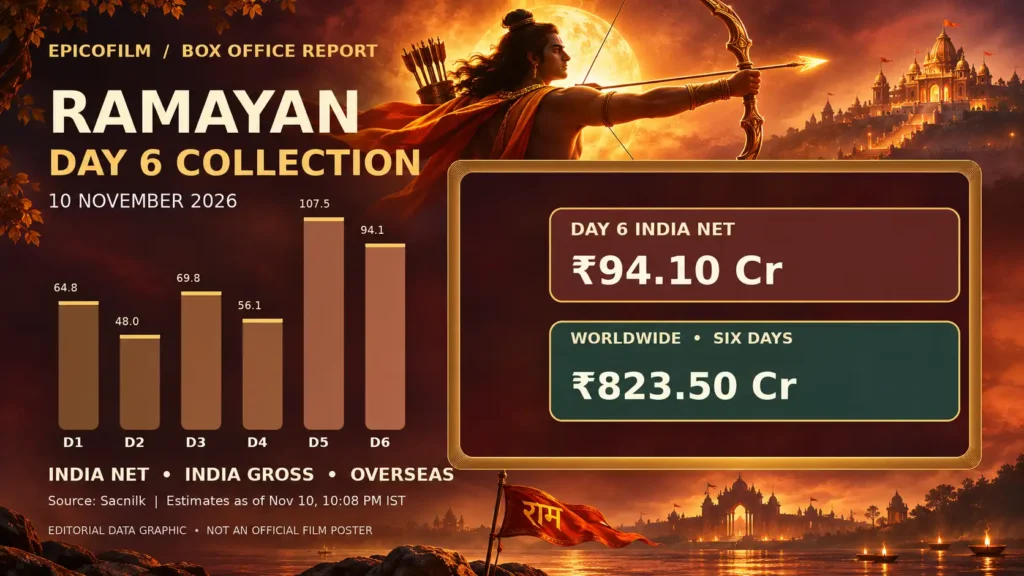

Last updated: November 11, 2026, 10:00 AM IST. Reporting basis: Sacnilk’s November 10, 10:08 PM IST Day 6 estimate, cross-checked against NDTV, India Today and The Times of India. Overseas estimates are provisional. This is an independently researched box-office report, not a producer-certified audit.
Ramayan Day 6 Collection: Nitesh Tiwari’s Ramayana: Part One, promoted internationally as Ramayana: Rise of a Legend, reportedly earned ₹94.10 crore India net on Tuesday, November 10, 2026, its sixth day in cinemas. The figure covers the Hindi, Kannada, Telugu, Tamil and Malayalam versions. According to Sacnilk’s late-night estimate, that takes the film to ₹440.45 crore India net, ₹526.50 crore India gross and ₹823.50 crore worldwide gross in six days. Its reported overseas component is ₹297 crore, a rough estimate that may change.
The headline number is remarkable, but a useful box-office article must explain what it measures. ₹94.10 crore is the estimated net earnings from Indian theaters on Day 6, not the film’s worldwide Day 6 revenue. Sacnilk reports ₹112.60 crore India gross on Day 6 and ₹35 crore overseas gross on that day. Adding those two reported gross amounts gives an indicative ₹147.60 crore Day 6 worldwide gross, subject to the same provisional overseas-data caveat. The six-day worldwide cumulative figure is a different number: ₹823.50 crore. Mixing these amounts would mislead readers.
For readers asking “ramayan collection day 6,” “ramayan day 6,” “ramayana movie collection day 6” or “Ramayana day 6 box office collection worldwide,” the answer is therefore straightforward: ₹94.10 crore India net on Day 6; ₹823.50 crore estimated worldwide gross after six days, based on Sacnilk’s November 10 snapshot. Below, we examine the day-wise trend, the impact of the unusually large Monday, language-market performance, occupancy, competing tracker figures, global earnings and what can—and cannot—be concluded from six days of receipts.Table of Contents
- Ramayan Day 6 Collection: India, Overseas and Worldwide Numbers
- Ramayana Movie Collection Day 6: Complete Day-Wise India Table
- Hindi, Kannada, Telugu, Tamil and Malayalam: Day 6 by Language
- Ramayan Collection Day 6 Worldwide: How ₹823.50 Crore Is Calculated
- Why Bollywood Hungama and Sacnilk Display Different Figures
- Occupancy and Show Count: What Tuesday’s Theater Traffic Suggests
- Diwali, Tuesday Demand and the Unusual Week-One Pattern
- Can Ramayana Reach ₹1,000 Crore Worldwide?
- Does the ₹823.50 Crore Box Office Mean Ramayana Is Profitable?
- What the First Six Days Tell Us—and What They Do Not
- Editorial Verdict on the Ramayan Day 6 Collection
- Frequently Asked Questions About Ramayana Day 6 Box Office Collection
- Sources and Reporting Methodology
Ramayan Day 6 Collection: India, Overseas and Worldwide Numbers
| Measure | Day 6 (Tue, Nov 10) | Cumulative after six days |
|---|---|---|
| India net | ₹94.10 Cr | ₹440.45 Cr |
| India gross | ₹112.60 Cr | ₹526.50 Cr |
| Overseas gross | ₹35.00 Cr (rough estimate) | ₹297.00 Cr (rough estimate) |
| Worldwide gross | ₹147.60 Cr (derived from reported components) | ₹823.50 Cr |
Source and status: Sacnilk’s Day 6 late-night box-office report. The derived worldwide Day 6 amount is a mathematical combination of its reported India-gross and overseas-gross estimates; it is not a separately confirmed distributor figure. All currency amounts here are Indian rupees in crores unless otherwise stated. The overseas component is particularly subject to revision. The above worldwide arithmetic is ₹526.50 Cr + ₹297.00 Cr = ₹823.50 Cr for six days, and ₹112.60 Cr + ₹35.00 Cr = ₹147.60 Cr for Day 6 alone.
What is new in the November 11 update?
The latest change is the publication of Tuesday’s estimated full-day tally. During November 10, trades shared running figures, including afternoon updates, projections and evening estimates. Some appeared smaller because the reporting window had not ended. Sacnilk’s 10:08 PM snapshot puts the all-language India net at ₹94.10 crore. NDTV Profit and India Today subsequently repeated this figure, with attribution to Sacnilk, on November 11. Repeating a number across news organizations does not transform it into a producer-audited final, but it does show that the reported basis is widely identified.
The movie also passed two highly visible thresholds on that accounting basis: more than ₹400 crore cumulative India net and more than ₹800 crore worldwide gross in its first six days. Both claims need the words “reported” or “estimated.” A six-day total is not a lifetime total; final theatrical business will continue to evolve as ticket sales and overseas reporting are reconciled.
Ramayana Movie Collection Day 6: Complete Day-Wise India Table
| Day | Date | India net | India gross | Net change versus previous day | Reported occupancy |
|---|---|---|---|---|---|
| Day 1 | Thu, Nov 5 | ₹64.85 Cr | ₹77.50 Cr | — | 36.0% |
| Day 2 | Fri, Nov 6 | ₹48.05 Cr | ₹57.30 Cr | −25.9% | 28.9% |
| Day 3 | Sat, Nov 7 | ₹69.80 Cr | ₹83.45 Cr | +45.3% | 41.3% |
| Day 4 | Sun, Nov 8 | ₹56.15 Cr | ₹66.95 Cr | −19.6% | 38.0% |
| Day 5 | Mon, Nov 9 | ₹107.50 Cr | ₹128.70 Cr | +91.5% | 64.9% |
| Day 6 | Tue, Nov 10 | ₹94.10 Cr | ₹112.60 Cr | −12.5% | 55.3% |
| Total | Six days | ₹440.45 Cr | ₹526.50 Cr | — | — |
Source: Sacnilk’s all-language tracker, figures as reported November 10. The occupancy percentage is a show-weighted measure and is not a direct estimate of nationwide population reach.
This series is unusually volatile for a conventional Thursday-to-Tuesday run. Friday fell versus the opening Thursday; Saturday recovered; Sunday eased; then Monday surged to the largest reported single-day net so far. Tuesday declined from that exceptional Monday but stayed above each of the film’s first four days. Therefore, saying “Ramayana crashed on Tuesday” would be an inaccurate interpretation of the same data. Conversely, saying Tuesday proved unstoppable growth would also ignore the 12.5% sequential drop.
Day 1: The opening establishes the scale
Sacnilk put the opening Thursday at ₹64.85 crore India net and ₹77.50 crore India gross. For a sprawling event release, this set an initial benchmark across multiple languages. Opening-day results depend on the number of shows, ticket prices, advance booking, local competition and whether a market’s most popular format is available. They should not be compared with another movie’s opening without aligning India net versus gross and the number of reporting languages.
The Hindi-language version was the largest opening contributor, according to the tracker, but dubbed-language screenings were already meaningful. That distinction matters because a nominally Hindi-language national release can have very different demand patterns by state. Local theatrical presentation and language preference influence which version gets the most showtimes and the most money per show.
Day 2: A decline does not decide the run
Friday’s estimated ₹48.05 crore India net was approximately 25.9% below the opening Thursday. A decline on its own is a limited signal. The structure of an event release can concentrate advance demand into the first evening or first morning, and later days may reflect different ticket-pricing or holiday patterns. It is safer to ask whether the fall continues through the weekend rather than decide a film’s future from a single daily percentage.
In this case, it did not continue into Saturday. The same tracker reports a meaningful rebound on Day 3, which changes the interpretation of Friday. A reliable daily report should preserve those sequential dates instead of presenting whichever day looks most favorable.
Day 3: Saturday’s rebound
Saturday’s India net was ₹69.80 crore, up about 45.3% from Friday. That rise indicated more theater traffic in the Saturday frame. A weekend rebound can reflect free time, stronger evening attendance, word of mouth and show allocation, although the figures themselves do not prove which cause was dominant. Commentators often attribute strong numbers to positive reviews, but proving a causal relationship would require more evidence than collections alone.
Saturday was higher than opening Thursday on this reported data. It gave the film a more robust opening period than Friday’s drop might have suggested. For readers tracking daily box-office charts, this is a useful reminder to compare multiple days rather than treat a single low point as a trend.
Day 4: Sunday softens despite festival interest
Sunday’s ₹56.15 crore net was down 19.6% from Saturday. The broader Diwali period shaped moviegoing and public discussion, but holiday availability and different regional observances can alter the audience mix from one day to another. A Sunday decrease is worth reporting accurately without automatically calling it weak. The cumulative total kept rising, and the next day’s movement was much larger than a conventional Monday pattern.
The Sunday number also underscores why week-one forecasting is challenging. Treating the weekend as the whole story would miss the extraordinary Monday spike. A complete six-day article should therefore emphasize the actual dates alongside the informal “weekend” label.
Day 5: An extraordinary Monday jump
Sacnilk reported ₹107.50 crore India net for Monday, November 9, a 91.5% increase from Sunday’s ₹56.15 crore. The corresponding India gross was ₹128.70 crore. This is the basis for headlines describing Monday as the film’s largest reported single-day performance to that point. The festival period, special pricing and holiday moviegoing were cited by contemporary reporting as relevant context. These are plausible contributors, not individually quantified by the available ledger.
Monday’s unusually high starting point is essential to understanding Tuesday. A 12.5% drop from a very large previous day can still leave a very strong absolute number. The reader should look at both the rupee amount and the percentage change. Articles that highlight only one can create an exaggerated impression.
Day 6: ₹94.10 crore after the Monday peak
On Tuesday, November 10, Sacnilk reported ₹94.10 crore India net. That is ₹13.40 crore below Monday’s ₹107.50 crore, a decline of approximately 12.5%. It remains ₹29.25 crore higher than opening Thursday and ₹24.30 crore higher than Saturday. Those comparisons show why Tuesday’s volume is noteworthy even without repeating Monday’s exceptional record.
The report lists 24,344 screenings and average occupancy of 55.3% across the tracked show network. This is a substantial number of showtimes, but occupancy should be handled carefully: it summarizes ticket usage across tracked screenings, not a national census of every seat. Different theater chains, time slots and price tiers can have different levels of demand. A full-day figure also includes variations between morning, afternoon, evening and night schedules.
Hindi, Kannada, Telugu, Tamil and Malayalam: Day 6 by Language
| Language version | Day 6 India net | Reported shows | Occupancy | Share of Day 6 India net |
|---|---|---|---|---|
| Hindi | ₹76.00 Cr | 19,845 | 54.6% | 80.8% |
| Kannada | ₹7.75 Cr | 931 | 80.7% | 8.2% |
| Telugu | ₹4.00 Cr | 1,860 | 32.8% | 4.3% |
| Tamil | ₹3.60 Cr | 859 | 76.8% | 3.8% |
| Malayalam | ₹2.75 Cr | 849 | 71.0% | 2.9% |
| Total | ₹94.10 Cr | 24,344 | 55.3% overall | 100% |
The main point is simple: Hindi accounted for just over four-fifths of the day’s India net. But the smaller-language markets still contributed a combined ₹18.10 crore. Kannada generated ₹7.75 crore from a notably smaller number of reported shows than Hindi; that gives it a different demand profile. It would be misleading to conclude that Kannada is necessarily the “bigger market,” however, because a per-show comparison depends on seat capacity, pricing and which venues are included.
Occupancy alone is not revenue. A 75% full auditorium with lower ticket prices might generate less money than a 55% full premium auditorium. Likewise, a language version with fewer screens may have high occupancy because demand has been concentrated into a smaller schedule. These facts help explain why ticket-sales reporting should present gross receipts, show counts and occupancy separately.
Hindi’s role in the six-day result
The Hindi version’s cumulative India net was ₹336.00 crore after six days in Sacnilk’s language breakdown, representing about 76.3% of all-language net revenue. Tuesday’s higher Hindi share, around 80.8%, suggests that the language mix on the day was somewhat more Hindi-weighted than the six-day average. That is a descriptive observation; it does not prove a permanent shift in future demand.
This is an example of analysis that adds value beyond copying a chart. The size of a language market affects overall daily results. If Hindi stays strong while smaller versions soften, the headline total may remain high; if the larger market weakens, even excellent occupancy in a smaller language may not offset it. The numbers should be updated rather than extrapolated into promises about week-two collections.
Southern-language contributions
Sacnilk lists six-day India net totals of ₹41.20 crore for Kannada, ₹33.00 crore for Telugu, ₹17.35 crore for Tamil and ₹12.90 crore for Malayalam. Together those four versions account for ₹104.45 crore of the six-day India net in the tracker. These are not equal-sized distribution markets, and the amount of screen space assigned to each varies considerably.
A useful coverage strategy is to describe them separately without claiming a statewide breakdown from national language receipts. Kannada-language box-office receipts are not identical to box office earned in Karnataka; Hindi-language screenings also take place in Karnataka, and dubbed versions can play outside the state most closely associated with the language. A language-wise number and a state-wise number answer different questions.
Ramayan Collection Day 6 Worldwide: How ₹823.50 Crore Is Calculated
Worldwide box-office headlines commonly combine different reporting concepts. The India net number excludes certain taxes from domestic ticket receipts. India gross includes the full reported theatrical gross before that deduction. Overseas gross covers international theatrical receipts outside India. Worldwide gross is the sum of India gross and overseas gross, not India net plus overseas gross. For the cited Sacnilk six-day estimate: ₹526.50 crore India gross + ₹297.00 crore overseas gross = ₹823.50 crore worldwide gross.
The ₹823.50 crore worldwide milestone does not mean the producer has received ₹823.50 crore in profit, or that the film has already recovered its entire production and marketing budget. Revenue is shared with exhibitors and distributors; taxes, fees, marketing, production, financing and contracted terms affect ultimate profitability. Public reporting of a box-office gross is not a complete cost-and-revenue audit.
The Day 6 overseas gross of ₹35 crore is marked by Sacnilk as a rough estimate. International markets can report on different schedules and may settle their final totals in foreign currencies before conversion to rupees. Exchange rates, reporting delays and revisions can move the worldwide cumulative total even after a local theatrical day has ended. Any story treating a late-night overseas estimate as immutable would be stronger as a headline than as journalism.
Why a worldwide Day 6 total is not the same as the six-day worldwide total
A frequent reader question is whether Ramayana earned ₹823.50 crore on Day 6. It did not, according to the cited data. That is the six-day cumulative worldwide gross. The estimated worldwide gross for the sixth calendar day alone, derived from Sacnilk’s stated components, is around ₹147.60 crore. One is a running total; the other is one day’s implied amount. The article title should distinguish the two rather than exploit the ambiguity for clicks.
Similarly, ₹440.45 crore is the six-day India net total, not the cumulative global gross and not the Day 6 India net. In a film with multiple regional versions and strong overseas business, using the wrong label can create discrepancies of hundreds of crores. Readers deserve the measure and the cutoff alongside every number.
Why Bollywood Hungama and Sacnilk Display Different Figures
Two sources can disagree even when both are covering the same film. Sacnilk’s November 10 late-night report lists Day 6 India net at ₹94.10 crore and cumulative net at ₹440.45 crore. Bollywood Hungama published an evening update at 9:29 PM on November 10 saying its tracked gross had reached ₹84.15 crore India net by 8:30 PM, with a projection in the ₹90–100 crore range for the end of the night. Its live tracker view also showed running figures rather than a fully reconciled closing result at some points.
These are not automatically two competing final totals. The reported times differ, and the trackers’ show coverage and estimation methods can differ as well. Bollywood Hungama’s website also listed differing numbers for earlier days, meaning one should not mix its Day 1 with Sacnilk’s Days 2–6 and present that sum as a consistent tally. For this article, we use a single named primary data series—Sacnilk—and present Bollywood Hungama’s numbers in a separate, clearly attributed comparison.
When two independently gathered box-office services eventually publish different finalized figures, the responsible approach is to show both with the measurement basis and reporting date. There is no universal independent auditor producing a legally certified same-day figure for every release in every market. Some platforms explicitly describe their numbers as estimates. Readers should be able to tell which number belongs to which tracker.
Day 6 tracker-status comparison
| Source | Figure | What it actually represents | Reporting context |
|---|---|---|---|
| Sacnilk | ₹94.10 Cr | Estimated full-day Day 6 India net | Nov 10, 10:08 PM IST snapshot |
| Bollywood Hungama | ₹84.15 Cr | Day 6 India net by 8:30 PM, not a final full-day total | Nov 10 evening news update |
| NDTV Profit | ₹94.10 Cr | Sacnilk-based Day 6 India net | Nov 11 morning report |
| India Today | ₹94.10 Cr | Sacnilk-based Day 6 India net | Nov 11 morning report |
The difference between two running snapshots should not be presented as evidence of misconduct or a scandal. Nor should it be “resolved” by averaging them. A live number recorded several hours before the final shows can naturally be lower. A reliable blog updates its attribution when a source updates, rather than silently overwriting the methodology.
Occupancy and Show Count: What Tuesday’s Theater Traffic Suggests
Sacnilk lists 24,344 tracked Day 6 shows, with weighted occupancy of 55.3%. The high absolute show count matters because theater revenue is partly a function of capacity. A film with wide distribution may collect a large total at moderate occupancy; a smaller film can sell out many screenings yet have a lower total because it occupies fewer auditoriums. Neither interpretation should be reduced to a single percentage.
The Monday-to-Tuesday occupancy movement is consistent with the lower Day 6 net total in the same tracker: Monday’s reported occupancy was 64.9%, Tuesday’s 55.3%. However, changing occupancy is only one factor. A different number of showtimes, an altered mix of premium and standard presentations, regional ticket prices and changes in the number of holiday moviegoers can also influence daily net receipts.
A further limitation is coverage. The source records theaters and schedules in its tracking network, not necessarily every individual ticket sold in all territories. Its own notes say box-office numbers are compiled from research and multiple inputs and may differ from producer statements. We therefore refer to the data as tracked and estimated, avoiding claims of absolute certainty.
Per-show earnings should be read carefully
A per-show figure can be a useful operational indicator, but its meaning depends on what is included in the numerator and denominator. Some reports quote a tracker-estimated average per show based on a subset of processed show data, while the full-day show count can be larger. Do not divide a figure from one definition by a denominator from another and call the result a verified theater yield.
Similarly, footfall estimates are not the same thing as admissions counted by a national government database. Estimated attendance can help interpret how many people may have gone to the cinema, but a blogger should not infer exact ticket price or profitability from broad ticket-sales and gross estimates unless the relevant assumptions are stated.
Diwali, Tuesday Demand and the Unusual Week-One Pattern
The movie’s first week falls within a period of major festivals and related celebrations. Contemporary box-office coverage connects the exceptionally strong Monday with Diwali-season attendance and discusses continued demand on Tuesday. It is reasonable to mention that seasonal context, but not to claim that a specific share of the reported ₹94.10 crore was caused by one holiday without supporting transaction-level research.
The weekday labels are particularly important here. A normal movie’s Monday may follow a Saturday–Sunday weekend with a predictable fall. In this run, Monday rose dramatically, so Tuesday’s decline is being measured against an unusually high comparison day. The fair editorial description is that Tuesday maintained substantial business after the Monday peak. It is neither proof of a collapse nor proof that every future weekday will be similar.
Long-term outcomes depend on what happens after the festival period, when discretionary moviegoing may normalize. It will be more informative to compare corresponding weekdays in the next week, track show retention and monitor whether weekend gains persist. Six days is enough to describe a strong opening period; it is not enough to reliably forecast a final lifetime global gross.
Can Ramayana Reach ₹1,000 Crore Worldwide?
At Sacnilk’s reported cumulative worldwide gross of ₹823.50 crore, the difference to a hypothetical ₹1,000 crore milestone is ₹176.50 crore. That is straightforward arithmetic, not a forecast. The film would need an additional ₹176.50 crore of reported gross to cross the threshold on the same accounting basis. Nothing in that calculation establishes when it will happen or whether future trackers will revise the current base upward or downward.
A tempting but weak method would be to take Tuesday’s derived worldwide gross and assume it repeats every day. That would turn a volatile holiday-period market into a mechanical projection. A better approach is to monitor the following Wednesday and Thursday, then compare the second weekend’s business with the first. We can discuss possible milestones without promising them or inventing a Day 7 figure.
The same caution applies to rankings such as “highest grossing film of the year” or “fastest film ever.” Rankings require a consistent methodology: India net versus worldwide gross, nominal versus inflation-adjusted amounts, language-specific versus all-language receipts and whether previews are included. Without those definitions, headline records may be impossible to compare. We have therefore not labeled the ₹823.50 crore figure an independently certified industry record.
Does the ₹823.50 Crore Box Office Mean Ramayana Is Profitable?
Not necessarily. Box-office revenue is not profit. The gross amount includes money collected at ticket counters across the world, while the producer’s realized share depends on theater rentals, distributor agreements, taxes, promotional expenses, financing and other arrangements. A film’s budget is also not always a single settled number, especially when publicity discusses the cost of a multi-part production rather than the accounting for one installment.
For these reasons, it is misleading to write that a film has “recovered its budget” solely because a worldwide gross headline exceeds an online budget estimate. Without reliable financial disclosures, an article can say the reported gross is large and that box-office momentum is strong. It cannot calculate definitive profit or loss. This distinction protects readers from an easy but inaccurate conclusion.
The same applies to streaming rights and brand partnerships. Such agreements may be financially important, but box-office trackers do not capture their full values. A theatrical collection article should stick to ticket revenue unless verified contract information is actually available and relevant.
What the First Six Days Tell Us—and What They Do Not
The strongest defensible conclusion is that Ramayana has registered large India theatrical receipts across several languages and substantial estimated overseas business in its first six days. Tuesday’s estimated ₹94.10 crore India net is a high absolute number even though it is 12.5% below Monday in the same series. The Hindi market dominates the all-language total, and the other regional versions add an important secondary contribution.
What we do not know from this snapshot is the exact final distributor share, audited profit, full overseas territory breakdown, second-week hold or eventual lifetime collection. We also cannot conclude from box-office receipts alone that every audience enjoyed the movie. Commercial demand and critical response are different measures, although strong attendance can be evidence that the film has attracted considerable attention.
This matters to readers who found the page through a search query rather than already following the entertainment trades. A good box-office update answers the immediate question first, provides the table, names the source and then explains why the daily trend matters. It should leave the reader better informed, not merely more impressed by a large number.
Editorial Verdict on the Ramayan Day 6 Collection
The November 10 reported result is a strong sixth-day performance, especially after the previous day’s extraordinary festival-period surge. On Sacnilk’s measure, the film earned ₹94.10 crore India net on Tuesday, raising its six-day India net to ₹440.45 crore and reported worldwide gross to ₹823.50 crore. Hindi receipts accounted for the largest share. Those are the central facts for this story.
For Epicofilm readers, the practical takeaway is that Day 6 is over, but the collection remains an estimate. Revisions to overseas receipts and later tracker reconciliations are possible. Readers should avoid confusing full-day with evening live updates, India net with gross or Day 6 single-day earnings with the six-day global cumulative total. We will describe new figures only when supported by dated source reports.
Frequently Asked Questions About Ramayana Day 6 Box Office Collection
1. What is the Ramayan Day 6 collection in India?
Sacnilk reported ₹94.10 crore India net on Tuesday, November 10, 2026, covering five language versions. This is a late-night trade estimate, not a producer-certified audited total.
2. What is Ramayana movie collection Day 6 worldwide?
Based on Sacnilk’s reported Day 6 components, India gross of ₹112.60 crore plus overseas gross of ₹35 crore implies around ₹147.60 crore worldwide gross for Day 6 alone. The overseas amount is a rough estimate. Do not confuse this with the six-day cumulative ₹823.50 crore.
3. How much did Ramayana collect worldwide in six days?
The reported six-day cumulative worldwide gross was ₹823.50 crore, made up of ₹526.50 crore India gross and ₹297 crore overseas gross in the Sacnilk snapshot.
4. What is the total India net collection after Day 6?
The total all-language India net was reported at ₹440.45 crore through November 10. Net and gross are different; the corresponding India gross estimate was ₹526.50 crore.
5. How much did the Hindi version earn on Day 6?
The Hindi version contributed ₹76 crore India net on Tuesday, according to Sacnilk. It represented about 80.8% of the day’s all-language India net.
6. What was the Kannada collection on Tuesday?
Sacnilk reported ₹7.75 crore Kannada-language India net for Day 6 across 931 shows. The published occupancy figure was 80.7% within its tracking sample.
7. What was the Telugu collection on Day 6?
The Telugu-language version was reported at ₹4.00 crore India net from 1,860 tracked shows. Its reported occupancy was 32.8%.
8. How much did the Tamil version collect on Day 6?
The Tamil version recorded an estimated ₹3.60 crore India net on November 10. Sacnilk listed 859 tracked shows and 76.8% occupancy.
9. How much did the Malayalam version collect on Day 6?
Sacnilk listed an estimated ₹2.75 crore India net, 849 shows and 71.0% occupancy for the Malayalam version. These are tracker figures rather than audited totals.
10. Did Ramayana cross ₹400 crore India net?
Yes, according to Sacnilk’s November 10 estimate. The six-day India net stood at ₹440.45 crore. Other trackers can use different estimates, so label the source clearly.
11. Did Ramayana cross ₹800 crore worldwide?
Sacnilk’s six-day worldwide gross estimate was ₹823.50 crore, which is above ₹800 crore. The overseas portion is rough and could be revised.
12. Was Day 6 lower than Day 5?
Yes. Tuesday’s ₹94.10 crore net was 12.5% below Monday’s ₹107.50 crore in the same Sacnilk series. The absolute Tuesday result nevertheless exceeded each of the first four days.
13. What was Ramayana’s biggest day in its first six days?
On the cited Sacnilk numbers, Monday, November 9, was the highest India-net day at ₹107.50 crore. Tuesday followed at ₹94.10 crore.
14. Why did Tuesday collection fall from Monday?
Tuesday was compared with an exceptionally high festival-period Monday. The lower receipts and reported occupancy establish a decline, but the public tracker does not isolate how much of it came from holiday patterns, pricing, schedules or other causes.
15. Is the ₹94.10 crore figure final?
No. It is a reported late-night estimate. Published collections can change as reporting improves or overseas territories settle. Always state the source and update time.
16. Why does Bollywood Hungama show another figure?
Bollywood Hungama reported ₹84.15 crore by 8:30 PM in its November 10 evening update, a different reporting window from Sacnilk’s later ₹94.10 crore estimate. Trackers may also use different data and methods. The figures should not be called two final results.
17. What is the difference between India net and India gross?
India net is a theatrical revenue measure after excluding relevant indirect taxes; India gross includes those ticket-revenue components. A worldwide gross calculation uses India gross plus overseas gross, not India net plus overseas gross.
18. How much did Ramayana earn overseas by Day 6?
Sacnilk’s cumulative overseas gross estimate was ₹297 crore, including approximately ₹35 crore reported for Day 6. The tracker expressly calls overseas figures rough estimates.
19. How many shows ran on Day 6?
Sacnilk listed 24,344 tracked shows on November 10 across the five versions. Different data services may record different networks, so do not assume a universally audited show count.
20. What was Ramayana’s Day 6 occupancy?
The tracker listed 55.3% overall weighted occupancy. This is not the same as saying 55.3% of the Indian population watched the film; it is a theater-screening measure.
21. Can Ramayana reach ₹1,000 crore worldwide?
It is mathematically ₹176.50 crore short of that threshold using Sacnilk’s six-day cumulative figure. Whether or when it reaches it cannot be established from six days alone; further confirmed collections are needed.
22. What is Ramayana Day 7 collection?
Day 7 is Wednesday, November 11, 2026. A full-day result cannot be known at the morning research cutoff of this article. Any live number should be timestamped and labeled provisional.
23. When was Ramayana: Part One released?
It opened theatrically on Thursday, November 5, 2026. Therefore Tuesday, November 10, is the sixth calendar day of its release, not the seventh.
24. Does ₹823.50 crore mean the producer has made that much profit?
No. Worldwide gross is ticket-revenue reporting, not net profit. Taxes, exhibitors, distributors, production expenses and other agreements must be considered before any profitability claim.
25. Where should readers verify the latest Ramayana collection?
Check the source’s original updated box-office tracker, including Sacnilk and Bollywood Hungama, and compare with dated reports from established publications. Prefer clearly labeled estimates and do not combine incompatible methodologies.
Sources and Reporting Methodology
The primary ledger in this article uses Sacnilk’s Day 6 box-office report, updated November 10, 2026, 10:08 PM IST, and its all-language film tracker. We cross-checked its key figures against NDTV Profit’s November 11 report, India Today’s November 11 report and The Times of India’s Day 6 report.
For tracker-context comparison, we consulted Bollywood Hungama’s November 10 evening update and its day-wise collection tracker. These are credited separately; their differing snapshots are not blended into the Sacnilk daily series.
For more on the film itself, read Epicofilm’s Ramayana: Rise of a Legend review. This contextual link is separate from the box-office source data.
Accuracy and reuse: Amounts in rupees are expressed in crores; all tables use a consistent source and time basis. Overseas estimates and cumulative box-office totals can change. This analysis does not imply access to private distributor accounting or claim to have independently verified every theater sale. Its purpose is to explain published trade estimates precisely rather than advertise an unverified record.
For the wider earnings picture, compare our Ramayana worldwide box-office tracker with the earlier Day 3 collection report. Each report uses a different reporting cutoff; compare like-for-like revenue measures and dates.