
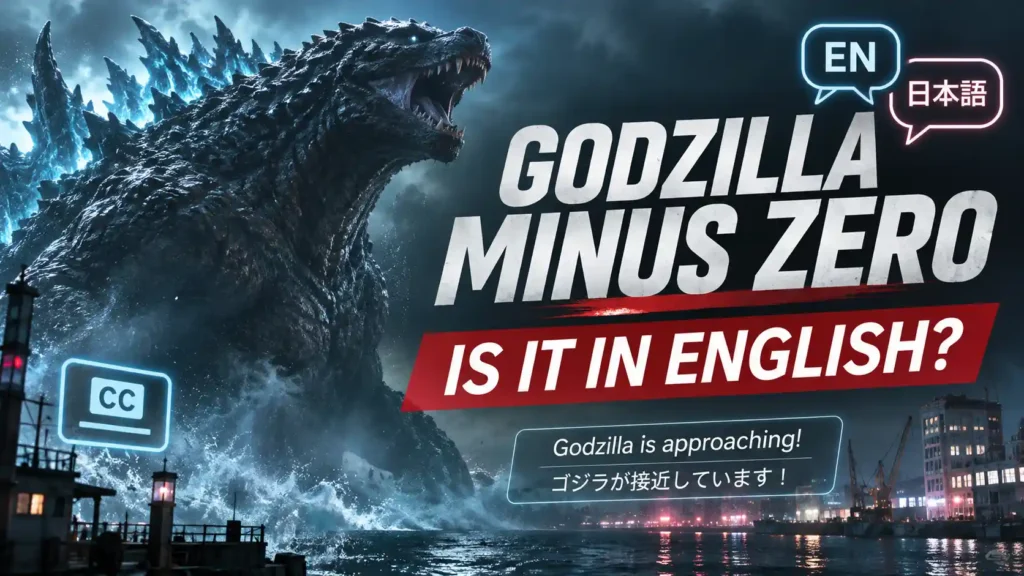

Godzilla Minus Zero Is It in English: Godzilla Minus Zero is originally in Japanese, and multiple official festival and American IMAX listings confirm English subtitles. An English-audio dub is not verified across US theaters in the sources checked; this guide explains how to select the correct screening.
Is Godzilla Minus Zero in English? Direct Answer
Godzilla Minus Zero is a Japanese-language film. The verified festival and theater listings consulted for this guide describe screenings in Japanese with English subtitles. Film at Lincoln Center and the BFI identify Japanese as the spoken language, and the Smithsonian's IMAX listing explicitly confirms Japanese audio with English subtitles.
That is different from saying the film is available with an English-language dub. An English dub replaces the original speech with English voice performances; subtitles display translated text while the actors continue speaking Japanese. The official listings cited here confirm subtitles, not a universal English-audio version for every market or screening.
For American audiences, this matters when choosing tickets. A movie may appear in an English-language theater directory even though the soundtrack is Japanese. The site's interface language, the language of its plot description, and the spoken language of the movie are separate pieces of information.
The responsible answer is therefore: expect Japanese dialogue with English subtitles in the verified theatrical screenings, and check your specific cinema if you are looking for English-dubbed audio. We have not found a confirmed nationwide English-dub rollout in the primary sources reviewed for this article.
Japanese Audio vs. English Subtitles vs. English Dub
Japanese audio with English subtitles preserves the original performances. Viewers hear the cast's speech, including vocal inflection, pace and emotional expression, while reading translated dialogue on screen. This is the format explicitly described by the official festival and American IMAX listings we checked.
An English dub would involve a separate voice recording track performed in English. It could help audiences who find subtitles difficult, but no particular English-dub voice cast or universal release arrangement should be invented. Even if individual theaters later announce dubbed screenings, that does not establish identical availability nationwide.
English captions are also a separate concept. Captions may include important non-dialogue sounds and speaker identification in addition to speech. A listing for English subtitles does not automatically guarantee accessibility captions for every sound. People who depend on captioning should ask their venue what specific service is available.
Audio description provides spoken narration of relevant visual information for blind and low-vision audiences. It is not the same as an English dub. The BFI has listed some accessible presentations, but audience members should verify the exact services attached to their chosen session rather than treating every festival feature as equivalent.
What the Official US and Festival Listings Say
Film at Lincoln Center's New York Film Festival listing describes Godzilla Minus Zero as a 135-minute Japanese film with English subtitles. The BFI's London Film Festival page likewise identifies the language as Japanese with English subtitles. The Smithsonian's IMAX program uses the same description for its North American showings.
A US theater listing from Grand 22 Theatres explicitly labels its November 6 showtimes 'Japanese with English Subtitles.' This provides a concrete example of how an American cinema presents the language option rather than relying on a general entertainment database.
The listings support a strong practical conclusion: English-speaking moviegoers can attend a subtitled theatrical screening in the United States. They do not support a stronger, unverified claim that every local showing includes an English-audio dub or that the film was originally made in English.
Because local schedules can change, each theater remains the final source for its own available formats. A venue may update a screening, cancel a session or add access options. A responsible guide should identify the verified general pattern while encouraging readers to check the actual booking description.
How to Find an English-Subtitled Showing Near You
Open the official Godzilla film page or the GKIDS distributor announcement and follow the ticketing information to a cinema listing in your city. Look for labels such as 'Japanese with English subtitles,' 'subtitled,' 'original language,' or the commonly used shorthand 'Japanese w/ English subs.' The precise wording varies by theater.
Confirm the date, time, auditorium and presentation format before payment. The film had IMAX early-access showings beginning November 3, followed by the North American wide release on November 6, so an early-access screening and a general release session may have different booking pages.
If the page simply says 'English' in a website language menu, that may mean the ticketing interface is translated rather than the movie's audio. Do not assume that all English-language text on a cinema page describes spoken dialogue. Look for the actual screening-language field or ask box-office staff.
For accessible formats, contact the cinema directly. If reading subtitles is difficult because of visual accessibility needs, ask whether suitable accommodations exist and whether the selected showing is compatible. Avoid buying a ticket on the assumption that an English dub can be selected inside the auditorium like a streaming soundtrack.
Why the Original Japanese Performances Matter
Godzilla Minus Zero continues a story set in postwar Japan, with returning human characters whose social and emotional circumstances are tied to that setting. Hearing the original voices can help preserve nuances of performance even for someone who relies on subtitles to understand the dialogue.
Subtitling is an interpretive translation process. A line may contain references, levels of formality or emotional implications that are difficult to reproduce exactly in another language. That does not mean subtitles are unreliable; it means any language transfer involves choices about clarity, naturalness and available screen time.
For an international viewer, the original-language screening offers a connection to the film's production context. Ryūnosuke Kamiki and Minami Hamabe perform in the film's original language. Presenting those performances through subtitles retains their actual delivery rather than substituting a new voice track.
Someone who prefers dubbing is not necessarily less interested in cinema. People have different reading speeds, accessibility needs and comfort levels. The purpose of this guide is to establish what formats are verified, not to prescribe one legitimate viewing preference for everybody.
Is an English Dub Coming to Theaters or Streaming?
The official sources checked for this article confirm Japanese-language screenings with English subtitles. They do not provide a nationwide English-dub release date or a verified English voice cast. It would therefore be inaccurate to publish a confident date for a dub based on speculation.
Distribution arrangements often change across a film's lifecycle. A theatrical release can be followed by home-video editions, digital rentals or streaming arrangements that offer additional language tracks, but those possibilities are not evidence that a particular edition has been scheduled for this film.
Viewers should look for a specific announcement from Toho, GKIDS or the relevant platform before treating an English-dub release as confirmed. A streaming-service search result can also appear before a title becomes available in a particular region, so checking the official listing remains important.
If an English dub is later announced, the update should identify the territory, release format, platform and voice cast only to the extent those facts are published. A global entertainment website must be especially careful not to confuse US availability with availability in the UK, Canada, Australia or other countries.
Godzilla Minus Zero in IMAX: What Language Will You Hear?
The official Godzilla website identifies the movie as the first Japanese production Filmed For IMAX and describes specialized cinematography and presentation. That technical distinction concerns the image and sound experience, not a confirmed switch to spoken English.
The Smithsonian's IMAX showings are explicitly listed in Japanese with English subtitles. This is especially useful because it demonstrates that a major US premium-format screening retains the original language. An auditorium's size or ticket price does not determine the soundtrack's language.
Subtitles can interact differently with a large expanded frame than with a conventional cinema screen, so seat position may influence comfort. A viewer who expects to read frequently may prefer a seat with a clear view of the entire screen rather than the most extreme front row. Exact subtitle placement and font size depend on the screening master, however, and should not be invented.
Some IMAX venues offer accessibility services, while others have different infrastructure. Ask the theater about the booked session if you require more than standard translated subtitles. The film's technical achievements should not be presented as a guarantee that every accessibility need is met automatically.
Do You Need to Know Japanese to Enjoy the Film?
No. English subtitles are intended to make the original Japanese dialogue understandable to viewers who do not speak Japanese. The film's central premise is also available in English through the official synopsis and promotional information, so English-speaking audiences can prepare without learning the language first.
The movie follows postwar Japan as it faces another enormous threat, continuing the Shikishima family's experiences from Godzilla Minus One. Familiarity with the earlier film may help explain relationships, but language proficiency is not a prerequisite for following a properly subtitled screening.
Many audience members successfully watch subtitled dramas, action films and animation. The important factors are a readable translation, a clear screen and a comfortable viewing distance. A viewer who finds subtitles distracting may reasonably prefer a different format if officially offered, but that preference should be based on confirmed availability.
Godzilla's visual action also communicates scale, danger and emotion without requiring every detail to be delivered through dialogue. Nevertheless, the human storyline matters, so viewers should not dismiss the subtitles as irrelevant just because the movie contains spectacular creature sequences.
Does the US R Rating Change Language Options?
The US release is rated R for violent content and bloody images according to Rotten Tomatoes. That classification describes content suitability and does not mean the film has an English-language audio track. Ratings, spoken language, subtitles and screen format are independent listing attributes.
A theater can sell an R-rated Japanese-language film with English subtitles in the same way it sells other subtitled international releases. Age and admission requirements may apply under local policies. Visitors should verify the cinema's rules if a younger person wishes to attend with an adult.
The distinction matters because online search snippets sometimes combine multiple fields into a short description. A reader may see 'R, English subtitles, IMAX' and interpret the grouping incorrectly. This guide separates what each label means so the booking decision is clear.
The film's violent imagery also gives viewers a reason to read the official content notes rather than assuming the monster premise makes it suitable for all children. Language accessibility and age suitability are separate questions that deserve separate factual answers.
How International Availability Can Differ
Godzilla Minus Zero opened in Japan on November 3, 2026 and was scheduled for wide North American release on November 6. Festival presentations took place earlier, including the New York Film Festival and BFI London Film Festival. These dates were communicated through official distributor and festival channels.
A presentation in the United Kingdom, United States or another market may carry subtitles suited to the local audience. The BFI's cited festival screenings and Smithsonian's US presentation both use English subtitles. That overlap does not prove that every version in every territory has identical subtitles or soundtrack options.
Language availability can also differ between theaters within the same city. A specialty cinema might emphasize original-language programming, while a multiplex's listings may use abbreviated labels. Always read the session details rather than assuming the entire country has just one version.
International search traffic makes accuracy especially important. An article written for a global website should avoid treating the US theatrical listing as a worldwide distribution guarantee. Label the country and source whenever claiming that a particular language version is available.
Common Myths About the Movie’s Language
One myth is that a Hollywood-style release must have been filmed in English. Godzilla Minus Zero is a Japanese production from Toho and distributed in North America by GKIDS. The official listings clearly identify Japanese as the original spoken language.
A second myth is that subtitles mean a film is incomplete or has a different runtime. The verified runtime is 135 minutes, and the existence of translated text does not ordinarily add minutes to a film. A premium theater or festival may add event programming, but that is a scheduling matter, not evidence of a different feature edit.
A third myth is that a database's English description confirms an English dub. Marketing copy and user-interface language are often translated independently of the soundtrack. Seek a label that specifically describes spoken audio if that matters to your viewing experience.
Finally, no credible source consulted confirms a secret English-only version with an alternate ending. Claims like that require explicit evidence. Treat suspicious clips and fabricated voice-cast listings skeptically until the distributor or a trustworthy publication verifies them.
Our Recommendation for English-Speaking Viewers
If you can comfortably read subtitles, the original Japanese-language presentation with English text is a verified option and preserves the performers' voices. The story continues the human-centered approach of Godzilla Minus One while increasing the spectacle, so following dialogue can be important even if you are primarily interested in monster battles.
Book through an official theater listing, check the subtitle language, and select your preferred screen format. If you need an English dub specifically, ask the cinema rather than relying on a search result that uses the word 'English' without identifying audio or subtitles.
As of this article's November 6 reporting cutoff, we can verify Japanese audio and English subtitles in several US and festival screenings. We cannot truthfully confirm a nationwide English-dub version from the primary materials reviewed. If distribution information changes, Epicofilm should update this article with the official announcement and the exact region affected.
That approach respects readers more than guessing. A short, accurate answer is useful immediately, while the longer guide helps anyone navigating showtimes, accessibility or regional availability.
English Subtitles and the Experience of a Japanese Film
Subtitles allow a film to travel while preserving its recorded performances. For Godzilla Minus Zero, that means American audiences can hear the actors' Japanese dialogue and read the translated English words. The format is not a compromise in authenticity; it is a common international method of making movies understandable across language barriers.
Reading subtitles involves some attention, particularly during dialogue-heavy scenes. Viewers can make the experience easier by choosing a comfortable seat, arriving before the feature starts and avoiding phones or other distractions. The film's visual storytelling also communicates emotion and scale, but the dialogue matters to the continuing family story.
An editor should not suggest that English subtitles are inferior to a nonexistent confirmed dub. The useful issue is availability and viewer comfort. Audiences deserve a clear description of the format so they can make an informed decision.
What an Official Dub Announcement Would Look Like
A reliable English-dub announcement would name the release format or territory, identify an English audio option and come from a distributor, cinema chain or authoritative release document. It might also mention a voice cast and the date the dubbed version becomes accessible.
None of those details should be manufactured merely because viewers are searching for them. The current sources confirm Japanese-with-English-subtitles presentations, but they do not establish a nationwide US English-dub rollout. A website can rank for a question by answering 'not verified,' if that is the accurate state of the evidence.
If new information appears, update the article with a dated note. The update should state whether the dub applies to theaters, streaming or home media and which markets are covered. A confirmation for one territory is not automatically a global release plan.
How to Read Theater Language Codes
Movie listings may use abbreviations that are not obvious to occasional international-film audiences. Labels such as 'Japanese w/ English subs,' 'Japanese / English subtitles,' or 'subtitled' typically identify the original audio plus translated on-screen text. An ambiguous 'English' entry should be checked before purchasing.
Some cinemas use special symbols for caption devices, audio description or assisted listening. Those accessibility services are not interchangeable with dubbing. A venue's support page can usually explain the symbols, and staff can clarify the precise arrangement for the individual screening.
When a film is available in different formats, the ticket description should carry more authority than a general search engine result. Search snippets may be shortened, updated slowly or combine fields from different sources. Make the purchase decision from the actual session information.
How the International Release Helps English-Speaking Viewers
The film has a near-simultaneous rollout: Japan on November 3, 2026, and wide North American theatrical release beginning November 6, with selected early IMAX access. That schedule gives English-speaking fans an opportunity to see the Japanese production close to its domestic opening.
The official English-language websites and trailers make key production information accessible even when the movie's dialogue remains Japanese. Readers can check the cast, synopsis and technical format in English without assuming the film has been remade or rerecorded.
For a global publication, the distinction between accessibility and localization is important. English descriptions, English subtitles and English audio are three different products. A movie can have the first two without having the third, and a good guide should say so plainly.
Why Checking Sources Matters More Than a Viral Dub Rumor
Fan enthusiasm can rapidly spread claims about voice actors, alternate cuts and streaming-language options. Sometimes those claims begin with a mistranslated announcement or a theater screenshot that does not show the full context. Repeating them without verification risks sending readers to the wrong screening.
For Godzilla Minus Zero, Film at Lincoln Center, BFI and Smithsonian provide consistent information: Japanese with English subtitles. That is the evidence readers can rely on at the reporting cutoff. A vague rumor about a dub does not outweigh those documented listings.
A future official update could change the picture. Until then, the honest recommendation is to assume subtitled Japanese presentation where explicitly listed and to confirm other options directly with the distributor or theater. Accuracy is a better service than claiming an unsupported release just to satisfy a popular query.
A Practical Guide for Viewers Who Need English-Language Accessibility
If you understand spoken English but cannot comfortably read subtitles, contact the specific theater before buying a ticket. Ask explicitly whether the session has an English-language audio track. If the staff says 'English subtitles,' clarify that you are asking about spoken dialogue rather than on-screen text. This simple distinction can prevent a frustrating experience.
Viewers with hearing loss may need information about captions, assistive-listening devices or other accommodations. Translated subtitles are not always designed to communicate every sound effect, speaker change or musical cue. The venue's accessibility staff can explain which facilities apply to a particular screening, and a festival's access page may list additional options.
If you are bringing children, remember that Godzilla Minus Zero has an R rating in the United States. An English subtitle option does not change the violent content or age restrictions. Families should review the content notes independently of language choices and check the theater's admission policy.
People who are new to foreign-language cinema may wish to watch Godzilla Minus One with a comfortable subtitle setup beforehand. Because the sequel continues the same characters, that may help familiarize viewers with the original performances and narrative context. This is viewing advice, not a claim that the earlier movie is required homework or that the sequel cannot be followed on its own.
If an official English dub becomes available later, the information should be updated with clear territory and format distinctions. A digital purchase with selectable English audio would not retroactively prove that every theatrical screening offered that option. Accurate global coverage depends on keeping theatrical, festival, streaming and physical-media versions separate.
Final Language Verification Checklist
The most reliable information in this guide comes from documented screenings: Japanese audio with English subtitles is explicitly listed by the New York Film Festival, BFI and Smithsonian IMAX. Before booking, compare that language information with the exact cinema session in your area, since the ticket listing is what determines your purchased presentation.
Do not assume that a theatrical listing in an English-language app means English speech. Do not infer an English dub from translated advertising. Do not treat a fan-edited clip or unsourced voice-cast rumor as distributor confirmation. If an English dub is eventually announced, the relevant details will be its named territory, format and release date.
For viewers comfortable with subtitles, the verified version provides a straightforward way to enjoy Takashi Yamazaki's original Japanese production. For those who require English audio, asking the venue directly is the responsible next action. The goal is to choose a screening that meets your needs, not to force certainty where no official dub announcement has been found.
Frequently Asked Questions
Is Godzilla Minus Zero in English?
Its original language is Japanese. The verified US and festival screenings are in Japanese with English subtitles.
Is there an English dub?
We have not verified an official nationwide English-dub release in the sources checked. Ask the theater or consult GKIDS for an update.
Does the US theatrical release have subtitles?
Yes. Film at Lincoln Center and Smithsonian IMAX listings confirm English subtitles for Japanese audio.
What language do the actors speak?
Japanese in the original production.
Can I watch it without understanding Japanese?
Yes, the verified English-subtitled screenings are designed for viewers who do not speak Japanese.
Is the IMAX version in English?
The Smithsonian lists its IMAX presentation as Japanese with English subtitles.
Will streaming have an English dub?
No verified English-dub streaming announcement was found at the reporting cutoff.
Is the film a Hollywood production?
No. It is a Japanese Toho production with GKIDS distributing it in North America.
What is its runtime?
135 minutes, or two hours and fifteen minutes.
Is it rated R?
The US release is rated R for violent content and bloody images.
Can I turn subtitles off in the theater?
Unlike a streaming player, theatrical subtitles are usually part of the selected presentation; ask the venue what is available.
Does the BFI show it with subtitles?
Yes. BFI London Film Festival listings specify Japanese with English subtitles.
Does a theater listing marked “English” always mean English audio?
No. It could refer to the website interface or subtitles. Verify the actual soundtrack description.
Are captions the same as subtitles?
Not necessarily. Accessibility captions may identify sounds and speakers in addition to translating dialogue.
Does dubbed audio change the story?
A dub would translate performances into another spoken language, but there is no verified nationwide English-dub release to describe here.
Who directed the movie?
Takashi Yamazaki, who also wrote the film and led its effects work.
Should I watch Godzilla Minus One first?
Yes if possible. The sequel continues the story of its returning human characters.
Where can I check the official language version?
Start with the Godzilla official site and GKIDS, then confirm the precise screening language on your local theater’s booking page.
Sources and fact-checking
Reporting cutoff: November 6, 2026. This is researched editorial coverage based on the linked sources; no first-hand screening or interview is claimed. Reports that conflict are identified as such.

Pingback: Godzilla Minus Zero Showtimes: 3 Easy Ways to Book
Pingback: Godzilla Minus Zero End Credits: 1 Surprising Sound
Pingback: Godzilla Minus Zero After Credits: 1 Surprising Reason to Stay
Pingback: Godzilla Minus Zero Post Credits: 1 Surprising Audio Tease
Pingback: Is There an End Credit Scene in Godzilla Minus Zero? 1 Surprise