
Voyager 1 Update 2026: 7 Incredible NASA Facts
Voyager 1: This is Epicofilm’s research-based, source-attributed guide updated November 5, 2026. It distinguishes verified facts from opinions, preliminary reports and changing figures.
What is happening with Voyager 1? NASA says its most distant spacecraft is approaching an extraordinary milestone: on November 18, 2026, it is expected to be about 16.094 billion miles (25.902 billion kilometers) from Earth, a separation equivalent to one light-day. The milestone follows an October communications interruption that NASA says resolved after the spacecraft’s signal returned, and a recent power-saving effort intended to extend its remaining scientific work. The probe remains an active extended mission rather than a new launch or a spacecraft returning to Earth.
These developments explain why ‘Voyager 1’ has attracted fresh interest in early November 2026. The spacecraft has been traveling since 1977, yet its story is not merely historical. Engineers still manage its dwindling power supply, use the Deep Space Network to communicate across enormous distances, and gather information about conditions beyond the Sun’s heliosphere. The forthcoming one-light-day mark gives a familiar name a new and striking numerical meaning.
This article draws primarily on NASA’s mission pages and its October 29 engineering update. It explains what ‘one light-day’ actually means, why the October signal loss mattered, which instruments are listed as operating, how deep-space communication works, and why the milestone does not mean the probe is approaching another planet or reaching the edge of the universe. All time-sensitive claims are dated to November 5, 2026.

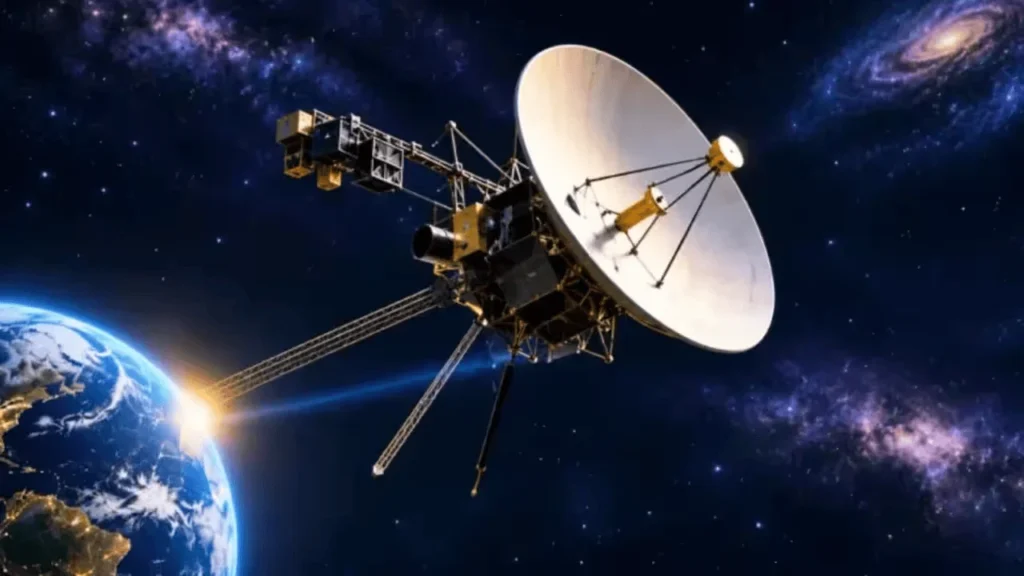
Original editorial artwork; not an official film still, actor photograph, or authenticated documentary image.
Voyager 1: The headline milestone: one light-day away
NASA’s position and mission-status page identifies November 18, 2026 as the expected date when Voyager 1 will be one light-day from Earth. Its detailed estimate gives 2:16:07 a.m. Pacific Standard Time, equivalent to 5:16:07 a.m. Eastern Standard Time, for the milestone. The stated separation is about 16.094 billion miles. These are NASA’s published estimates, not distances calculated independently for this article.
The phrase ‘light-day’ sounds like a unit of time, but here it refers to distance: how far light travels in 24 hours. Light moves about 186,000 miles per second in a vacuum, making even one second of travel enormous by everyday standards. Multiply that movement across a full day and the result is an amount that helps people grasp the tremendous separation between Earth and the probe.
This is a distance relative to Earth. NASA also sometimes describes the spacecraft’s distance from the Sun, and those values should not be substituted for one another without context. Because Earth moves around the Sun, Earth-spacecraft distance can vary slightly differently from heliocentric distance. Clear measurement labels are important even when discussing a milestone whose scale is far beyond ordinary experience.
Why the one-light-day moment is historic
Voyager 1 is already the most distant human-made object. According to NASA’s history, it overtook Pioneer 10 in 1998 and later crossed into interstellar space in 2012. Reaching a one-light-day separation marks another first for human engineering, not because a new physical boundary lies at that location, but because a machine built in the 1970s has continued operating across distances almost unimaginable when described in kilometers alone.
NASA explicitly explains that the spacecraft will not encounter a special barrier or experience an environmental transformation at the instant it passes the one-light-day line. The milestone is meaningful to people tracking the mission, not a sudden event that changes Voyager’s instruments or trajectory. Treating it as the ‘edge of the universe’ or an unknown cosmic gateway would be scientifically false.
The achievement also makes communications latency intuitive. If light and radio waves require a full day to travel from Earth to Voyager 1, the shortest possible signal delay for a reply is roughly two days. Engineers cannot operate the craft like a remotely controlled vehicle with instant feedback. They must plan carefully, send instructions and allow for long waits before data returns.
What happened to Voyager 1 in October 2026?
NASA’s October 29 update reports a temporary loss of communications during two scheduled attempts on October 18 and 19. The Deep Space Network could not detect the probe’s radio signal during those opportunities, separated by approximately a day. The signal reappeared on October 20, and NASA said communication had been maintained afterward as engineers investigated the cause. The interruption was therefore real, but claims that NASA permanently lost Voyager 1 are not supported by the cited update.
NASA reported that one set of thrusters went offline and backup thrusters came on. The spacecraft’s protective systems can automatically respond to a problem by moving into a more stable configuration and interrupting normal activity while engineers investigate. The agency was still examining the precise circumstances. It would be premature to announce a definite root cause or state that an irreversible systems failure occurred.
The incident highlights the fragility and ingenuity of a nearly half-century-old spacecraft. Its systems were engineered with redundancy, but its operators must now make decisions under severe limits in power, equipment age and communication delay. The fact that a radio signal returned does not mean every engineering question is solved. It means there was a successful recovery of contact, followed by ongoing diagnosis.
The September power-saving operation
The same NASA update describes a power-management effort completed in early September. Engineers replaced three powered devices with lower-power alternatives in a coordinated operation the team nicknamed the ‘Big Bang’. The objective was to retain sufficient thermal management while reducing electrical consumption and making it possible to continue operating the remaining science instruments longer than previously projected.
Voyager uses radioisotope thermoelectric generators, which convert heat from radioactive decay into electricity. The available power declines with time. NASA estimates that the two spacecraft lose around four watts of electrical power each year. That may sound minor compared with a household appliance, but the spacecraft operate on narrow power margins in deep space, where every subsystem matters.
The engineering challenge is not simply switching everything off. Equipment also needs to remain warm enough to function in an extremely cold environment. Changing one electrical load can affect heating or system balance, which is why NASA emphasized the careful simultaneous nature of the operation. The agency said the successful effort could postpone the need to turn off another Voyager 1 science instrument, which might otherwise have been necessary as early as summer 2027.
Is Voyager 1 still working?
Yes, according to NASA’s latest mission status, Voyager 1 remains active. But ‘working’ does not mean operating exactly as it did in 1977 or taking fresh photographs of planets. Many original instruments were switched off as their missions ended or as resources became scarce. NASA’s current instrument-status page lists the magnetometer and plasma-wave subsystem as operating on Voyager 1, while several other instruments have been turned off.
The science objectives have changed over time. During the primary planetary mission, the spacecraft provided close-up observations of Jupiter and Saturn. Its present value lies in measurements of the environment beyond the heliosphere. That transition is one of the extraordinary aspects of the mission: a spacecraft designed for planetary encounters has become an interstellar scientific instrument.
Readers should consult NASA’s live status page for current instrument operation because engineering configurations can change. A statement based on a year-old mission overview may list equipment that has since been deactivated. For this article, the more recent instrument table is a stronger source than an older biography that describes systems operating during previous years.
What is the heliosphere?
The heliosphere is the immense region influenced by particles and magnetic fields associated with the Sun. Solar wind flows outward and interacts with the surrounding interstellar environment, producing a boundary known as the heliopause. Both Voyager spacecraft have traveled beyond that boundary. NASA says Voyager 1 crossed it in 2012 and Voyager 2 did so in 2018.
Crossing the heliopause is often described in popular coverage as ‘leaving the solar system’, but that phrase can be ambiguous. The Sun’s gravitational influence extends far beyond the heliosphere, and objects in the distant Oort Cloud remain associated with our solar system in a broader gravitational sense. The precise claim supported by NASA is that Voyager 1 entered interstellar space outside the heliosphere. It did not escape the Milky Way galaxy.
That distinction helps avoid sensational mistakes. Interstellar space is not an empty void with no matter or physical processes. It contains particles, magnetic fields and radiation that the mission can study. Voyagers offer direct measurements from a region no other spacecraft has explored in the same operational way, which is why preserving their remaining instruments matters scientifically.
A journey that began in 1977
NASA launched Voyager 1 on September 5, 1977. Voyager 2 had launched earlier, on August 20, but the spacecraft followed different paths. The pair took advantage of a rare arrangement of outer planets that enabled a sequence of encounters and gravity assists. The combined mission provided close-range exploration of the giant planets and transformed scientific understanding of their moons, atmospheres, rings and magnetic environments.
Voyager 1’s principal planetary flybys included Jupiter in 1979 and Saturn in 1980. NASA records the spacecraft’s closest Jupiter approach on March 5, 1979 and its closest Saturn approach on November 12, 1980. Those encounters belong to a different phase of the mission from today’s interstellar measurements. The current spacecraft is not preparing to return to Jupiter or Saturn or enter an orbit around a new planet.
The long lifetime of the mission is remarkable partly because no one can repair it directly. Engineers operate through commands transmitted across the Deep Space Network, using decades-old hardware and limited power. This makes each successful extension a case study in durable engineering, contingency planning and the creativity required to preserve scientific instruments far beyond their original design environment.
Why Voyager 1 passed Voyager 2
The names can be confusing. Voyager 2 launched before Voyager 1, yet Voyager 1 ultimately became the more distant spacecraft. The order is explained by their different trajectories and speed. The pair did not follow the same route at different starting times. Voyager 2’s journey enabled encounters with Uranus and Neptune, while Voyager 1’s route focused on Jupiter and Saturn before it headed outward.
NASA reports that Voyager 1 overtook Pioneer 10 in distance in February 1998. Since then, it has held the distinction of the most distant human-made object. Voyager 2 is also in interstellar space but at a shorter distance from Earth. NASA currently expects Voyager 2’s one-light-day milestone much later, around November 2035.
These facts show why a simple ranking of the spacecraft does not describe their scientific value. The different paths allowed the missions to study different worlds and, now, different portions of the interstellar environment. Voyager 2’s comparatively slower outward progress does not make it a failed mission. It fulfilled a complementary exploration strategy.
The Deep Space Network and communication delays
NASA uses the Deep Space Network, a collection of powerful antenna facilities around the globe, to communicate with distant spacecraft. From Voyager’s location, radio signals are extremely weak when they reach Earth. Long-distance communications require sensitive equipment, careful scheduling and signal-processing techniques. The network also supports many other missions, so contact opportunities have to be coordinated.
At a one-light-day separation, an Earth-to-spacecraft command takes approximately 24 hours to arrive, and a response takes about another 24 hours to return. That two-day round trip assumes a spacecraft capable of responding promptly and a communication schedule that permits detection. Real engineering investigations can take much longer because teams need to interpret data, prepare commands and manage risks.
This latency explains why automation and fault protection matter. The probe cannot wait for a human to notice every sudden problem and intervene immediately. It needs onboard systems that can respond to certain anomalies by protecting essential operations until ground engineers receive information. NASA’s October incident illustrates the importance of these capabilities and the uncertainty they can still leave behind.
Why the Golden Record remains fascinating
Both Voyager spacecraft carry Golden Records: physical messages intended as representations of Earth, human culture and aspects of life on our planet. NASA describes them as gold-plated copper discs accompanied by instructions for interpretation. The records include imagery, sounds, greetings and music selected to communicate something about their place of origin if they are ever encountered by another intelligence.
The records are culturally remarkable but are not the cause of the current November trend. The immediate verified news is the approaching distance milestone and recent engineering developments. A credible article can explain the Golden Record as background without transforming speculation about extraterrestrial discovery into a headline. There is no NASA announcement that Voyager has encountered alien life or received an extraterrestrial message.
The more grounded significance is human: people designed a spacecraft to explore their neighboring planets and also sent with it an artifact representing an optimistic act of communication. That creative gesture coexists with rigorous engineering and scientific measurement. It is one reason the Voyager mission continues to inspire interest far beyond aerospace specialists.
Can Voyager 1 take new photos?
NASA’s current instrument-status page lists the imaging system as switched off to save power, with the cameras deactivated in 1990. Therefore, claims that Voyager 1 has just photographed an undiscovered planet or sent back a new image of Earth require exceptional verification. Many beautiful Voyager images online are archival, artist-created or derived from data captured decades ago.
An image’s caption is important. The famous ‘Pale Blue Dot’ is associated with the mission’s distant look back toward Earth, not a newly released picture from 2026. A generated picture of the spacecraft near stars can be useful as conceptual artwork, but should not be labeled a photograph captured by Voyager. The probe has no external photographer following it through space.
For a trustworthy article, use official NASA image credits and dates whenever possible. If an original illustration is produced for visual storytelling, state clearly that it is conceptual. Mislabeling generated visuals as authentic spacecraft imagery would undermine the accuracy of otherwise solid reporting.
What will actually happen on November 18?
As Voyager 1 reaches the one-light-day separation, nothing dramatic is expected to change onboard simply because it passes that numerical threshold. It will continue along its path through interstellar space, subject to its existing engineering conditions. The milestone is defined by the distance to Earth, not a barrier with unique physical properties. NASA’s explanatory materials emphasize this distinction.
The event will provide an opportunity to reflect on the extreme scale of space. Human minds can struggle to interpret billions of kilometers; a familiar measure of communication time makes the number easier to understand. One day for light to travel in one direction means an ordinary conversation with the spacecraft is physically impossible in real time.
The date is a published trajectory estimate, and position calculations depend on time and geometry. For the latest status, readers should consult NASA rather than relying on a permanently frozen counter or a social-media image. An online tracker may show slightly different values depending on when it updates, what reference point it uses, and the rounding method.
Is there any danger to Earth?
No evidence in NASA’s milestone explanation suggests that Voyager 1 poses a danger to Earth. The spacecraft is moving outward at an enormous distance and is not on a return trajectory. Its passing a round-number separation does not generate a shockwave, radio event or physical effect that can be felt at home. Headlines suggesting a threat from the milestone misunderstand the basic concept.
The spacecraft’s radioisotope generators are also sometimes misrepresented online. Their purpose is to provide electricity for a remote space mission. The news about declining power concerns the spacecraft’s long-term ability to operate, not a reported emergency affecting Earth. The fact that engineers are conserving power does not indicate that a catastrophe has occurred.
Scientific communication benefits from distinguishing awe from alarm. Voyager’s story is extraordinary enough without false warnings. Its endurance, distance and surviving science instruments offer an authentic reason to pay attention.
What Voyager’s present work can still teach us
NASA’s mission overview describes the twin probes as the only spacecraft to have operated beyond the heliosphere. Measurements of magnetic fields and plasma waves can help researchers understand the boundary between the Sun’s influence and the surrounding interstellar medium. Those observations complement remote astronomical research by providing direct data from the region being studied.
The present mission is much narrower than the full instrument suite launched in 1977. Equipment has been turned off over time to save energy, and engineering operations increasingly focus on protecting essential functions. That makes each remaining stream of data more valuable. The goal is not to restore the mission to its original condition; it is to obtain scientifically useful information for as long as circumstances permit.
As the available power declines, further choices will become necessary. NASA’s recent power-saving operation suggests engineers are actively extending the time available, but it does not promise indefinite operation. Claims that Voyager will send data forever would be false. Its continuing life is a remarkable success precisely because it has physical limits.
How to follow the spacecraft without falling for false updates
The best starting point is NASA’s Voyager mission website and live location page. NASA publishes a position visualization, instrument-status information and news updates. When a social-media claim says that Voyager has been lost, restarted, photographed an alien craft or crossed an impossible boundary, compare it with the latest official material before sharing it.
Pay attention to dates. A report about a past communications interruption can resurface months later and appear current. An old instrument-status article might list a subsystem as operating even though NASA has since turned it off. The October 29, 2026 update is particularly important because it explains both the recent signal loss and the September power-saving action.
A high-quality publication should link directly to NASA’s source and preserve nuance. ‘Signal lost briefly, recovered, cause under investigation’ is a useful statement. ‘Voyager disappears forever’ would be misinformation based on the same episode. The same principle applies to the one-light-day headline: dramatic language is unnecessary when the verified distance is already astonishing.
Final takeaway: why Voyager 1 is trending in November 2026
Voyager 1 is trending because of a genuine combination of news: it is nearing one light-day from Earth on November 18, and NASA recently reported a brief October communications interruption followed by recovery, along with a September operation to conserve power. The spacecraft remains active and continues a mission that began in 1977.
The milestone symbolizes the endurance of human engineering and the vastness of interstellar distances. It is not the edge of the universe, a new planetary encounter or evidence of alien contact. The most useful coverage keeps the science clear, acknowledges ongoing engineering uncertainties and gives readers authoritative NASA sources to follow.
Why a space story is different from a movie-trend story
The fact that Voyager 1 appears in the same rising-query screenshot as several film titles does not make the spacecraft part of the movie news cycle. Trending-search dashboards can combine unrelated questions because they reflect a period, region or broad search interface rather than a carefully curated editorial beat. A publisher should ask whether the subject genuinely serves its readers before posting about it simply because the graph is climbing.
For a dedicated entertainment site, a NASA spacecraft article would make sense only as part of a clearly established science, space-cinema or science-fiction explainers section that readers can navigate. Without that context, it may feel unrelated to the site’s editorial promise. Publishing information outside a specialty is not inherently forbidden, but the content should be reported with the same expertise, sourcing and factual care as the core subject. In this case, NASA primary sources make a reliable article possible; they do not automatically make it a good fit for a movie publication.
If this story is published elsewhere, it can be accompanied by a simple trajectory illustration, a labeled light-time diagram or a link to NASA’s location visualization. Those choices improve understanding more than an invented spacecraft photograph or dramatic depiction of an alien encounter. The reader deserves to know which images are conceptual and which are authentic mission records.
Frequently asked questions
1. Why is Voyager 1 trending in November 2026?
NASA has announced that Voyager 1 is approaching a one-light-day distance from Earth on November 18. An October communications incident and a power-saving operation also attracted attention.
2. When will Voyager 1 be one light-day away?
NASA gives November 18, 2026 at approximately 2:16:07 a.m. PST, or 5:16:07 a.m. EST, as the milestone time in its published estimate.
3. How far is one light-day?
It is the distance light travels in 24 hours, roughly 16 billion miles or 26 billion kilometers. NASA gives a more precise estimated Earth separation for the milestone.
4. Is Voyager 1 still operating?
Yes. NASA identifies it as an active extended mission, although many instruments have been deactivated to preserve limited power.
5. Did NASA lose contact with Voyager 1 in October?
NASA reported unsuccessful signal detections on October 18 and 19, followed by the signal’s return on October 20. The agency said contact was maintained afterward.
6. What caused the October signal interruption?
NASA was still investigating in its October 29 update. It reported a thruster-related automatic response but did not announce a definitive root cause.
7. Why is Voyager 1 losing power?
Its radioisotope generators produce less electrical power as their radioactive heat source decays over time. NASA estimates roughly four watts of loss each year for the probes.
8. What was the ‘Big Bang’ operation?
NASA used that nickname for coordinated replacement of three powered devices with lower-power alternatives while maintaining essential heating. It was completed on Voyager 1 in September 2026.
9. Can Voyager 1 communicate instantly with Earth?
No. At the one-light-day distance, a one-way radio signal requires about 24 hours. A prompt round-trip exchange therefore takes roughly two days even before engineering processing delays.
10. When did Voyager 1 launch?
September 5, 1977, according to NASA. Voyager 2 launched earlier in August of the same year.
11. When did Voyager 1 enter interstellar space?
NASA identifies August 2012 as the time it crossed beyond the heliopause. Voyager 2 reached interstellar space in 2018.
12. Has Voyager 1 left the galaxy?
No. It is outside the heliosphere and still within the Milky Way. Interstellar space does not mean beyond our galaxy.
13. Is Voyager 1 taking new pictures?
NASA’s instrument table lists its imaging system as turned off since 1990. Claims of fresh photographs should be checked carefully against official releases.
14. What is the Voyager Golden Record?
It is a physical record carried by each Voyager spacecraft containing sounds, images, greetings and music intended to represent aspects of Earth and humanity.
15. Will Voyager 1 reach Earth again?
No return mission is planned. The probe is traveling outward on its long-term trajectory.
16. What will change when it crosses the light-day mark?
No special physical boundary is crossed. The milestone describes Earth-spacecraft separation and emphasizes the enormous delay for light and radio signals.
17. Where can I check the current position?
NASA’s Voyager mission and ‘Where Are Voyager 1 and 2 Now?’ pages provide official position visualizations, mission updates and instrument-status information.
Primary sources
- NASA’s November 2026 one-light-day explanation: https://science.nasa.gov/mission/voyager/voyager-1/voyager-1-what-is-a-light-day/
- NASA October 29 engineering report: https://science.nasa.gov/blogs/voyager/2026/10/29/nasas-voyager-1-conserves-power-resolves-brief-communications-pause/
- NASA current position and instrument status: https://science.nasa.gov/mission/voyager/where-are-voyager-1-and-voyager-2-now/
- NASA Voyager 1 mission page: https://science.nasa.gov/mission/voyager/voyager-1/
- NASA Voyager history and facts: https://science.nasa.gov/mission/voyager/fast-facts/
Editorial note: This is a NASA-sourced science explainer. It should not be presented as movie news. The milestone is future-dated relative to the November 5 research cutoff and should not be described as already completed.
Editorial standard: Figures, ratings and availability can change; consult the dated sources linked in this article. Generated illustrations are conceptual, not documentary evidence.