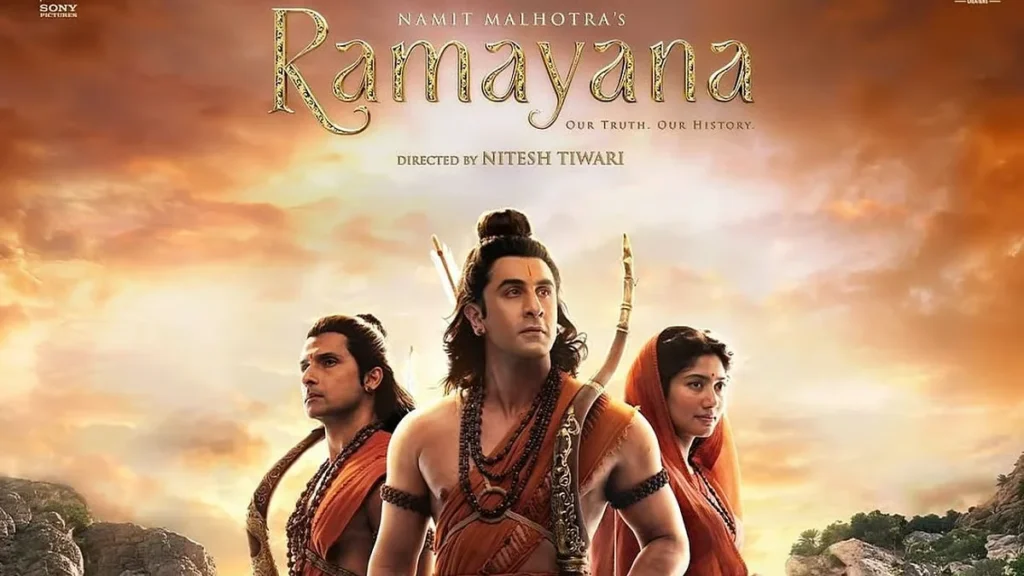

Ramayana movie collection Day 10 was estimated at ₹11.78 crore India net as of 12:03 p.m. IST on Saturday, November 14, 2026. Sacnilk’s tracker showed a running domestic total of ₹624.48 crore net. Saturday was still in progress; neither figure was a final ten-day result. Source: Sacnilk’s Day 10 report.
For Ranbir Kapoor’s epic, the second Saturday is an important test of continuing theatrical demand. The question is whether the completed day can improve on Friday, how the different language versions contribute, and whether the international total receives a matching update. A noon collection alone cannot answer all three.
Reporting cutoff: Day 10 live snapshot: November 14, 12:03 p.m. IST. Completed-day context: through November 13. This is a dated editorial report, not an automatically updating counter. All collection figures below are attributed trade estimates and remain subject to revision.
Jump to the details
- Day 10 collection snapshot
- Revised Day 9 collection
- Day-wise collection table
- The second-Saturday test
- Language-wise performance
- Advance bookings explained
- Worldwide and overseas position
- Ranbir Kapoor, cast and film details
- Formats and theater choices
- Fair comparisons and milestones
- What the next update should establish
- 25 frequently asked questions
- Sources and methodology
Ramayana Movie Collection Day 10: The Latest Reported Snapshot
| Measure | Amount | Status |
|---|---|---|
| Day 10 India net | 11.78 | Partial day |
| Day 10 India gross | 13.90 | Partial day |
| Cumulative India net | 624.48 | Includes partial Saturday |
| Cumulative India gross | 746.40 | Includes partial Saturday |
| Day 10 final worldwide | Not established | Awaiting comparable reporting |
The source tracker counted 7,258 shows in this live snapshot. That is a tracked-so-far count, not a final nationwide daily inventory.
The most useful distinction in the table is between a daily amount and a cumulative amount. The first describes the current day’s reported business; the second includes earlier days. Reading the cumulative figure as Saturday’s standalone collection would dramatically misstate the result.
There is also a difference between a number being current and a period being complete. A tracker can provide a very recent estimate for a day that still has many screenings ahead. The timestamp establishes when the snapshot was taken. The status column establishes how much confidence a reader should place in a full-day interpretation.
Readers arriving from a search notification should therefore keep the words “partial day” attached to the amount. This is especially important when the article is shared later in the afternoon or evening. The number may have been accurate for the stated snapshot without remaining the newest available estimate.
The article’s opening gives the quick answer; the following sections explain the context needed to use it responsibly. A box-office update is most helpful when it tells readers what changed, what is comparable and what remains unknown, rather than making every refresh sound like a new record.
Ramayana Day 9 Collection: The Revised Friday Baseline
Ramayana Day 9 collection was revised to ₹48.10 crore India net. Sacnilk’s dedicated Friday report, updated November 14 at 10:41 a.m. IST, listed ₹57.45 crore India gross and ₹25 crore overseas gross for that day. Friday’s all-language net was approximately 10.1% below Thursday. Source: Day 9 tracker.
Earlier coverage used a slightly different snapshot. NDTV’s morning report quoted ₹47.85 crore Friday net, ₹612.45 crore cumulative India net and ₹1,110.70 crore worldwide. The revised tracker subsequently increased the domestic figures. That explains the difference readers may see between a morning news headline and this article. Source: NDTV.
Using the revised Friday baseline matters for any Saturday growth calculation. If one report compares Saturday with the earlier estimate and another uses the revised amount, their percentages will not be identical. Neither percentage should be presented without identifying the underlying daily figures.
A revision is also different from an additional day’s revenue. When a tracker changes a previous day, the cumulative total may rise even before the new day is complete. Treating every adjustment as fresh Saturday business can create an inaccurate narrative about momentum.
For this report, the later completed-day estimate is the comparison point. The earlier news coverage remains useful as a record of what was reported at that time. We do not average the two versions or combine the lower daily figure with the higher cumulative total.
What Friday tells us about Saturday
Friday provides a nearby full-day benchmark. It helps frame whether the second Saturday eventually improves on the previous day, but it does not determine the outcome. Theaters can have different schedules, ticket-price mixes and attendance patterns from one day to the next.
The correct question is whether Saturday’s completed India-net result rises or falls against the same measure for Friday. Comparing a noon Saturday amount with a full Friday and calling the difference a collapse would be premature. The same caution applies to celebrating a rebound before the reporting window closes.
Ramayana Box Office Collection Day 10 in the Day-Wise Timeline
| Day | November 2026 | Net | Coverage |
|---|---|---|---|
| 1 | 5 | 64.85 | Completed day |
| 2 | 6 | 48.05 | Completed day |
| 3 | 7 | 69.80 | Completed day |
| 4 | 8 | 56.15 | Completed day |
| 5 | 9 | 107.50 | Completed day |
| 6 | 10 | 94.10 | Completed day |
| 7 | 11 | 70.65 | Completed day |
| 8 | 12 | 53.50 | Completed day |
| 9 | 13 | 48.10 | Revised completed day |
| 10 | 14 | 11.78 | Partial, 12:03 p.m. IST |
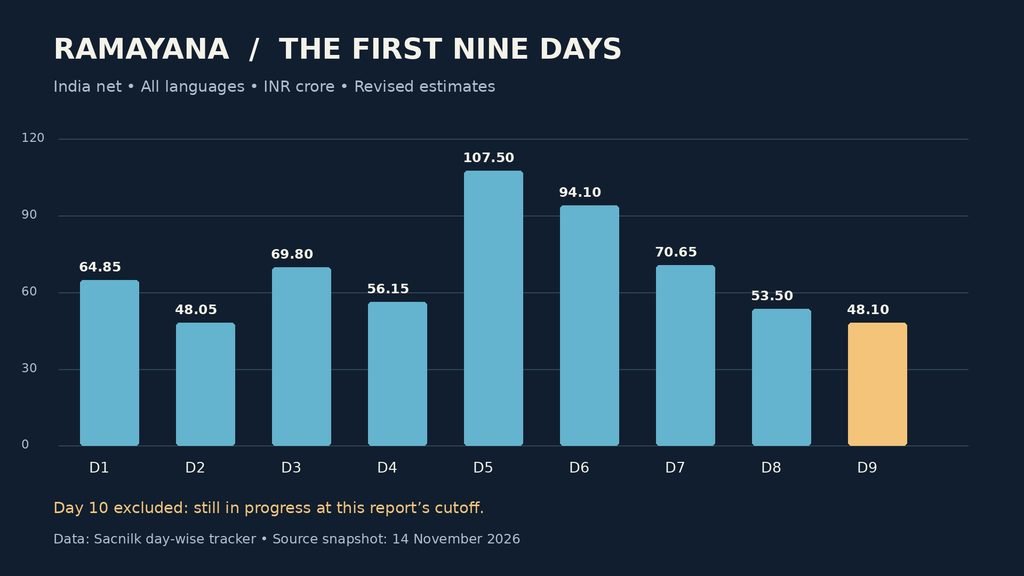
Historical series: Sacnilk day-wise tracker. Saturday is visually separated by its coverage label because it is not comparable with a full day yet.
The sequence shows why a film’s theatrical run should not be reduced to its opening day. Collections can rise after release, fall from a particularly large day and then encounter a new weekend. Each movement contributes to the cumulative result, but each movement also has its own calendar context.
The largest completed day is a reference, not a daily expectation
Sacnilk’s Day 5 report recorded ₹107.50 crore India net on November 9, a reported increase of 91.5% over the preceding day. That was a substantially different daily level from the later weekdays. Source: Day 5 report.
It would be unhelpful to treat the strongest day as the minimum acceptable result for every subsequent date. A peak is useful for describing the run’s range. It is not a contractual promise that the film will generate identical business each day until it leaves cinemas.
Likewise, a decline from a peak does not automatically reveal its cause. The collection series alone cannot separate the effects of available shows, audience schedules, prices or word of mouth. Assigning a single explanation without supporting evidence would turn an observation into speculation.
Why the first-week label needs care
The tracker treats Days 1–8 as an extended opening week. Its Day 8 report lists ₹564.60 crore India net and ₹1,028.55 crore worldwide gross through that period. Source: Day 8 report.
An eight-day period should not be compared with another film’s seven-day week without saying so. A calendar label can hide an extra day of business. For readers comparing opening runs, specifying the number of days is often clearer than relying only on the phrase “first week.”
Why the Second Saturday Matters for Ramayana
The second Saturday offers another opportunity to see whether theatrical demand continues beyond the initial release period. For viewers who did not attend earlier, the weekend can provide a new chance to organize a group visit, choose a preferred format or find a convenient screening.
That is a reason to watch the completed result, not a guarantee of growth. A weekend date creates an opportunity; actual business still depends on people buying tickets. A confident forecast would need more than the calendar alone.
Three questions that make the update useful
First, does the completed all-language domestic net improve on Friday? Second, does the improvement, if any, appear across several versions or mainly one? Third, does a new worldwide snapshot arrive with a clearly matching international cutoff? Together, these questions describe the day more accurately than a single dramatic adjective.
The first question addresses overall domestic movement. The second helps distinguish broad demand from a change concentrated in one segment. The third prevents a domestic update from being mislabeled as a complete global one.
There are also different ways for a Saturday to look stronger. More screenings can create more selling opportunities. Better attendance within the existing schedule can raise receipts. A larger share of higher-priced formats can change revenue without a proportionate change in admissions. A headline amount cannot identify the contribution of each mechanism.
What would count as evidence of a rebound?
A completed Saturday estimate above the revised Friday estimate would support a straightforward statement that domestic net increased day over day. To describe the size of that increase, calculate the difference relative to Friday and label the result as an editorial calculation.
For illustration only, a hypothetical film rising from ₹40 crore to ₹50 crore would show 25% growth. Those are not predictions for Ramayana. The example demonstrates why the denominator matters: a ₹10 crore gain means something different depending on the starting level.
A broader claim about sustained momentum would require more than one day. Sunday and the next working days would add useful evidence about how the run is developing. Saturday can be an important chapter without being the final verdict on the entire theatrical release.
Language-Wise Collection: How to Read the Different Versions
The Day 10 noon snapshot listed Hindi at ₹9.68 crore, Kannada at ₹1.04 crore, Tamil at ₹0.77 crore and Telugu at ₹0.29 crore India net. A separate Malayalam live-day amount was not shown in that table; it should not be invented or interpreted as confirmed zero. Source: live language table.
Those four reported figures reconcile with the live total. The reconciliation is a useful arithmetic check, but it does not independently verify the tracker’s ticketing data. It simply shows that the displayed components and total are internally consistent.
Friday’s language mix provides completed-day context
| Version | Net |
|---|---|
| Hindi | 36.50 |
| Malayalam | 3.25 |
| Kannada | 3.00 |
| Tamil | 2.75 |
| Telugu | 2.60 |
Source: revised Day 9 report.
A version with the largest revenue is not automatically the version with the highest occupancy or the largest average ticket price. Those are separate measures. A wider release can generate a larger gross even when some smaller segments fill a higher proportion of their available seats.
Language totals also do not equal state totals. A Hindi screening can take place in Karnataka, while a Kannada screening can take place elsewhere. A geographical claim needs geographical data. The language table describes the version watched, not the identity or home state of every ticket buyer.
For Saturday, the most meaningful language comparison will use completed-day figures for both days. A noon mix can change as different screenings report. It is therefore too early to announce that a particular version has delivered a full-day turnaround based on a partial snapshot.
Day 10 Advance Bookings: A Separate Measure of Demand
Sacnilk’s advance-booking report, with data as of 6 a.m. IST, listed ₹38.19 crore gross for Saturday, or ₹32.17 crore excluding blocked seats. It covered 24,535 shows. The source also listed 11.43 lakh booked tickets, or 9.73 lakh after excluding blocked seats. Source: Day 10 advance bookings.
These figures describe advance availability and bookings, while the noon collection table describes reported business so far. They have different scopes and tax bases. It would be incorrect to add the larger advance amount to the live net amount and call the sum Saturday’s collection.
Why advance gross can be larger than a live collection counter
A pre-sale report can cover screenings scheduled throughout the day, including shows that have not happened at the time of a morning or noon collection update. A running counter may cover only the screenings and estimates incorporated so far. The two numbers therefore need not move together hour by hour.
The comparison is further complicated if one number is gross and the other net. Even after the same screenings have occurred, those labels describe different measures. Before treating a difference as a contradiction, check both the time coverage and the accounting basis.
What the blocked-seat distinction means for readers
The source presents figures with and without blocked seats. Both should retain those labels when quoted. A blocked position in a booking interface is not a sufficient basis for us to assert that an ordinary customer purchased it at the listed price.
This report does not assign a motive to blocked seats or claim that the distinction proves manipulation. The useful editorial practice is to preserve the source’s categories and avoid treating a booking-map estimate as an audited attendance statement.
Where the pre-sale interest was concentrated
The same advance report listed Bengaluru, NCR and Mumbai as its leading cities by reported gross. It also showed a material premium-format contribution despite those screenings representing a small share of the schedule. These are advance-booking observations, not final city collections or a completed-format breakdown.
For the eventual Saturday result, the interesting question is how those advance patterns translate into reported receipts after screenings take place. A strong pre-sale base may coexist with different levels of walk-in demand. Neither component should be assumed from the other without evidence.
Worldwide Collection: The Global Total Still Has a Day 9 Cutoff
The revised worldwide snapshot through Day 9 was ₹1,111 crore gross: ₹732.50 crore from India and ₹378.50 crore overseas. The corresponding India-net figure was ₹612.70 crore. Source: worldwide tracker.
The important label is “through Day 9.” A Saturday domestic counter does not automatically refresh every international territory. This article therefore does not manufacture a ten-day global total by combining partially updated categories.
Why worldwide gross uses India gross
Worldwide gross combines gross receipts across the included markets. India net is useful for domestic reporting, but it is not the domestic component to use when constructing a gross-based global total. Adding net and gross categories can produce a mathematically neat number with an incorrect label.
There is a second common mistake: adding overseas revenue to a figure already labeled worldwide. Overseas is already included. Likewise, language totals that form part of the India total should not be added again after India has been counted.
What overseas means for U.S. readers
In this context, overseas means markets outside India. It does not mean the United States alone. A North American report may include Canada, while a global international total may include many other territories. Those geographic labels need to survive when figures are shared.
No verified U.S.-only Day 10 collection is established in this article. That is a limit of this report, not evidence that the film earned nothing in America. A territorial figure should be added only when a source identifies its market and reporting period clearly.
Understanding rupee crore without guessing a dollar amount
One crore means ten million. Converting a rupee amount into dollars requires a specific exchange rate and date. A currency conversion is different from measuring the film’s box office in the United States, and a converted global amount should never be labeled U.S. revenue.
For ongoing cumulative coverage, see Epicofilm’s Ramayana box-office tracker. This article focuses on the dated Saturday update and its comparison with Friday, while the broader tracker can serve readers following the overall run.
Ramayana Movie: Ranbir Kapoor, the Ensemble and the Film Behind the Numbers
Readers searching for “Ramayana movie Ranbir Kapoor” are asking about the actor-led screen adaptation, rather than the ancient text or an earlier television production. The central cast includes Ranbir Kapoor as Rama, Sai Pallavi as Sita and Yash as Ravana. Ravie Dubey plays Lakshman, and Sunny Deol plays Hanuman. Source: The Indian Express cast guide.
Sony Pictures Singapore lists Nitesh Tiwari as director, Namit Malhotra and Yash as producers, and Hans Zimmer and A. R. Rahman as the composers. Its official film page identifies the adaptation’s basis as Valmiki’s Ramayana and lists November 5 as the cinema release date for its market. Source: Sony Pictures Singapore.
Why cast recognition matters without proving a revenue cause
A recognizable ensemble gives audiences several entry points into a film. Some viewers may follow a particular performer, while others may be interested in the story, music or visual presentation. Those are plausible viewing motivations, not a measured explanation of exactly which factor sold each ticket.
It would be excessive to attribute the entire collection to one actor on the basis of a headline. The reported result belongs to the film’s release. Establishing the individual commercial contribution of performers would require a different kind of evidence.
Ranbir Kapoor is central to the search interest around the movie, but a collection report should still identify the ensemble and filmmakers accurately. That gives unfamiliar readers enough context without turning a financial update into an unsupported fan ranking.
What newcomers need to know before watching
The official distributor’s synopsis frames the story around Rama and Ravana and the forces connecting their destinies. Readers who want a spoiler-light introduction can consult that official synopsis. It provides a clearer starting point than treating fragments of social-media commentary as a complete description of the adaptation.
Viewers should also distinguish the cultural source material from this particular screen version. A film adaptation makes choices about structure, emphasis and presentation. A box-office total measures ticket revenue, not the completeness or theological authority of those choices.
For an assessment of the viewing experience, use Epicofilm’s Ramayana movie review. A review and a collection report serve different purposes: one helps readers evaluate the film as cinema, while the other tracks its reported theatrical business.
Ticket Prices, Formats and the Weekend Viewing Decision
For someone deciding whether to watch on Saturday, the collection is only one piece of information. The practical choices are the screening language, subtitles, format, location, time and final ticket price. Those details can affect the experience more directly than the size of a national revenue headline.
Check the actual cinema listing before paying. A film page can describe available formats in general, but it does not guarantee that every format is offered at every theater. Likewise, a language version or subtitle option should be confirmed for the specific show you select.
How premium tickets affect box-office interpretation
Higher-priced screenings can raise average revenue per admission. That means a change in gross does not necessarily imply an identical percentage change in ticket sales. A film can generate more revenue through a different ticket mix even when attendance changes by a smaller amount.
The reverse can also happen: lower-priced screenings can attract more viewers without producing proportionately higher revenue. For comparisons about audience size, admissions data is more directly relevant than money alone.
Why occupancy is not the same as nationwide demand
Occupancy measures the share of available capacity filled within a defined sample. A packed small auditorium and a partly filled large auditorium can sell different numbers of tickets. A high percentage needs context about the size and coverage of the underlying schedule.
Selected screenshots of sold-out screenings cannot establish that the entire country is sold out. Empty-seat screenshots cannot establish the opposite. A useful collection analysis relies on a defined dataset rather than a handful of visually striking examples.
For a family or group booking, the practical lesson is straightforward: choose the version and schedule that suit the group, compare the displayed prices and confirm the booking details. Commercial success can explain public attention, but it does not substitute for checking the show you are actually buying.
Records, Milestones and the Limits of a Day 10 Verdict
A film crossing a large cumulative threshold is newsworthy, but the threshold must retain its measurement label. Worldwide gross, India gross and India net describe different amounts. Treating them as interchangeable can turn a legitimate milestone into an inflated claim.
The same discipline applies when comparing Ramayana with another release. Match the market, accounting measure, language coverage and number of days. A nine-day all-language total should not be placed beside a Hindi-only opening weekend as though the two describe the same opportunity.
Day-over-day and week-over-week answer different questions
A Saturday-versus-Friday comparison describes the immediate daily movement. A second-Saturday-versus-first-Saturday comparison describes retention across a week. Both can be useful, but they should not be confused or selectively substituted because one produces a more flattering percentage.
The source and status also matter. If one side is a revised completed-day estimate and the other is a preliminary live value, the comparison is unfinished. Waiting for comparable coverage improves the accuracy of the eventual conclusion.
Why gross does not establish producer profit
The entire ticket gross does not flow unchanged to one producer. Exhibition and distribution arrangements affect who receives what, and the collection table does not reveal all costs or contractual terms. A headline amount therefore cannot establish an exact profit.
For a multi-part project, budget comparisons require additional care about how costs are allocated. A combined development or production figure cannot automatically be assigned to one installment. This report does not set a break-even target without reliable evidence about that allocation.
Similarly, non-theatrical revenues such as streaming or television rights belong to a wider financial assessment. They should be reported separately from theatrical collections. Adding them to a number labeled worldwide box office would change the metric while keeping the old name.
Why this report avoids a guaranteed lifetime forecast
Future screenings, competing releases, sustained attendance and the length of the run remain relevant. A current total provides a starting point for analysis, not a guarantee that a particular final number will be reached. Forecasts need assumptions and should be labeled as forecasts.
At this stage, the defensible editorial conclusion is narrower: Saturday is developing, Friday provides the revised completed-day benchmark, and the latest global snapshot still has an earlier cutoff. The next completed report can support a more specific assessment of weekend movement.
What the Next Ramayana Day 10 Update Should Establish
The next useful update should answer five concrete questions: what the completed Saturday domestic estimate is, whether Friday was revised again, how the language split reconciles, whether overseas reporting has advanced, and what period the worldwide number covers.
Each answer should carry a source and timestamp. Updating only the headline can leave a page internally inconsistent if its table, introduction or graphic still shows an earlier figure. The article should tell one coherent numerical story at the chosen cutoff.
How to recognize a meaningful update
A meaningful update adds information or corrects a previously reported estimate. Merely changing the publication time without changing the underlying data does not make an old snapshot new. Readers benefit from a short note identifying what actually changed.
When the completed Saturday result arrives, the partial-day amount can remain in an explicitly labeled update history if it is useful. It should no longer occupy the main answer position. That keeps the current result easy to find while preserving the reporting sequence.
What remains open at this cutoff
A final Saturday worldwide total, a full-day growth percentage and an exact territory-by-territory global split are not established here. We also have not verified a numerical Google Trends score or search-volume count for the supplied phrase. Current news coverage does not itself prove a specific search ranking.
The report’s value lies in a dated answer, a clear comparison baseline and a transparent explanation of the evidence. Readers can follow the next update without having to untangle whether a number refers to today, the entire run, India alone or the whole world.
Ramayana Movie Collection Day 10: Frequently Asked Questions
1. What is Ramayana movie collection Day 10?
At the stated noon cutoff, the India-net live estimate was ₹11.78 crore. It was a partial Saturday figure, not a completed daily result. The main snapshot table also separates daily and cumulative domestic measures. Check its timestamp before quoting the amount as a current update.
2. Is the Day 10 figure final?
No. The source labeled the day as live and still developing. A final or later completed-day estimate should replace the partial result only when a new report identifies it clearly. A page being published on Saturday does not by itself establish that Saturday’s business has finished.
3. What was Ramayana Day 9 collection?
The revised Friday India-net estimate was ₹48.10 crore. This is the completed-day comparison point used in this article. Earlier coverage used a slightly lower estimate, which is preserved in the revision section so readers can understand why two versions appear in news reports.
4. Why do some reports quote ₹47.85 crore for Friday?
That amount appeared in the earlier morning reporting snapshot before the revision used here. Differences should be evaluated by timestamp and category. It is better to explain the revision than to mix the earlier daily result with a later cumulative total or assume every difference is a new day’s revenue.
5. Did Saturday already beat Friday?
This report does not establish that at the noon cutoff. Saturday was incomplete, while Friday had a full-day estimate. A fair day-over-day comparison requires the same measure over comparable periods. A live counter can indicate progress, but it cannot settle the completed-day result in advance.
6. Is ₹1,111 crore the final ten-day worldwide total?
No. That worldwide snapshot covers through Day 9. It should keep that cutoff whenever it is quoted. The presence of a newer domestic counter on a page does not mean every overseas territory has been updated to the same period.
7. What is the difference between India net and gross?
India net generally excludes applicable ticket taxes, while gross includes them. Neither is automatically the producer’s profit. The categories should be labeled consistently across the headline, table and graphic. Comparing net with gross can create a misleading impression even when both underlying figures were accurately reported.
8. Can I add the advance-booking figure to the live collection?
No. Advance bookings can include tickets for screenings later in the day, and those receipts may become part of the reported collection. Adding both can double count business. The advance report and live table also use different coverage and may use different tax bases.
9. Why is advance gross higher than the noon live net?
The advance report can cover a full day’s scheduled screenings, while the running collection reflects reporting incorporated so far. Gross and net are also different measures. Check those differences before treating the numbers as inconsistent or assuming the film has already earned the advance gross as net collection.
10. What are blocked-seat figures?
The advance source distinguishes totals that include blocked seats from totals excluding them. Preserve that distinction when quoting the report. We do not infer that every blocked seat represents a customer purchase, and we do not infer an improper motive from a booking interface without additional evidence.
11. Which language is contributing the most?
Hindi has the largest listed contribution in the cited live snapshot and Friday table. That describes reported revenue within those datasets, not the cultural identity of viewers. It also does not automatically establish the highest occupancy or the strongest performance per available screening.
12. Does a missing Malayalam live amount mean zero business?
No. An amount not separately shown in the captured live-day table should be treated as unreported there. It should not be replaced with an invented number or a confirmed zero. The completed-day table gives a separate, clearly labeled reference for the prior day.
13. Are language collections the same as state collections?
No. A language version can screen in more than one state, and a state can screen several versions. Language and geography are distinct breakdowns. A claim about a state’s revenue needs location-based reporting rather than an assumption based on the language name.
14. Who plays Rama in the Ranbir Kapoor Ramayana movie?
Ranbir Kapoor plays Rama, alongside Sai Pallavi as Sita and Yash as Ravana. The cast section links to the reported role guide and the official distributor page. These credits identify the production being tracked and distinguish it from other adaptations with similar titles.
15. Who directed the film and composed the music?
The official Sony Pictures Singapore page credits Nitesh Tiwari as director and Hans Zimmer and A. R. Rahman for music. Those are production credits, not evidence of a particular financial outcome. A collection report should keep creative facts separate from claims about what caused ticket sales.
16. Is this the same title as Rise of a Legend?
The official Sony page markets this production as Ramayana: Rise of a Legend. The collection sources also use Ramayana and Ramayana Part 1. Matching the cast, director and release context helps readers identify the film rather than combining figures from unrelated adaptations of the epic.
17. Does overseas mean the United States?
No. Overseas means markets outside India in this reporting context. U.S. business is only one possible component. A North American figure may also include Canada. Keep the source’s geographic label rather than rewriting a broad international total as an American collection.
18. How much is one crore in international numbering?
One crore equals ten million. This changes the way a number is expressed, not its currency. A rupee-crore figure still needs an exchange rate to become a dollar amount. State the rate and date if making a conversion, and do not confuse converted global revenue with U.S. ticket sales.
19. Can the noon amount be multiplied to predict the final day?
That would assume revenue accumulates evenly across the day, which is not established by the snapshot. Screening schedules and reporting coverage differ. A forecast may be constructed with stated assumptions, but it should not be presented as a confirmed collection or a simple guaranteed extrapolation.
20. Does higher collection prove more people watched?
Not necessarily. Ticket prices, formats and market mix affect revenue per admission. A higher gross can come with a smaller change in ticket sales. If the question concerns audience size, a credible admissions dataset is more appropriate than dividing revenue by an unsupported average ticket price.
21. Is the film already profitable?
This article does not establish exact profitability. That requires reliable cost information, revenue-sharing arrangements and clarity about any multi-part project allocation. Gross ticket revenue is not all retained by the producer. A commercial verdict needs more evidence than a cumulative collection alone.
22. Are streaming rights included in worldwide box office?
No. Streaming and television agreements belong to separate revenue categories. They may matter in a broader financial analysis, but adding them to theatrical gross changes the meaning of the number. A well-labeled report keeps those revenue streams separate instead of presenting one inflated collection figure.
23. Should I choose a premium format because the film is earning well?
Choose based on the actual format offered, your preferred language, subtitle availability, theater quality and budget. The collection does not guarantee that every premium screening is the right choice for every viewer. Confirm the details on the specific cinema listing before buying.
24. Is the article claiming a verified Google Trends breakout?
No. It covers a current box-office news topic, but no measured Google Trends breakout status or exact search volume is asserted. News attention and search-volume data are different evidence. The article is designed around the supplied search intent without inventing numerical popularity claims.
25. Where should readers look for the next result?
Use the linked primary collection pages and check their update times, then compare like-for-like categories. Epicofilm’s broader tracker provides the continuing collection context. When a newer report appears, keep its reporting cutoff attached to the amount and confirm that the article’s headline, table and graphic agree.
Sources, Cutoffs and Editorial Method
This report uses Sacnilk’s dated Day 10, Day 9, Day 8, Day 5, advance-booking and cumulative pages for attributed collection estimates. NDTV documents the earlier Friday snapshot. Sony Pictures Singapore supplies official production context, and The Indian Express supplies the cast-role reference.
These sources serve different purposes. A distributor page is authoritative for its own promotional credits but is not an independent audit of ticket receipts. A trade tracker supplies estimates that can be revised. Several publications repeating the same tracker do not become several independent ticket-sales measurements.
- Day 10 live collection, 12:03 p.m. IST snapshot
- Revised Day 9 report
- Cumulative and day-wise tracker
- Day 8 context
- Day 5 context
- Day 10 advance-booking report
- NDTV’s earlier November 14 report
- Official Sony Pictures film page and promotional material
- The Indian Express cast guide
Interpretation, hypothetical examples and viewing considerations are Epicofilm’s editorial analysis. No private accounts were audited, no exact profit was inferred, and no final Saturday worldwide amount was invented. The next revision should identify its new source timestamp and update all affected figures consistently.