


ゴジラ マイナス ゼロ is the Japanese search wording for Godzilla Minus Zero (2026). Official TOHO materials style the film 『ゴジラ-0.0』. This verified guide explains the movie’s Japanese name, release dates, cast, soundtrack and screening formats, using official studio, distributor and festival information rather than speculation.
Editorial disclosure: This is a factual research guide, not a claim that the writer attended a screening. All release facts are attributed; local ticket availability and streaming announcements can change.
Godzilla Minus Zero (ゴジラ-0.0): Fast Facts
| Detail | Verified information |
|---|---|
| Japanese official title | ゴジラ-0.0 |
| Japanese reading | ゴジラマイナスゼロ |
| English release name | Godzilla Minus Zero |
| Japan opening | November 3, 2026 |
| North America wide opening | November 6, 2026 |
| Director / screenplay / VFX | Takashi Yamazaki |
| Production | TOHO; TOHO Studios; ROBOT |
| VFX studio | Shirogumi |
| US distributor | GKIDS |
| Listed feature runtime | 135 minutes |
| Verified festival language | Japanese with English subtitles |
Primary sources: TOHO official Japanese website, Godzilla.com, New York Film Festival and TOHO’s opening-day coverage.
In This Guide
- Quick Answer: What Is ゴジラ マイナス ゼロ?
- Godzilla Minus Zero Japanese Title: Official Spelling and Reading
- Is ゴジラ-0.0 the Same Movie as Godzilla Minus Zero?
- Why Does the Japanese Title Look Like a Mathematical Expression?
- When Did ゴジラ マイナス ゼロ Release in Japan?
- When Is the US and Canada Release?
- What About Other Countries and International Release Dates?
- Director Takashi Yamazaki: What Is Confirmed?
- Godzilla Minus Zero Cast: Confirmed Performers
- Plot: What Does the Official Synopsis Actually Say?
- How Does It Connect to Godzilla Minus One?
- ゴジラ マイナス ゼロ and Japanese Search Intent
- Japanese Audio, English Subtitles and Dubbing
- Runtime, Rating and Cinema Formats
- Japanese Box Office: What Has Been Officially Announced?
- Why Japanese and North American Box-Office Headlines Differ
- How to Find Official Japanese Posters and Trailers
- What the Official Material Does Not Confirm
- Can Readers Watch Godzilla Minus Zero Without Seeing Minus One?
- What Makes This Film Important for International Godzilla Coverage?
- Practical Guide: How to Check a Local Screening
- Editorial Conclusion: The Correct Way to Read the Japanese Title
Quick Answer: What Is ゴジラ マイナス ゼロ?
ゴジラ マイナス ゼロ is a Japanese search phrase for Godzilla Minus Zero, the 2026 theatrical sequel to Godzilla Minus One. The official Japanese title is styled 『ゴジラ-0.0』, and official Japanese material gives the reading ゴジラマイナスゼロ (Gojira Mainasu Zero). The spaces in the trending query simply make the Japanese words easier to separate when searching; they do not refer to an alternate release.
TOHO released the movie in Japan on November 3, 2026; GKIDS set its wide North American theatrical launch for November 6, 2026. Takashi Yamazaki returns as director, screenwriter and visual-effects lead. The new film is set two years after the events of the earlier installment. These details are documented in TOHO’s opening-day report and GKIDS’ distributor announcement.
This guide is designed for readers encountering multiple versions of the title in search results. It explains what the title means, how to recognize official spellings, the verified cast and production team, how the international distribution differs by region, and how to avoid misinformation about showtimes, formats and box office. It is a factual release and language guide, not a claim that the writer attended a screening.
Godzilla Minus Zero Japanese Title: Official Spelling and Reading
On the Japanese movie website, the title appears as ゴジラ-0.0. The Japanese word ゴジラ is the franchise’s standard katakana rendering of Godzilla. The characters after it are a hyphen and the numerals zero, decimal point, zero. It is a visual title design that retains its meaning across languages without requiring a literal word-for-word translation of the numerals.
TOHO’s title announcement also describes the Japanese reading as ゴジラマイナスゼロ. In romanized form, that is commonly written Gojira Mainasu Zero. You may also encounter a spaced search expression such as ゴジラ マイナス ゼロ. Those spellings are useful for search but should not be confused with three independently named films.
For English-language publishing, Godzilla Minus Zero is the established release title used by GKIDS. A responsible article can place the official Japanese spelling near the start, but it should preserve the exact form used by the source when citing a Japanese release notice. Search-engine optimization does not justify inventing a different name or attaching a year to the title as though that were part of the official logo.
One reason this distinction matters is that the predecessor was officially styled Godzilla Minus One and ゴジラ-1.0. The new movie’s title intentionally resembles that earlier format. Whether readers see the romanized phrase, the Japanese katakana, or the abbreviated numerical design, the context is the same 2026 film.
Is ゴジラ-0.0 the Same Movie as Godzilla Minus Zero?
Yes. ゴジラ-0.0 and Godzilla Minus Zero are the Japanese and English market presentations of the same 2026 TOHO film. This is confirmed by the official Japanese site at godzilla-minuszero.toho-movie.jp, TOHO’s own news coverage and the distributor’s English-language page at Godzilla.com.
When an international publication refers to Godzilla Minus Zero and a Japanese listing uses 『ゴジラ-0.0』, they are not describing separate cuts by default. Whether a specific cinema uses Japanese audio, subtitles, or any localized presentation is a separate question that should be checked against the actual theater listing.
For readers comparing Google search results, the most reliable identification points are director Takashi Yamazaki, the November 2026 theatrical rollout, the link to Godzilla Minus One, and TOHO/GKIDS as the relevant release companies. Using only a thumbnail or a machine-translated title may be less reliable than checking those consistent production details.
Why Does the Japanese Title Look Like a Mathematical Expression?
The two films’ title designs are distinctive: the 2023 predecessor is ゴジラ-1.0, while the 2026 sequel is ゴジラ-0.0. Those numerals immediately suggest a relationship across the installments, and they give the series a recognizable graphic identity in print, posters and online search.
The official synopsis for the earlier story framed postwar Japan as a country reduced to zero, and then pushed further downward by Godzilla’s arrival. The new distributor synopsis refers back to that devastation and a society trying to recover before another catastrophe hits. This provides a verified thematic context for the titles, without requiring us to claim that every decimal place has a hidden canonical explanation.
It can be tempting to present fan speculation about “zero” as a definitive plot secret. That would be inappropriate for a fact-focused publication unless Yamazaki or TOHO directly confirms the interpretation. Here, the safest conclusion is that the title clearly connects the films visually and thematically; the official synopsis anchors that connection in destruction and recovery.
Fans may have their own readings of the number sequence. Those are interesting as commentary, but an informational release guide should distinguish what the studio actually says from interpretations written by viewers after watching a trailer.
When Did ゴジラ マイナス ゼロ Release in Japan?
TOHO opened the film in Japanese theaters on Tuesday, November 3, 2026. That date is particularly meaningful within the franchise: November 3 is associated with the original 1954 Japanese Godzilla release and is now widely marked as Godzilla Day.
TOHO’s opening-day coverage records a launch in 448 Japanese cinemas, including 383 standard theaters and 65 IMAX locations. These are the figures for the domestic opening described in the studio’s November 3 report, not an invented count of global theaters or screenings.
Choosing a recognizable anniversary date gives a theatrical release an obvious connection to the history of the series. But the opening on November 3 should not be confused with a worldwide simultaneous release. The North American wide release began on November 6, and other territories follow locally determined schedules.
Japanese cinema websites may display local time, age-classification details, special formats and theater-specific preview sessions differently. For a reader in Japan, the official Japanese site and the individual cinema’s booking page are the best places to confirm an actual screening time.
When Is the US and Canada Release?
GKIDS announced a Friday, November 6, 2026 wide North American theatrical release. The official English-language Godzilla site identifies GKIDS as the distributor for this rollout, while TOHO handles Japan. These facts do not mean the film premiered in every country worldwide on November 6.
The film also had an earlier festival presentation: Film at Lincoln Center lists Godzilla Minus Zero as a Spotlight Gala world premiere at the 64th New York Film Festival, with a September 26 start date. Festival premiere dates and ordinary national theatrical openings are different kinds of events.
For a United States reader searching “ゴジラ マイナス ゼロ tickets,” the appropriate next step is to find the title under Godzilla Minus Zero in local listings. A cinema may promote IMAX, standard screenings or advance sessions separately. The exact formats and showtimes should be confirmed on the theater’s site before purchase.
In Canada, similarly, a distributor’s regional announcement does not prove that every multiplex will show the film. Availability varies by chain, city and language presentation. Avoid treating a nationwide release announcement as a promise of a particular theater seat or soundtrack format.
What About Other Countries and International Release Dates?
The official January GKIDS announcement focused on Japan and North America, noting that additional international release dates would be announced separately. That distinction is important because search results from different regions can show different dates without being contradictory.
For example, a Hong Kong cinema listing identifies a November 5, 2026 release, Japanese audio and Chinese/English subtitles. Such a local listing is evidence for that cinema market, not for every theater in Asia. The MCL listing is useful specifically for that presentation.
International news articles may use phrases such as “worldwide release,” “global rollout,” or “international opening” in a loose sense. If the date matters to ticket buyers, region-specific release information is safer than generalized promotional wording. A useful film guide should name the country, release date and source together.
The distinction becomes even more important with premium formats. A film may debut in one market in IMAX, open a different premium format later, or have selected early screenings before its normal release. Those are variations in exhibition, not separate film releases. Our guide therefore avoids a single supposedly universal date for all countries.
Director Takashi Yamazaki: What Is Confirmed?
Takashi Yamazaki returns to direct and write the sequel and is credited with visual-effects responsibilities. GKIDS and TOHO emphasize his work on the earlier film, which won the Academy Award for Best Visual Effects. This creative continuity is one of the most important verified facts about the production.
A good director profile should not confuse a filmmaker’s on-screen story with behind-the-scenes responsibilities. Yamazaki’s return establishes continuity in the creative leadership, but it does not prove that every individual technique or creative decision from Minus One is repeated without change.
The studio identifies TOHO as the producer, TOHO Studios and ROBOT as production entities, and Shirogumi with effects production in its official materials. Those credits are more dependable than speculative lists from social media accounts. Film and crew credits are sometimes translated differently, so readers should treat studio acknowledgments as the baseline.
For a deeper critical assessment of Yamazaki’s direction, the appropriate destination is a dedicated review article that attributes specific opinions to published critics or reports a genuine firsthand viewing. A release and title guide should explain the production accurately rather than offer an invented artistic verdict.
Godzilla Minus Zero Cast: Confirmed Performers
TOHO’s film site and opening-day press material confirm a returning and expanded Japanese cast. The listed performers include Ryunosuke Kamiki, Minami Hamabe, Yuki Yamada, Kuranosuke Sasaki, Jun Kunimura, Mio Tanaka, Sakura Ando, Masami Nagasawa, Min Tanaka and Hidetaka Yoshioka. English romanizations may differ slightly between cinema listings and international press kits.
The official Japanese film site matches performers to characters. For example, Ryunosuke Kamiki reprises Kōichi Shikishima and Minami Hamabe appears as Noriko. Yuki Yamada appears as Shirō Mizushima, while Hidetaka Yoshioka is associated with Kenji Noda. Character names are included here only where the official listing makes the connection clear.
For a movie that follows the earlier installment, the return of familiar performers helps establish narrative continuity. The listing of additional performers should not be used as a license to invent character relationships, secret cameos or plot twists.
Entertainment sites sometimes publish alleged unannounced casting or post-credit appearances shortly before a major release. Epicofilm should distinguish confirmed studio credits from reported claims and not assert an unverified appearance merely because a popular fan account repeats it.
Plot: What Does the Official Synopsis Actually Say?
The official synopsis begins with Japan attempting to rebuild after war and Godzilla’s previous attack. Two years have passed. Recovery has been difficult, but a fragile everyday peace has emerged before a new threat arrives. The story is intentionally presented as a continuation rather than an unrelated Godzilla adventure.
The New York Film Festival description places the film in 1949 and emphasizes the Shikishima family as the narrative continues. This date is consistent with the two-year progression established by the studio. These are grounded, spoiler-light details useful for readers who have seen the earlier film.
There are more detailed review descriptions available, but this release guide deliberately separates officially promoted story information from ending explanations. That helps readers decide whether to attend a screening without encountering a major character fate or climactic revelation.
When describing a film’s themes, it is possible to make an analysis without claiming unsupported scenes. Themes of postwar recovery, trauma and insecurity are apparent in official materials. Specific claims about the ending, the monster’s defeat or a secret final shot belong in carefully sourced, clearly spoiler-marked reporting.
How Does It Connect to Godzilla Minus One?
Godzilla Minus Zero is the direct follow-up to Yamazaki’s Godzilla Minus One, released in 2023. Both films take place in postwar Japan, and the 2026 story returns to characters and experiences established in the earlier installment.
The GKIDS release announcement describes Minus One as having earned more than $116 million worldwide and winning Best Visual Effects at the 96th Academy Awards. That is a historical figure for the earlier movie, not a current box-office result for Minus Zero. Keeping those totals separate prevents a common reporting error.
The earlier film established a strong international audience for a Japanese-language Godzilla production. The sequel’s comparatively quick North American rollout therefore has commercial context, but it is not possible to know its ultimate financial performance from the schedule alone.
Viewers unfamiliar with Minus One may appreciate the new movie’s spectacle, but because the story explicitly continues returning characters, watching the predecessor first is a sensible editorial recommendation. It helps explain the family relationships and the emotional consequences that remain central to the sequel.
ゴジラ マイナス ゼロ and Japanese Search Intent
People searching in Japanese do not always type the exact typographic form used in official advertising. The same user might search ゴジラ-0.0, ゴジラマイナスゼロ, or ゴジラ マイナス ゼロ. These variations can reflect keyboard habits, a preference for phonetic words, or simply uncertainty about the official punctuation.
An English website should use one clear canonical article title and identify the alternates naturally in the first section. Repeatedly printing Japanese phrases without providing meaningful answers would be keyword stuffing, not helpful localization.
If Epicofilm aims to serve Japanese-speaking readers directly, the strongest long-term approach is a genuinely written Japanese-language page with Japanese headings, accurate movie terminology, and local sources. Simply translating a few keywords while keeping the entire page in English is not equivalent to a localized experience.
For the current English guide, the Japanese phrase is valuable because it helps readers match Japanese posters and theater listings to the English release. It can also correct misreadings of the numerical title. It should not be used to imply a second film or an alternate plot.
Japanese Audio, English Subtitles and Dubbing
The New York Film Festival listing identifies the movie as Japanese with English subtitles. A Smithsonian IMAX theatrical listing for the United States also specifies Japanese audio and English subtitles. These are strong sources for those presentations.
That is not the same as confirming an English dub for every release market. An English-subtitled screening displays translated dialogue as on-screen text while preserving the original spoken performances. A dubbed screening replaces spoken dialogue with another language track.
The safest answer to “Is ゴジラ マイナス ゼロ in English?” is therefore that verified listings show Japanese-language screenings with English subtitles. If a particular chain advertises a dubbed presentation later, the theater’s own ticket page should be checked rather than assuming a dub exists everywhere.
Subtitle availability can vary with region, session and accessibility requirements. For example, Hong Kong exhibitors may list Chinese and English subtitles together. A movie description that lists English in a general language field might refer to subtitles rather than the underlying dialogue, so readers should inspect the exact format description.
Runtime, Rating and Cinema Formats
Film at Lincoln Center, the Smithsonian and other listings give the film a runtime of 135 minutes, or two hours and fifteen minutes. This is the listed feature duration, not a promise that a cinema visit will last exactly 135 minutes from ticketed start time to exit.
Cinema advertisements, trailers, accessibility announcements and local intervals can affect the total time spent in a theater. Someone arranging transport or a late screening should allow additional time rather than treating the feature duration as the entire event length.
The Smithsonian’s US listing gives the film an R rating. That classification belongs to the United States and should not be copied as if it were the rating issued in Japan, Hong Kong, India or every other region. Local classification systems may produce different designations.
TOHO and GKIDS also describe the film as the first Japanese production filmed for IMAX. Not all screenings are IMAX screenings, and a theater can offer standard, Dolby or other formats depending on the location. For accuracy, a general article should distinguish the production claim from the specific format of each ticket.
Japanese Box Office: What Has Been Officially Announced?
In a November 4 announcement, TOHO and GKIDS reported ¥910 million from the film’s Japanese opening day on November 3, with more than 590,000 admissions. The companies described this as the highest opening-day box-office result for a live-action film in Japan, including domestic and foreign live-action releases.
The comparison to Godzilla Minus One was also notable: the official statement described the new film’s opening-day total as 201% of its predecessor’s opening-day level. This is a comparison of specific opening days, not a forecast of the final theatrical run.
Because figures are reported in yen and sometimes converted to US dollars, different sites may display slightly different equivalent dollar amounts. Exchange-rate conversions should be timestamped, and the original yen figure should remain primary when quoting a Japanese studio statement.
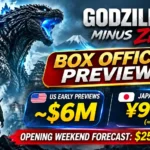
An opening-day record is significant, but it does not establish a final worldwide lifetime gross, a profit figure or an end-of-weekend result. The numbers belong to the film’s Japanese opening day alone. Readers looking for US previews should use the separately sourced preview article, not add the Japanese opening total to every other reported number without checking periods and overlap.
Why Japanese and North American Box-Office Headlines Differ
Japan’s box-office reporting uses yen and typically provides local admissions alongside sales. North American reports often focus on dollars, weekday preview grosses, domestic opening-weekend projections and distributor estimates. Those figures operate on different timelines and can use different definitions.
For Godzilla Minus Zero, the official Japanese opening on November 3 preceded the North American wide opening on November 6. A November 4 Japanese opening-day headline and a November 5 American preview headline can both be correct even if neither describes the film’s worldwide gross at the same moment.
Projected opening-weekend revenue is not money already collected. Preliminary preview figures can combine special screenings before a regular Friday opening. A final cumulative worldwide gross would require compatible, non-overlapping regional returns.
This is why Epicofilm’s separate box-office preview article exists. The present Japanese-title guide mentions only confirmed background context and explains terminology; it should not become a second copy of an earnings tracker with rapidly changing numbers.
How to Find Official Japanese Posters and Trailers
The most reliable starting point is the official Japanese movie website. It provides trailers, promotional artwork, Japanese-language cast information and official film news. The international Godzilla.com film page offers an English-language entry point.
Searching for “ゴジラ-0.0 公式” can help identify Japanese official materials. However, search results can include fan uploads, edited thumbnails, reposted posters and unofficial trailers. A publisher should check source identity before presenting any image as an authentic release still.
Official publicity images and posters are generally protected by copyright. Their presence on the film’s website does not automatically grant an unrelated site permission to download, alter and republish them. Use press-asset permissions, a license or an appropriately justified editorial use, as applicable in the publication’s jurisdiction.
For SEO imagery, a correct alt description should say what the image actually shows. If the image is a typographic release guide or original data graphic, it should not be labeled an “official cast photo.” Such accurate visual labeling builds reader trust and avoids confusing AI-generated illustration with film footage.
What the Official Material Does Not Confirm
An important part of factual journalism is specifying the limits of a source. A studio’s release announcement can verify the date, director and listed credits. It does not automatically verify an unannounced sequel, a secret cameo, an OTT launch date or the existence of a localized dub.
Likewise, a festival listing confirms how a movie was shown for that festival. It does not prove that every future screening uses the same projector, subtitles or edits. Those details require theater-specific confirmation.
An opening-day earnings announcement can establish the reported first-day result. It should not be stretched into a definitive projection of profits, worldwide totals or audience satisfaction. Box-office tracking and critical reception are separate subjects.
For this reason, this article deliberately avoids fabricating a global streaming service, an English dubbing cast, a hidden title meaning or complete ending details. Readers who want a spoiler explainer should follow a clearly labeled spoiler article that cites actual film evidence.
Can Readers Watch Godzilla Minus Zero Without Seeing Minus One?
The new film is marketed as a continuation of Godzilla Minus One, rather than as an unrelated reboot. The official synopsis and festival description explicitly place it after the earlier events and return to an established family storyline.
That makes the predecessor a useful introduction. Watching it first helps establish who the central characters are and why their postwar circumstances matter. This is a viewing recommendation, not a claim that theaters require proof you saw the earlier film.
Filmgoers who prefer to go in without additional context may still follow the broad conflict, but they should expect a continuation of emotional stakes from the first installment. The official materials make that relationship clear without requiring us to expose plot twists.
There is also no need to watch every previous Godzilla film in the long-running franchise to understand the production context of these two titles. They are directly connected entries within the broader history, and the franchise includes many distinct periods and continuities.
What Makes This Film Important for International Godzilla Coverage?
The combination of a major Japanese opening and a near-immediate North American rollout demonstrates the increasing international focus of this TOHO production. GKIDS’ role as North American distributor is confirmed, while the earlier film’s global success helps explain the audience interest.
The project is also notable for its creative continuity. Yamazaki’s leadership and the return of performers from Minus One make it a follow-up to an internationally recognized production rather than a standalone marketing exercise built only around a familiar monster name.
Its inclusion at the New York Film Festival and its IMAX-oriented presentation provide further confirmed reasons for the film’s international coverage. These are concrete facts that a trustworthy publication can report without inflating them into an unsupported claim of universal critical acclaim.
A globally oriented movie site can serve readers by connecting Japanese official announcements to English-language explanations. That role is especially useful when promotional typography, regional release dates, alternate romanizations and local screening formats create confusion.
Practical Guide: How to Check a Local Screening
Start with the official movie or distributor website to confirm the film identity. Then search your local cinema’s booking portal using the English title Godzilla Minus Zero or the Japanese title ゴジラ-0.0 where relevant. Check the date, location and the label for subtitles or dubbing.
Next, confirm the screening format. “Filmed for IMAX” describes the production, but only a specific IMAX session lets you experience that format. A standard ticket may be perfectly suitable if a larger-screen showing is unavailable or expensive.
Finally, review the local age classification and timing. The US listing identifies an R-rated feature running 135 minutes, but ratings, presentation options and scheduled start times differ by territory. A theater’s local rules govern entry and seating.
If a date or cast fact appears to conflict across search results, check when each page was published and which territory it covers. A dated source from TOHO or GKIDS should take precedence for official release facts over an undated social-media graphic.
Editorial Conclusion: The Correct Way to Read the Japanese Title
The most important answer is simple: ゴジラ マイナス ゼロ is a search variation of the official Japanese title 『ゴジラ-0.0』, the movie internationally released as Godzilla Minus Zero. It is a sequel to Godzilla Minus One, directed by Takashi Yamazaki, and set two years after that film.
TOHO’s Japanese release began November 3, 2026, followed by GKIDS’ North American wide release November 6. Verified movie listings identify Japanese audio with English subtitles and a runtime of 135 minutes for the presentations examined. These points are source-based and suitable for a factual reference article.
The film’s Japanese opening-day earnings are also documented by an official announcement, but ongoing box-office stories deserve their own dated tracking. Likewise, spoilers and review judgments are better served by separately labeled articles. That keeps this title guide useful beyond the opening weekend.
For Epicofilm readers, the principle is consistency: use the official names, identify regions, quote the right figures for the right dates, distinguish confirmed facts from opinion, and never invent additional scenes or titles to satisfy a search trend.
Frequently Asked Questions About ゴジラ マイナス ゼロ
What does ゴジラ マイナス ゼロ mean?
It is a spaced Japanese search phrase referring to Godzilla Minus Zero. The official Japanese title is ゴジラ-0.0 and TOHO gives the reading ゴジラマイナスゼロ.
What is the official Japanese title of Godzilla Minus Zero?
The official title printed on TOHO material is ゴジラ-0.0. The phrase ゴジラマイナスゼロ is its Japanese phonetic reading.
Is ゴジラ-0.0 the same movie as Godzilla Minus Zero?
Yes. TOHO’s Japanese film listing and GKIDS’ English international marketing refer to the same 2026 sequel.
When did Godzilla Minus Zero open in Japan?
TOHO released it in Japan on November 3, 2026.
When did Godzilla Minus Zero open in the United States?
GKIDS set its wide North American theatrical release for November 6, 2026.
Who directed Godzilla Minus Zero?
Takashi Yamazaki returned as director, screenwriter and visual-effects lead, according to official release information.
Who plays Kōichi Shikishima?
Ryunosuke Kamiki is listed as Kōichi Shikishima in the Japanese film’s official cast information.
Who plays Noriko?
Minami Hamabe reprises Noriko, according to official cast listings.
Is Godzilla Minus Zero a sequel to Godzilla Minus One?
Yes. It follows the 2023 film and takes place two years later.
What year is the story set in?
Film at Lincoln Center places the sequel in 1949.
What is the runtime of Godzilla Minus Zero?
The New York Film Festival and Smithsonian listings give a runtime of 135 minutes.
Is Godzilla Minus Zero in Japanese?
Yes. Verified US and festival listings describe Japanese audio with English subtitles.
Does Godzilla Minus Zero have an English dub?
The sources checked confirm subtitled Japanese screenings, not universal availability of an English dub. Check your specific cinema listing.
Is Godzilla Minus Zero rated R in the United States?
The Smithsonian US theatrical listing identifies an R rating. Local age classifications differ by country.
How much did Godzilla Minus Zero earn on opening day in Japan?
TOHO/GKIDS announced ¥910 million and more than 590,000 admissions for November 3, 2026.
Is the ¥910 million figure a worldwide total?
No. It refers to the film’s opening day in Japan, not the cumulative worldwide theatrical gross.
Was Godzilla Minus Zero filmed for IMAX?
GKIDS describes it as the first Japanese production filmed for IMAX; the available format depends on local theater schedules.
Where can I find the official Japanese trailer?
Visit the official Japanese TOHO site at godzilla-minuszero.toho-movie.jp and use its trailer section.
Does the film have a secret post-credits scene?
That is a separate spoiler-related question. Readers should consult clearly attributed post-credits reporting rather than infer the answer from the release title.
Is Godzilla Minus Zero available on Netflix?
The sources used for this guide establish its theatrical rollout but do not confirm a worldwide Netflix streaming date. Do not treat unverified streaming claims as official.
Primary Sources and Verification
- TOHO: Godzilla Minus Zero Japanese film site
- TOHO: November 3, 2026 opening-day stage greeting
- GKIDS: North American November 6 release announcement
- GKIDS: September trailer and casting details
- Film at Lincoln Center: New York Film Festival listing
- Smithsonian: US IMAX listing
- Godzilla.com: Japanese opening-day announcement
- SciFi Japan: TOHO official title press release
Last verified: November 6, 2026. Sources are linked where their facts are discussed. Movie artwork belongs to its respective rights holders. This guide contains no fabricated cast credits, scores or theatrical availability claims.




Pingback: MCU Release Order: Easy Guide to Watching Marvel